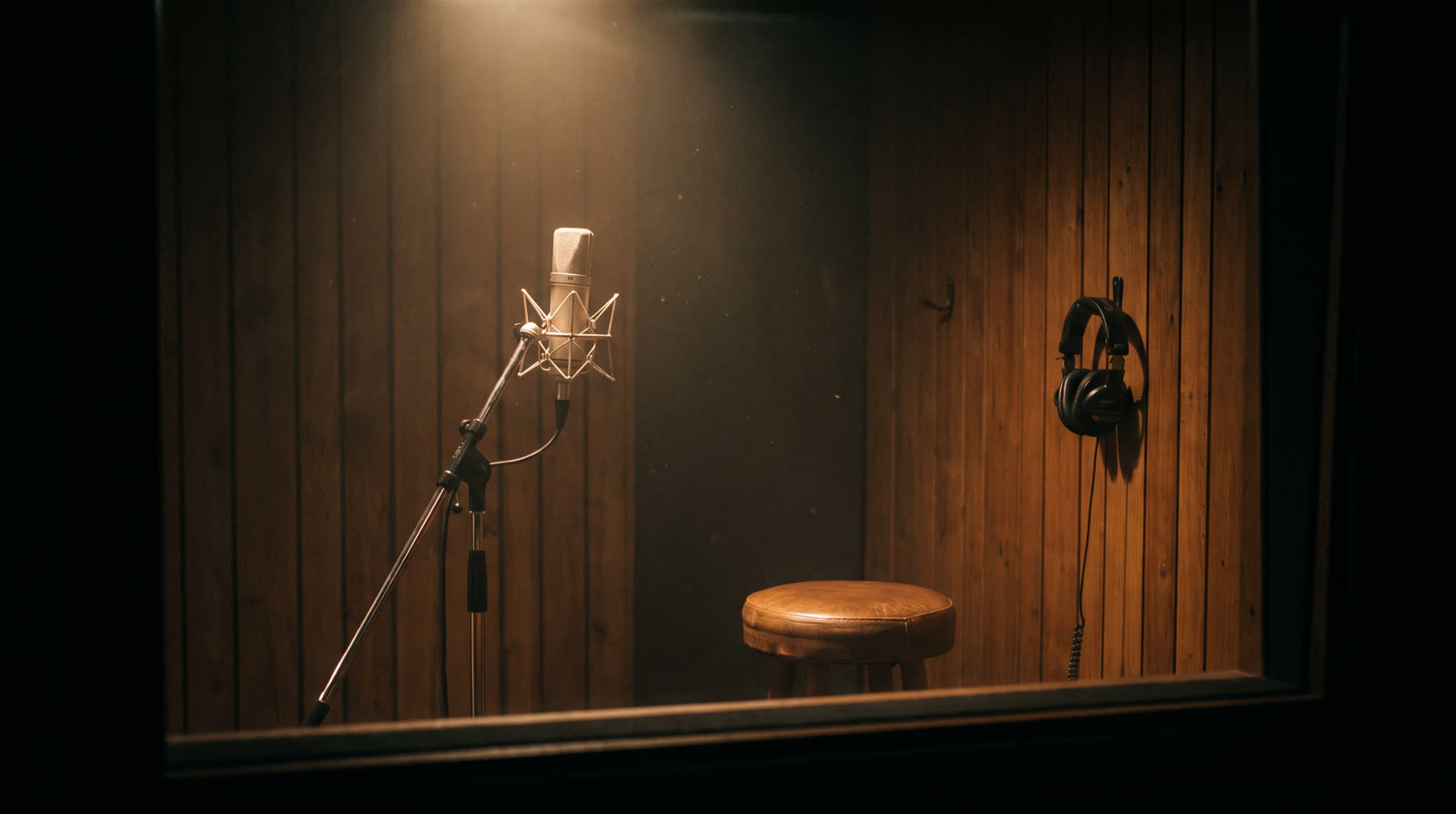
In 2019 and 2020, two New York voice actors recorded short scripts for what they were told were limited internal uses: a research project in one case, test scripts for radio ads in the other. Years later, Paul Skye Lehrman and Linnea Sage say they found synthetic versions of their own voices for sale on an AI platform under the names "Kyle Snow" and "Sally Coleman". Lehrman has described hearing his cloned voice in the wild; in a detail almost too on-the-nose to invent, reporting on the case notes the couple once listened to a podcast about the dangers of AI, voiced by what sounded like him.
Their lawsuit against Lovo Inc. became the test case for a question the whole industry is now living inside: what protects a working voice, and what happens when the answer turns out to be "less than you assumed"? This article lays out where that fight actually stands in 2026, using the survey data, court records, contracts, and platform numbers, with every source linked at the end. No speculation, no doom, no hype. Numbers.
One in Five: What the 2026 Survey Data Shows
The National Association of Voice Actors (NAVA) ran its State of Voiceover survey between January 22 and February 22 of this year and collected 1,379 responses from working voice actors. The headline finding: 21 percent of voice actors reported losing work directly to AI, up from 14 percent one year earlier. That is a 50 percent relative increase in a single year, and it is the first time the industry has had year-over-year data on the same question.
NAVA did not stop at publishing the survey. In May 2026 its leadership took the findings to Washington, appearing on panels at the Commission on the Arts and Humanities and the Martin Luther King Jr. Memorial Library in D.C., after a Los Angeles panel at the El Portal Theatre earlier the same week.
"These numbers tell a story that policymakers and communities need to hear. Voice actors are on the front lines of what is happening across the broader creator economy. We're here to ensure our industry's voice is part of this conversation."
Hold the 21 percent figure next to the industry it comes from and the picture sharpens. The audiobook market alone was valued around $11 billion in 2025, with analysts projecting growth above 20 percent a year through the early 2030s. The work is not disappearing. The question 2026 keeps asking is who, or what, gets hired to do it.
The Case That Tested the Law, and What It Found
Lehrman and Sage filed their proposed class action against Lovo in May 2024, claiming the company obtained their voice recordings under false pretenses through freelance marketplace messages, then sold AI versions of them. The paper trail in the complaint is specific: Lehrman says he was told his recordings were for a research project; Sage that hers were test scripts that would "not be disclosed externally and will only be consumed internally."
In July 2025, U.S. District Judge J. Paul Oetken ruled on Lovo's motion to dismiss, and the result was a split that should focus every working voice actor's attention. The judge dismissed the claims that a voice is protected by federal copyright or trademark law as such, but allowed the case to continue on other grounds, including New York's right-of-publicity statute and contract-based claims. In plain terms: the sound of your voice, by itself, is not copyrightable. What protected Lehrman and Sage's claims was not some inherent ownership of their sound; it was state publicity law and the words in their agreements.
Then the case stopped moving for the least satisfying reason imaginable. In May 2026, Lovo filed for Chapter 7 bankruptcy, automatically staying the litigation. Two years of test-case litigation, paused not by a verdict but by the defendant running out of money. Whatever precedent the case might still set, its practical lesson is already usable: the contract you sign before you press record is doing more legal work than any statute currently on the books.
The one-sentence takeaway for working voice actors
Courts so far say your voice is not copyrightable sound. Your protection lives in contracts, consent clauses, and state publicity laws, which means the words in your agreements are not fine print. They are the whole fortress.
The Contract That Finally Said 'Human'
While the courts stalled, the labor side moved. In mid-2026, SAG-AFTRA members ratified a new Interactive Media Agreement covering video game voice and performance capture work, closing out a dispute that included a long strike over AI protections. Roughly 80 percent of voting members approved it. The agreement contains a dozen AI provisions, and one of them is quietly historic: it defines a voice actor as a human performer. A synthetic voice is not a cheaper substitute inside the contract; it is a separate category requiring separate, written consent.
- Consent is specific and revocable in a strike. Performers can suspend consent for new synthetic generation during a strike, so a digital replica cannot keep working while its human walks a picket line.
- Replicas require written agreement, with terms for how a digital voice replica can be made and used, and compensation attached to that use.
- The groundwork was laid earlier: SAG-AFTRA's 2024 agreement with AI voice company Replica Studios, announced at CES, was the union's first attempt at a consent-and-compensation framework for licensed digital voice replicas, controversial with members at the time and a template for what followed.
Union contracts only cover union work, and most of the voice over economy, the e-learning modules, corporate narration, indie games, and audiobooks that fill a working actor's calendar, is negotiated one contract at a time. Which is why the union language matters beyond the union: it is becoming the reference point for what a fair AI clause looks like anywhere.
Meanwhile, 50,000 Titles: What the Platforms Actually Did
Whatever the courts and unions decide, the platforms have not waited. Audible began testing AI narration for self-published authors in 2023 under the name Virtual Voice. By May 2025 it announced an expansion working directly with publishers, offering more than 100 AI-generated voices across English, French, Spanish, and Italian, with an AI translation beta to follow. Searching Audible for titles "Narrated by: Virtual Voice" now returns over 50,000 audiobooks, a catalog that did not exist three years ago.
It is worth being precise about what that number means. Most Virtual Voice titles are books that would likely never have funded a human narration at all, low-volume backlist and self-published work where the alternative was no audiobook. That is the honest case for the technology. The equally honest observation is that a catalog of 50,000 machine-narrated titles trains listeners, and eventually publishers, to treat narration as a commodity with a default price of nearly zero. Both things are true at once, and pretending otherwise, in either direction, is how an industry sleepwalks.
The Law Is Moving, State by State
Legislation is doing what legislation does: arriving late, unevenly, and in fifty flavors. Tennessee moved first with the ELVIS Act (Ensuring Likeness Voice and Image Security), signed in March 2024 and effective that July, the first state law to explicitly extend publicity rights to AI simulations of a person's voice, with both civil claims and misdemeanor penalties attached. Other states have followed their own paths: some prohibit deceptive deepfakes outright, others require disclosure that content is AI-generated. There is still no federal law that protects a voice from cloning as such, though proposals continue to circulate.
For a working voice actor the patchwork has one practical consequence: where you live, and where the company that clones you operates, currently matters more than it should. Which loops back, again, to the same place the Lovo ruling pointed: the contract in front of you is the protection you actually control.
"The conversation around AI and creative work can't happen without the people most affected by it. Voice actors are seeing this technology reshape our industry, and we're stepping up to help shape the rules around it."
What a Working Voice Actor Can Actually Do in 2026
- Put an AI clause in everything. No training, no cloning, no synthesis from your recordings, no exceptions without separate written consent and separate compensation. NAVA publishes contract language guidance for exactly this; the union agreements give you the reference points.
- Ask the question before every session: what will these files be used for, and does anything in this agreement license machine learning, 'research', or 'internal testing'? Those were precisely the words in the Lovo plaintiffs' account.
- Keep receipts. The Lehrman and Sage case ran on saved messages and the specific promises made before recording. Your email trail is evidence; treat it that way.
- Know your tools' policies too. Every service that touches your raw audio, from editors to noise cleaners, has a data policy, and 'we may use your content to improve our services' can mean training. Read that sentence before you upload a voice you make your living with.
That last point is one we have skin in: VoiceEditSuite processes audio on our own servers and commits in writing that your recordings are never used to train AI, never sold, and never retained beyond the job. We built the policy page before anyone asked, because after the year this industry just had, "trust us" is not a policy.
↗ Try the tool
Home Studio Analysis
The human edge is craft, and craft is measurable. The free Home Studio Analysis scores your actual recording space, the thing no cloned voice has, and tells you exactly what to fix first. No account, and your audio is processed under the no-AI-training promise above.
Open Home Studio Analysis →Where This Goes
Strip the noise away and 2026 has produced three durable facts. The displacement is real and measured: one in five and rising, per the only year-over-year survey we have. The legal system's answer is incomplete by design: no copyright in a voice, protection through contracts and a patchwork of state laws. And the institutions that did move fastest, a union writing 'human performer' into a contract and platforms shipping 50,000 synthetic titles, are pulling in opposite directions at once.
What nobody has yet built is the settled middle: an economy where consent is the default, licensing a replica is a negotiated job like any other, and a human read commands the premium that thirty years of audiobook listeners suggest it deserves. The pieces of that settlement are all visible in the events above. Whether they assemble is the story of the next two years, and we will keep reporting the numbers as they land.
Sources and Further Reading
- NAVA, State of Voiceover Survey 2026: 1,379 respondents, fielded January 22 to February 22, 2026.
- GlobeNewswire, Voice Actors Head to Washington to Address AI's Impact on Creative Economy, May 5, 2026: the 21 percent and 14 percent figures and the Friedlander and Gilfry quotes.
- CBS News, Two voice actors sue AI company over claims it breached contracts, cloned their voices: the Lehrman and Sage allegations.
- Skadden, New York Court Tackles the Legality of AI Voice Cloning, July 2025: analysis of Judge Oetken's ruling.
- Bloomberg Law, Voice Actors' Suit Against Lovo Paused Amid AI Firm's Bankruptcy, May 2026.
- SAG-AFTRA, Artificial Intelligence member resources and the Replica Studios agreement announcement, CES 2024.
- TechCrunch, Audible is expanding its AI-narrated audiobook library, May 13, 2025: the 100+ voices, four languages, and 50,000-title figures.
- Holland & Knight, First-of-Its-Kind AI Law Addresses Deep Fakes and Voice Clones, April 2024: the ELVIS Act's scope and penalties.
- Fortune Business Insights, Audiobooks Market Size, Share and Growth Report: market size and growth projections.
Corrections
This article reports third-party surveys, court filings, and public statements as published at the time of writing. If you spot an error or a development we should add, tell us through the contact page and we will correct it with a note.