
The short answer: a voice over contract does two separate jobs. It pays you for recording, and it grants the client a license to use that recording in specific media, for a specific term, in a specific territory, sometimes with a fee for keeping you exclusive to their product category. Every usage right you grant should be named in writing and priced, and since 2024 every contract should also say plainly whether your voice can be cloned, synthesized or used to train AI.
Most voice actors learn contract terms the expensive way: a client reuses a regional radio spot nationally two years later, or a one-time e-learning module turns up as the narration for an entire new course line, and there is no clause covering it because nobody asked. The read was fine. The contract was the problem, and it was a problem the day it was signed, not the day the reuse was discovered. Podcasters meet the same problem from the other side: a sponsor asks to reuse your host read in its own social ads, or a platform offers to translate your show with a cloned version of your voice.
This is not legal advice
This Guide is general information about how voice over contracts usually work, written for working voice actors and podcasters. It is not legal advice and it does not create a lawyer-client relationship. Laws differ by country and state and change often. For a high-value deal, a buyout, any AI or digital replica clause you do not fully understand, or a dispute, have an entertainment lawyer or your union read the contract before you sign.
What a Voice Over Contract Actually Sells
A session fee pays for your time and performance on the day. A usage fee pays for the client's right to broadcast or publish the result. The distinction matters because the value of a recording to the client depends almost entirely on how widely and how long it runs: a national campaign that airs for a year is worth far more to the advertiser than the same script on one local station for a month. Our Guide to usage fees and buyouts covers the pricing side in depth; this Guide is about the words on the page that define what you have sold.
There is also a legal question underneath the commercial one: who owns the recording? In the United States, a client gets rights in your work in one of three ways. A license lets them use it in defined ways while you keep the underlying rights. An assignment transfers ownership, and under the Copyright Act a transfer of copyright is only valid if it is in a signed writing. A work made for hire clause makes the client the legal author from the start, and for freelancers that only works for nine statutory categories of commissioned work, one of which is a part of a motion picture or other audiovisual work, and only with a written agreement signed by both sides. The practical difference: an author who assigns rights can, under section 203 of the Copyright Act, terminate that grant after 35 years, while a work made for hire has no termination right at all. Most voice jobs should be a license. If a contract says assignment or work made for hire, the fee should reflect that you are selling the recording outright.
Your voice itself is a different matter from the recording. Copyright protects a fixed recording, not the sound of a person. In July 2025, a federal court in New York ruled on a case brought by two voice actors who said an AI company used recordings, bought through a freelance marketplace for what they were told was internal research, to build voice clones it then sold. According to Loeb and Loeb's summary of the decision in *Lehrman v. Lovo*, the court let the breach of contract and New York right of publicity claims proceed but dismissed most of the copyright claims, because an AI clone imitates a voice rather than copying the recording. The lesson for anyone who records for money: the use limits in your contract, and state publicity law, are what protect your voice. Copyright mostly does not.
The 12 Clauses to Check in Every Agreement
Not every job needs a twelve-page contract. A short email that names each of these terms is a real agreement in most places. What matters is that each one is answered, because a missing clause is not neutral: when a contract is silent, the gap tends to be filled by whatever the client's template or later reading of the deal says, and the client usually wrote the template.
1. Scope of work
What you are recording: the script or an approximate word count, the number of versions (a 30 and a 15, three tag variations), file format and delivery spec, whether editing is included, whether a directed session is included, and the deadline. A scope that says "voice over for campaign" with no length invites the client to add scripts at the original price.
2 to 4. Usage term, media and territory
These three define the license and should always appear together. Term is how long the recording may be used, counted from a clear start point such as first air date or delivery. Media lists the channels: broadcast TV, radio, streaming audio, online video, paid social, organic social, in-store, internal, in-app, podcast. Territory is where: a city or market, a country, a region or worldwide. Be wary of the phrase "all media now known or hereafter devised", which grants channels that do not exist yet, and "in perpetuity", which means forever.
5. Exclusivity
Whether you may voice a competing product while the deal runs. Exclusivity has real value to the advertiser and a real cost to you, because it closes off work. A fair clause names a narrow category ("quick-service burger restaurants", not "food and beverage"), a term that ends, and a fee. If you are asked for exclusivity with no end date, that is the clause to push back on first. The FTC's 2024 rule banning most non-competes was set aside by a federal court and formally removed in 2026, so do not count on federal law to rescue you from a broad one.
6. Payment terms
The amount, currency, what triggers the invoice, the due date and any late fee. "Net 30 from delivery" is a date; "upon completion of the project" is not, because the project might be the client's whole campaign. Some places now set a legal floor. New York State's Freelance Isn't Free Act, effective May 20, 2024, requires a written contract for freelance work of $800 or more (alone or across 120 days with the same client) and payment no later than 30 days after the work is done if no date is set. California's Freelance Worker Protection Act, in force since January 1, 2025, requires a written contract at $250 and the same 30-day default.
7. Revisions
How many rounds of changes are included and what counts as a revision. The usual line is that pickups for your own errors or the director's performance notes are free, while script changes after recording are paid at a stated rate. Revision pricing is one of the most common ways a fairly priced job turns into an unpaid one.
8. Cancellation and kill fees
What you are paid if the client cancels after you have held the date or recorded. A common structure is a percentage of the fee if cancelled inside a stated window, and the full session fee once recording has happened, whether or not the spot ever airs. Usage fees are a separate matter: if the client never runs the spot, they may not owe usage, but they should still owe the session.
9. AI, digital replicas and training
The newest clause and now one of the most important. It should say, in plain terms, whether the client may use your recordings to create a synthetic version of your voice, whether they may use them to train or fine-tune an AI model, and whether they may let anyone else do either. The safe default for a non-union job is a flat prohibition unless a separate, signed rider describes the specific use and the payment. The sections below explain what the union contracts and state laws require.
10. Rights reversion and renewals
What happens when the term ends. A good clause says the license expires on a stated date unless renewed at a stated fee, and that continued use after that date without payment is a breach. Put the expiry in your calendar the day you sign. The expensive mistake is not forgetting to renew; it is never having a term to renew in the first place.
11. Indemnity and liability
An indemnity is a promise to cover the other side's losses if a claim arises. Watch for one-way clauses in which you indemnify the client against anything connected to the ad, including claims about the script they wrote. A fair version is mutual: you stand behind your own conduct and the originality of anything you supplied, and the client stands behind the script, the product claims and the music. Where you can, cap your liability at the fee you were paid.
12. Ownership and credit
Whether this is a license, an assignment or a work made for hire, as explained above, plus whether you may use the finished piece in your demo reel and portfolio. Ask for a portfolio clause on every job; most clients agree once the campaign is public.
Worked Examples of Usage Terms
A usage grant is really four dials, and every one of them can be turned up or down. The table below shows how five common jobs might set those dials. The terms are illustrations of how a clear grant reads, not market rates, and your own deal should reflect the client's actual media plan, which most clients will share if you ask.
Here is how those grants read when written out as contract language. Each is a sentence a client can say yes to without calling a lawyer:
- Regional radio: "Client may broadcast the recordings on terrestrial radio and streaming audio in the Denver, Colorado Springs and Pueblo markets for 13 weeks from first air date. Further 13-week cycles may be purchased at the same fee. Talent will not voice another automobile dealer in these markets during any paid cycle."
- National campaign: "Usage: broadcast and cable TV, online video and paid social, United States only, 12 months from first air date. Exclusivity: talent will not voice another national wireless carrier during the term, for which client pays an exclusivity fee of [amount]. Use outside these media or after the term requires a new agreement."
- Corporate e-learning: "Recordings are licensed for the client's internal employee training on its own learning platform, worldwide, for five years from delivery. Public, broadcast, paid advertising or resale use is not included."
- Podcast host read: "Sponsor may distribute the read as part of the episode for the life of that episode. Reuse of the read or the host's voice in sponsor's own advertising, on social or elsewhere, is not included and requires written approval and a separate fee. Host will not read for a direct competitor for 30 days after the episode is released."
- Video game: "Recordings may be used in the game and in its trailers and marketing for the life of the game. No recording may be used to create a digital replica of the performer's voice, or to train an AI system, without a separate written agreement."
Notice the last sentence in the national example. A clause that says what happens if the client wants more is better than one that only lists what they have, because it turns a future dispute into a future invoice. When the client wants broader usage than your base rate assumed, that is a pricing conversation, and a proper rate calculation builds usage into the number from the start.
How Union Contracts Handle Usage
SAG-AFTRA work comes with usage rules already written. The union's commercials codes are built around 13-week use cycles: the session fee includes the first cycle, and the advertiser pays again for each further cycle it runs the spot. SAG-AFTRA's published regional commercials codes show the pattern clearly. The Arizona-Utah code, for example, states that the session fee covers a 13-week use cycle, prices a 21-month period as a multiple of it, and says that once 21 months have passed since first use, the producer must negotiate with the performer to keep using the spot. That 21-month window is the maximum period of use. Exclusivity is bought too: a Joint Policy Committee explainer for advertisers describes holding fees, equal to a session fee, paid to hold a performer exclusive to a product category or to keep a spot available between cycles. Rates and multipliers differ between the national contract and each regional code, so check the current rate sheet for your market.
If you work union, you generally do not negotiate these mechanics job by job, and you should not sign side terms that conflict with them. If you work non-union, the union system is still the best model available: a defined cycle, a renewal fee, a hard outer limit and paid exclusivity. Borrow it.
The non-union version of a use cycle
Quote broadcast usage in 13-week or annual blocks, write the renewal fee into the contract, and add one sentence: "Use after the term without a paid renewal is unlicensed use." That gives you the same structure a union performer gets, and it gives the client a predictable price for extending.
AI and Digital Replica Protections
Since 2023, AI terms have become a standard part of union contracts and a growing part of state law. They do not all say the same thing, and none of them covers every job, so it helps to know which layer applies to you.
SAG-AFTRA's AI terms
Under the 2025 Commercials Contracts, the Joint Policy Committee's client alert to advertisers sets out the mechanics: 48 hours' notice before services to create or use a digital replica, consent through a Digital Replica Rider or a separate signed writing, 1.5 times the scale session fee for each commercial that uses a replica-generated performance, and destruction of the replica after its last use unless the performer agrees otherwise. The 2025 Interactive Media Agreement for video games, ratified in July 2025, requires separate, written, reasonably specific consent before a replica is made or used. Frankfurt Kurnit's analysis notes that employers cannot collect that consent at hiring to cover future games, that real-time AI dialogue carries higher minimums, and that producers must give a usage report within 90 days of a game's release. Our Guide to SAG-AFTRA's AI agreements three years on compares every contract in detail.
NAVA's AI rider for non-union work
The National Association of Voice Actors publishes an AI and synthetic voice rider for performers to attach to contracts. NAVA's guidance tells non-union actors to ask their agent to include it, or add it themselves when dealing directly with a client. It says a contract should include the performer's consent to use, explicit limits on synthetic use and machine training, term limits or a way to opt out, appropriate payment, clearly stated exclusivity and safe storage of the voice data. It also lists words to look for and strike, such as "simulation", "synthesization", "digital double" and "machine learning". NAVA's advice for union members is different: do not try to fix the language yourself, report it to SAG-AFTRA's voiceover department.
State laws on digital replica clauses
Three states now void the worst kind of replica clause by statute. California's AB 2602, signed September 17, 2024 and in force since January 1, 2025, makes a contract term unenforceable when it lets a digital replica of your voice or likeness do work you would otherwise have done in person, lacks a reasonably specific description of the intended use, and you were not represented by a lawyer or a union. New York General Obligations Law section 5-302 has the same three-part test. Illinois's Digital Voice and Likeness Protection Act does too, and an amendment in force since January 1, 2026 applies it to new replica performances made from that date. Separately, Tennessee's ELVIS Act, in force since July 1, 2024, added a person's voice to the state's right of publicity, explicitly covering AI imitations. Our Guide to AI voice and likeness laws in 2026 covers these state by state, plus the federal NO FAKES Act, which is not yet law.
These laws are a backstop, not a substitute for a clear clause. They only help if your situation fits the statute, and the cheapest protection is a contract that never granted replica rights in the first place.
Red Flags That Mean Stop and Ask
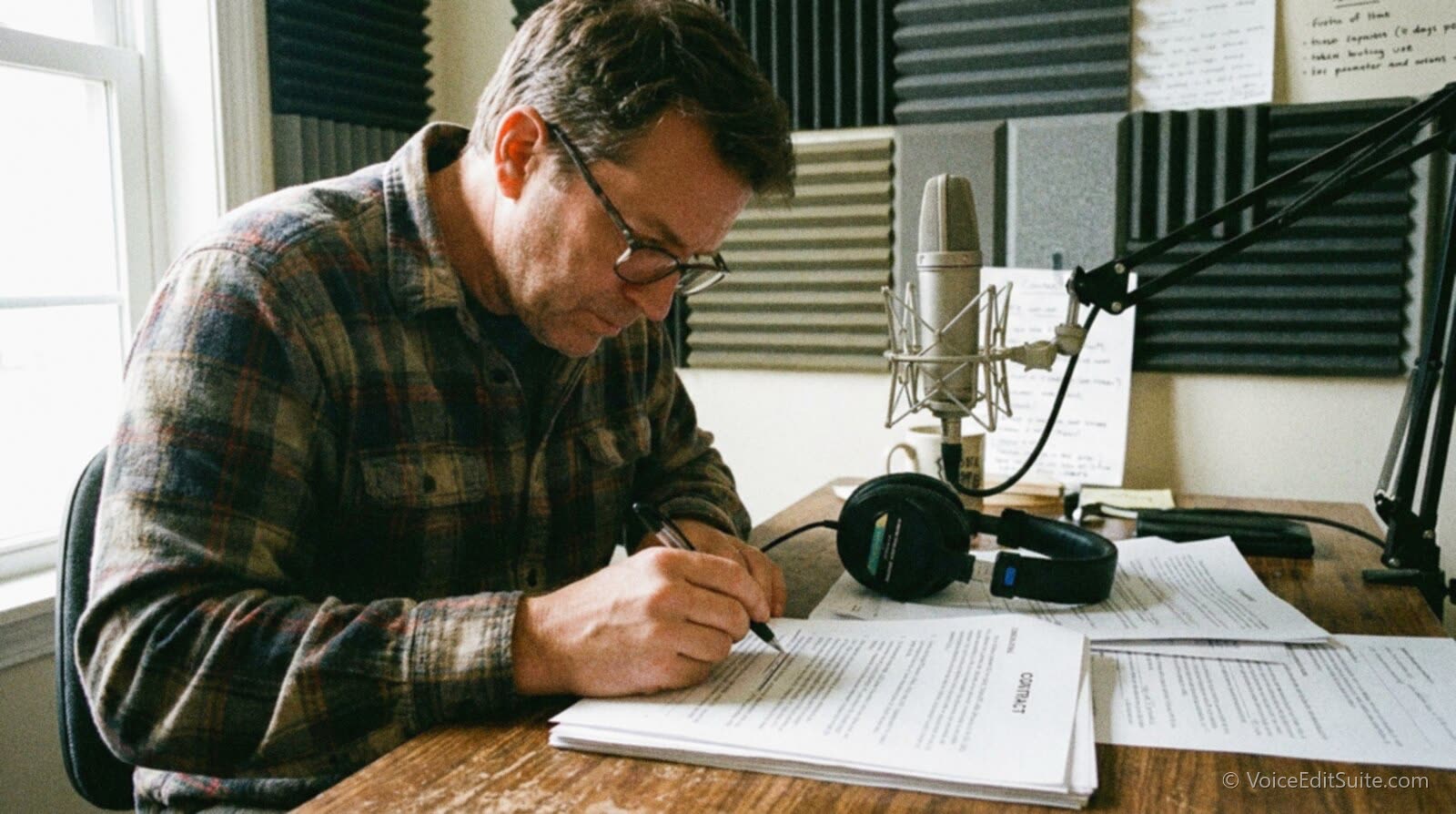
A surprising number of problem contracts are not malicious. They are templates a client reused from a different kind of deal, often one written for a full-time employee or a video production crew. These phrases are the ones worth stopping on, whoever wrote them:
- "In perpetuity, throughout the universe, in all media now known or hereafter devised." The broadest grant possible. Fine for a properly priced buyout, wrong for a standard fee.
- "Work made for hire" or "assigns all right, title and interest" on a job priced as a simple license.
- "Simulate", "synthesize", "digital double", "voice model" or "machine learning" anywhere in the grant. These are the kinds of words NAVA tells performers to look for.
- "Including but not limited to" in the media list. It turns a list of channels into an example of channels.
- Exclusivity with no end date or a category as wide as "any consumer product".
- "Pay when paid", meaning you are paid only after the end client pays the agency or producer, with no outside date.
- One-way indemnity with no cap, covering the script and product claims you had no say in.
- Unlimited revisions or "until client approval" with no rate for script changes.
- Automatic renewal of usage at no extra fee, or a renewal option priced at zero.
- Rights to sublicense or transfer to "affiliates, successors and assigns" with no limit. In the Lovo case, the actors said they were told the recordings were for research; a limit on who may use the files and for what is the kind of clause that let their contract claim go forward.
Podcasters should add two of their own. Guest release forms sometimes include broad AI or reuse language, so check what you are asking guests to sign as well as what you sign. And hosting or translation platforms that offer AI dubbing of your show need a clear answer on whether your voice model can be used for anything else, and whether it is deleted when you leave.
Negotiation Wording That Keeps the Job
Asking for clarity is normal. Clients who hire voice talent regularly expect the questions, and ones who bristle at them are worth noting for next time. The trick is to propose the missing term rather than just flag its absence, and to price the gap rather than close it for free. These lines work by email:
- When usage is missing: "Happy to go ahead. Could we confirm usage in writing? My quote assumes online video and paid social in the US for 12 months from launch. If you need broadcast or a longer term, I'll send a revised figure."
- When the grant is in perpetuity: "For all-media, perpetual use I quote a buyout of [amount]. If a 12-month term with a renewal option works for you, the fee stays at [lower amount]."
- When exclusivity is broad: "I can agree to exclusivity for direct competitors in [narrow category] for the campaign term. A wider category or a longer lock would carry an exclusivity fee of [amount]."
- When there is AI language: "I'm not able to grant rights to create a synthetic version of my voice or to use the recordings for AI training. Could we strike clause [number], or add this sentence: 'No recording may be used to create a digital replica of Talent's voice or to train any AI system without a separate written agreement.'"
- When payment is open-ended: "Could we set payment at 30 days from delivery of final files? My standard terms add a late fee of [rate] after that."
- When indemnity is one-way: "Could we make the indemnity mutual and limit it to each party's own materials and conduct, capped at the fee?"
The habit that protects you here is the same one that protects your rate: name the term, name the price, and offer a cheaper option with a narrower grant rather than giving the broad grant away.
↗ Try the tool
Revision Checker
Free to try: when a revision request arrives, run the old and new scripts through the Revision Checker to see exactly what changed, so you can tell whether it falls inside the revisions your contract included or is a paid script change.
Open Revision Checker →Frequently asked questions
What are usage rights in voice over?
Usage rights are the license that says where, for how long and in which media a client may use your recording. They are separate from the session fee for recording it. If the contract is written clearly, a spot licensed for 13 weeks of regional radio cannot be run on national TV for a year without a new agreement.
What does a buyout mean in a voice over contract?
A buyout is a single payment for broad usage, often all media, worldwide and in perpetuity, so the client never pays usage again. It can be a fair deal when the fee reflects the realistic full value of that use. It is a bad deal when it is a standard session fee with perpetual rights added to the paperwork.
Can a client clone my voice with AI if I signed a contract?
It depends on what the contract says. If it grants rights to synthesize, simulate or train on your recordings, the client may have those rights. In California, New York and Illinois, a replica clause can be unenforceable if it was vague about the use and you had no lawyer or union. Under SAG-AFTRA contracts, specific consent and payment are required. The safest route is a clause that prohibits replicas and training unless a separate signed agreement covers them.
Is an email agreement a real contract?
Often, yes. In the Lovo case the court was satisfied, at an early stage, that messages exchanged on a freelance platform could plausibly form a binding agreement with limits on how the recordings could be used. An email that names the scope, fee, usage, payment date and AI terms, followed by a clear yes from the client, is far better than a phone call. Some laws, such as New York's and California's freelancer acts, require a written contract above a set amount.
Do podcast host reads need usage terms?
Yes. A host read is usually licensed for the life of the episode it appears in, but sponsors increasingly ask to reuse the audio in their own ads or social posts. That is a second use and should be priced separately. Our Guide to host-read podcast ads covers rates and delivery.
Do I need a lawyer for every voice over contract?
No. For routine jobs, a checklist and clear email terms are enough. Bring in an entertainment lawyer or your union for buyouts, long exclusivity, any AI or replica clause, an assignment of copyright, or any deal large enough that a mistake would hurt. In California, New York and Illinois, having counsel negotiate a replica clause also changes whether that clause can be enforced.
The Habit That Actually Protects You
Contracts are not adversarial by default, and most clients who hire voice talent want the same clarity you do, because ambiguity costs them time and disputes too. The protection is not a perfect legal document. It is the habit of naming scope, usage, exclusivity, payment, revisions, cancellation, AI terms and reversion in writing every time, on every job, however well you know the client, because the one time you skip it is the time it matters.
Sources and Further Reading
- SAG-AFTRA, Arizona-Utah Regional Commercials Code: the 13-week use cycle and the 21-month limit on use.
- Joint Policy Committee, SAG-AFTRA maximum period of use and holding fee examples.
- Joint Policy Committee, 2025 JPC SAG-AFTRA Commercials Contracts client alert: digital replica notice, consent, pay and storage.
- Frankfurt Kurnit Klein and Selz, Inside the new SAG-AFTRA Interactive Media Agreement.
- Davis+Gilbert, SAG-AFTRA's new video game agreement.
- SAG-AFTRA, Digital Replicas 101.
- National Association of Voice Actors, Synthetic and AI voices, and the NAVA AI rider.
- Manatt, California enacts a host of new AI and digital replica laws: AB 2602 and AB 1836.
- New York State Senate, Senate Bill S7676B, and the text of N.Y. General Obligations Law section 5-302.
- Illinois General Assembly, Digital Voice and Likeness Protection Act, 815 ILCS 550/10, and Public Act 104-0282.
- Office of the Governor of Tennessee, Governor Lee signs ELVIS Act into law.
- Loeb and Loeb, Lehrman v. Lovo, Inc.: the July 2025 ruling on AI voice clones, contract and publicity claims.
- US Copyright Office, Circular 30: Works Made for Hire, and 17 U.S.C. section 101 definitions, section 203 termination of transfers and section 204 execution of transfers.
- Foster Garvey, New protections for freelancers statewide under the New York Freelance Isn't Free Act.
- Federal Register, Removal of the Non-Compete Rule to conform to federal court decisions, February 12, 2026.
- National Law Review, California governor signs Freelance Worker Protection Act.