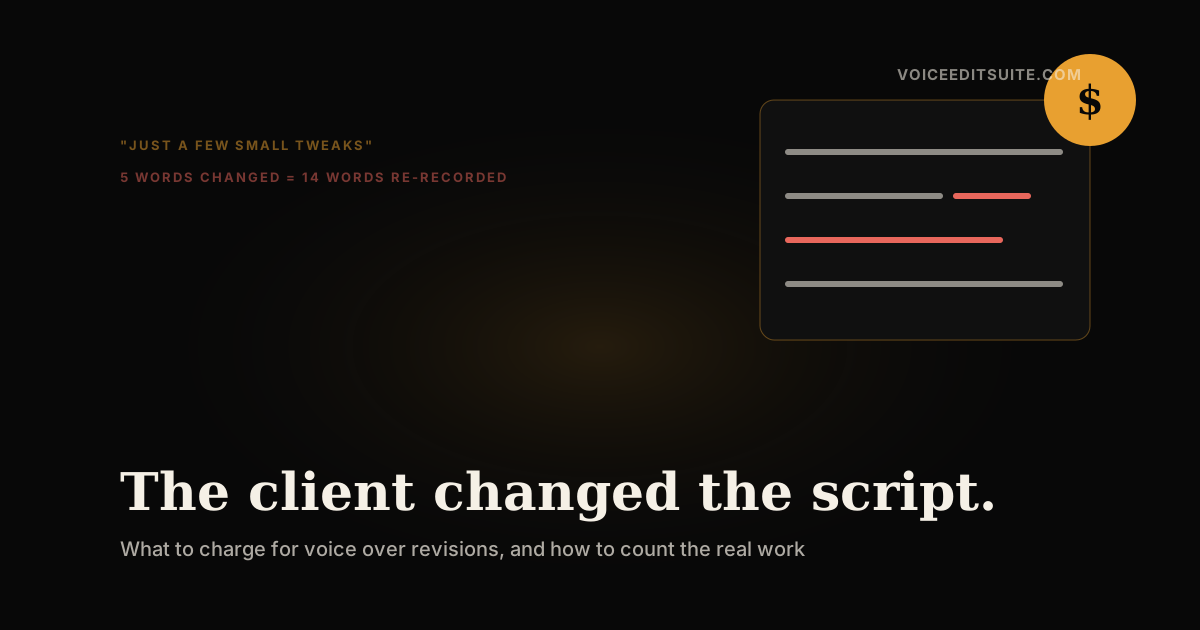
The job is delivered, invoiced, maybe even paid. Then the email arrives: 'Legal wants a few small tweaks, can you send it over today?' Attached is a script with five words changed, and an unspoken assumption that five words is five minutes and five minutes is free.
Every working voice actor faces this, usually within their first few jobs. Handle it with no policy and you either work free forever or have an awkward money conversation with a client you like. Handle it with a clear framework set up before the job, and revisions become a normal, friction-free line item. This guide gives you that framework.
Why 5 Changed Words Is Never 5 Words of Work
You cannot punch one new word into a finished take. The tone will not match, the pacing will not match, and the room will not match, even in the same booth on the same day. The realistic unit of re-recording is the sentence, and often the paragraph, so the sound stays seamless around the change.
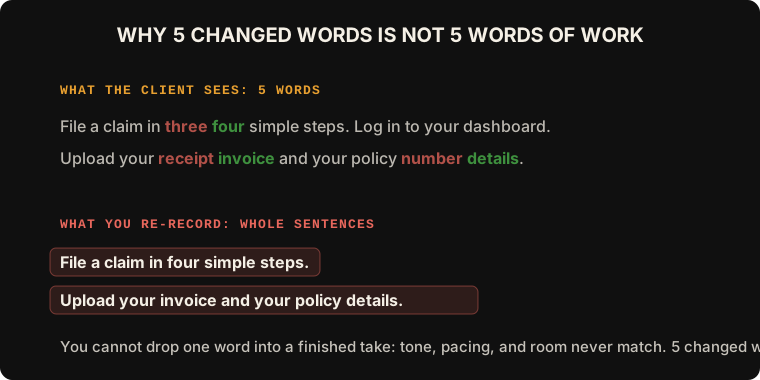
And the re-record is only part of it. A 'small tweak' session still includes setting up the booth to match the original, finding the original tone weeks later, editing the new lines in, matching levels, re-mastering the file to spec, and delivering again. The minimum real cost of any revision is a session, not a sentence.
A Fair Revision Pricing Framework
There is no single industry number, but working voice actors converge on a structure like this:
- Your own errors: always free. Misreads, wrong emphasis you missed, technical faults. You fix your mistakes at no charge, fast, without being asked twice. This is what makes the rest of the policy easy to enforce.
- A small goodwill window for tiny script changes. Many actors include one round of minor changes (commonly under about 10 changed words) free within a week or two of delivery. It costs you little and buys enormous goodwill.
- Minor script changes beyond the window: a pickup fee. A flat minimum session fee, often somewhere between 25 and 50 percent of the original session, covering up to a defined amount of new material. This is the most common revision scenario.
- Substantial rewrites: price as new work. When a third or more of the script changes, it is not a revision, it is a new session at your normal rate.
- Rush: multiply. Same-day or overnight turnaround on any of the above earns a rush premium, commonly 25 to 50 percent.
The principle underneath
You are not charging for words. You are charging for a session: your time, your booth, and a delivery that matches a file recorded on a different day. Frame it that way and clients get it immediately.
Put It in the Quote Before the Job
The revision conversation is only awkward when it happens after the fact. Two sentences in your original quote remove the problem forever:
"Includes one round of minor script revisions (up to 10 changed words) free within 14 days of delivery. Further revisions or larger script changes are billed as a pickup session at [your fee], and changes to more than a third of the script are quoted as a new session."
Now the revision email is not a negotiation, it is a lookup. You reply with 'this falls under the free round, new file tonight' or 'this one is a pickup session per the quote, I can have it to you tomorrow,' and either answer feels professional instead of personal.
↗ Try the tool
Rate Calculator
Revision fees only work when the original quote was right. The Rate Calculator prices the session from real industry data (project type, usage, term) and generates a quote-ready email, which is exactly where your revision policy sentence belongs.
Open Rate Calculator →How to Count What You'll Actually Re-Record
When the revised script lands, resist eyeballing it. Diffing two scripts by hand is slow and error-prone: you will catch the obvious swaps and miss the quietly deleted clause in paragraph four, then discover it in the booth mid-session. What you need before quoting the revision is the true count of sentences you will re-record, not the count of words the client changed.
↗ Try the tool
Revision Checker
Paste the script you recorded and the version the client sent back. The Revision Checker finds every change and counts the words you will actually re-record, whole sentences, not just the edits, then maps it to a suggested fee band. It also marks up the script so the client can see the real scope. It's free, no account needed.
Open Revision Checker →Handling the Conversation Gracefully
- Lead with the yes. 'Happy to get these in for you' comes before any mention of the fee. You are a partner solving a problem, not a tollbooth.
- Show the scope, not just the price. A marked-up script showing two full sentences to re-record explains the fee better than any paragraph of justification.
- Use the policy as the messenger. 'Per the quote, this falls in the pickup band' is impersonal in the best way. Nobody is being difficult, the agreement is just being followed.
- Waive strategically, and say so. Eating a fee for a great long-term client is fine business. Make it visible: 'I've waived the pickup fee on this one.' A free thing has no value unless it is known to be a thing.
Clients change scripts. That is not a problem, it is a revenue line, as long as the price of change was agreed before anyone needed it. Set the policy once, quote it every time, and the 'few small tweaks' email stops being a groan and starts being Tuesday.