
The short answer: burnout is a recognized occupational syndrome, not just a bad week. The WHO's ICD-11 defines it through three measurable dimensions: exhaustion, cynicism toward the work, and reduced effectiveness. Freelance voice actors and podcast producers face specific risk factors: feast-or-famine booking that trains people to say yes to everything, always-on rush expectations, home-studio isolation, and physical strain stacked on the mental load. None of that is fixed by one good vacation. It is fixed by a schedule built around capacity limits, protected rest, and more than one income source, held to across a career rather than abandoned the first time a big project shows up.
What Burnout Actually Is, Clinically
"Burnout" gets used loosely enough that it is worth being precise about where the term was defined. In May 2019, the WHO included burn-out in the 11th Revision of the International Classification of Diseases, but not as a disease. It sits in the ICD-11 chapter for factors influencing health status, the category for reasons people contact health services that are not illnesses. The WHO's own description: a syndrome conceptualized as resulting from chronic workplace stress that has not been successfully managed. Chronic and not successfully managed is the part that matters. A hard week is not burnout. A hard eighteen months with no system for managing the load is.
ICD-11 characterizes burnout through three dimensions, and all three need to show up for the term to apply clinically, not just one bad feeling in isolation. The first is exhaustion: energy depletion that does not lift with an ordinary night's sleep. The second is mental distance from one's job, as negativism or cynicism, the flattened sense that the work has stopped mattering. The third is reduced professional efficacy: a felt drop in competence, even when bookings or feedback have not changed. The WHO is explicit that the term applies to the occupational context only, not being tired about anything in general.
- Exhaustion. Energy depletion that persists even through normal rest, often felt as dreading the booth before a session has even started.
- Cynicism (or depersonalization). Increased mental distance from the work: scripts, clients, and projects that used to feel engaging start to feel interchangeable or pointless.
- Reduced efficacy. A felt drop in your own competence and accomplishment, doubting takes or edits that used to feel routine, independent of whether anyone else has actually noticed a change.
One more detail matters: ICD-11 is explicit that burnout is not a medical condition in its own right, and clinicians rule out other explanations, such as depression, before attaching the label. Burnout describes an unsustainable relationship between a person and their workload, which is why the fix is structural and ongoing, not a single remedy applied once. This differs from the audition anxiety covered in calming nerves before a self-tape audition, an acute spike around a single task. Burnout is the slow result of a schedule that never let the nervous system come back down.
Why Freelance Voice Work Carries Specific Burnout Risk
Burnout is not evenly distributed across every kind of work. Freelance voice acting and independent podcast production share structural features that make the unmanaged, chronic stress ICD-11 describes easier to fall into than in a lot of other freelance fields, and harder to notice early because so much of the pressure is self-generated rather than imposed by a visible boss.
Feast-or-Famine Booking Trains You to Say Yes to Everything
Project-based voice work rarely arrives at an even pace. A booked-solid month can be followed by three quiet weeks with no warning, a pattern covered in building an emergency fund for freelance income volatility. The unpredictability is only half the problem. The behavioral half drives burnout: because nobody can reliably predict the next booking, the learned response is to accept every job during a busy stretch, regardless of real capacity to rest. That is sensible given income uncertainty, but it also means the busiest months are where the three ICD-11 dimensions compound fastest.
Always-On Availability and the Normalization of Rush Jobs
A second pressure is specific to how voice over and podcast work gets requested. Clients increasingly expect a turnaround measured in hours, and building a workflow for same-day rush jobs exists because that has become common enough to need a system, not a scramble. The risk is not the occasional genuine rush job. It is short-notice availability, nights, weekends, a planned day off, becoming the baseline a performer feels obligated to hold to stay competitive. A phone checked at all hours functions almost like being on call, minus the overtime pay or defined end date an actual employee would have.
The Isolation of Home-Studio Work
Most full-time voice actors and many podcast producers work alone, in a treated room in their own home, with no coworkers present to notice someone looking worn down, and no office culture setting a shared expectation for when the workday ends. That isolation cuts both ways: it removes the daily friction of office politics and commuting, part of why the work appeals to people, but it also removes the informal signals that catch burnout early elsewhere, a coworker saying you look exhausted, a manager noticing a dip in output. Alone in a booth or editing suite, the cynicism dimension can go unnoticed for a long time, with no one there to register the quiet flattening of enthusiasm for work that used to feel engaging.
A Physical Toll Layered on Top of the Mental One
Voice work also carries a physical cost that compounds the psychological one rather than running on a separate track. The vocal mechanism is under real, measurable load during a long recording day, which is why the actual research on vocal strain in voice work matters here too. Someone pushing through mental exhaustion is frequently also pushing a tired voice or tired ears past the point they would normally stop, and the two reinforce each other: strain makes the work feel harder, which deepens exhaustion. Producers carry an analogous toll in the ears, from the hours of close listening editing demands, a load the speech science behind podcaster and voice actor vocal fatigue covers directly. Treating the two as separate problems is one reason burnout here goes unaddressed too long.
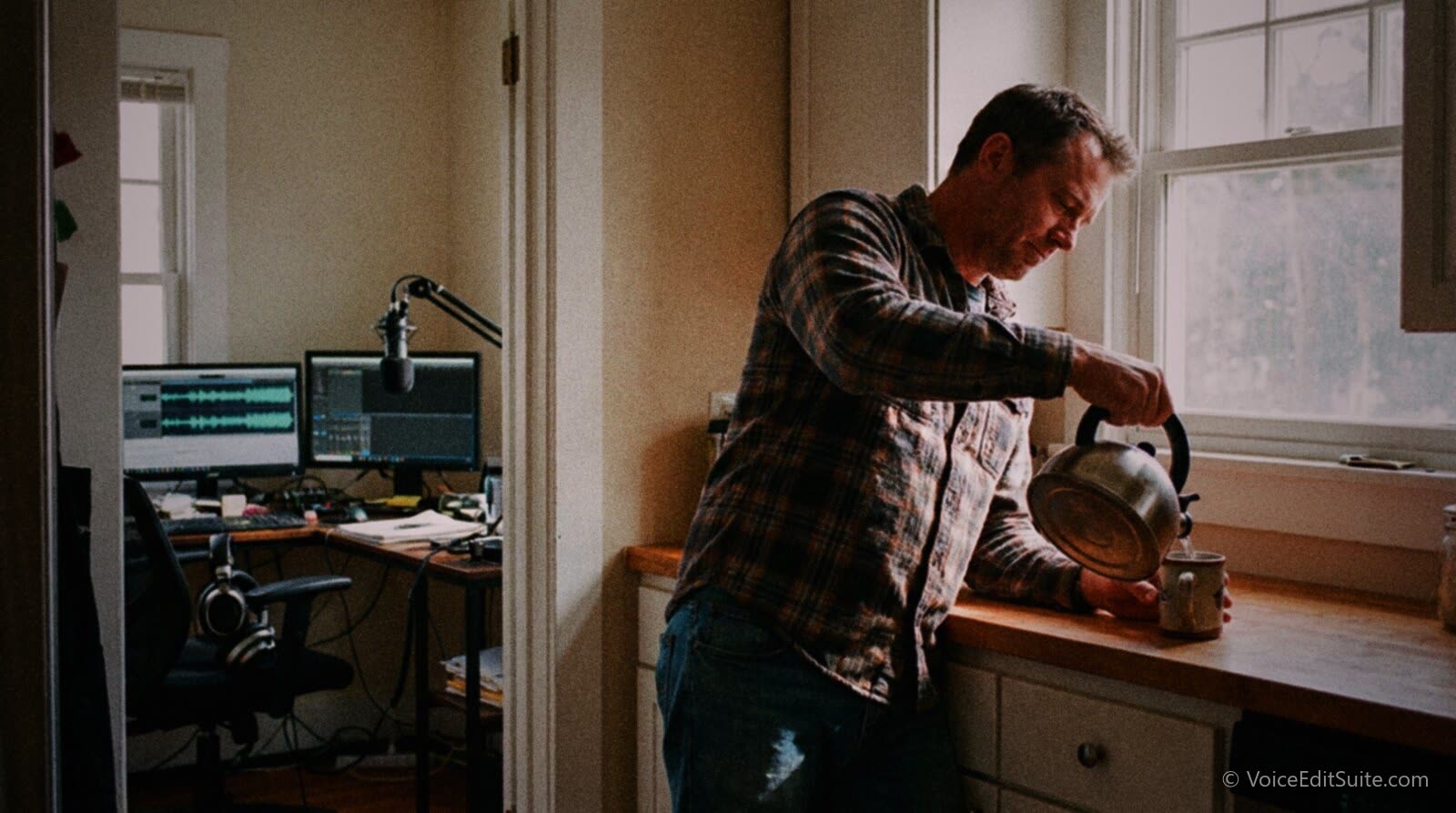
Put those four factors together, unpredictable booking that rewards saying yes to everything, an always-on rush expectation, isolation that removes the signals that usually catch burnout early, and a physical cost layered onto the mental one, and the picture looks like the chronic, unmanaged workplace stress ICD-11 describes, except distributed across a career with no employer to hold responsible. That absence means noticing early signs and building in recovery falls on one person, which is why a deliberate, written schedule matters more here than for an employee whose employer is at least nominally accountable.
What the Research and Workplace Surveys Actually Show
General workplace research backs up how widespread this pattern is, even outside freelance work. Gallup's ongoing workplace research has repeatedly found that roughly three in four employees experience burnout at least sometimes, and about one in four very often or always. The American Psychological Association's 2023 Work in America Survey, run by the Harris Poll among a representative sample of employed adults, found workers at psychologically unhealthy workplaces reported harm to their mental health at a far higher rate than workers at healthier ones, 52 percent versus 15 percent, and that nearly one in five rated their workplace as toxic. A freelancer has no HR department setting that baseline, and voice work has fewer built-in limits, like fixed hours and paid leave, than a structured workplace has by default.
Freelance-specific research tells a more mixed but useful story. Leapers, a UK research project on self-employed wellbeing, surveyed more than a thousand freelancers for its 2025 report and found 40 percent had seen their mental health decline over the year, with more describing it as poor (28 percent) than good (22 percent), and only 22 percent feeling adequately supported. Other research, including Dutch national statistics bodies, has found self-employed workers sometimes report lower overall burnout than employees, so the picture is genuinely mixed. The honest reading: the factors above make burnout a real, elevated risk a freelancer has to manage on purpose, since the freedom that makes the work appealing also removes most guardrails an employee would have by default.
Building a Schedule That Actually Holds Up Over a Career
None of the strategies voice actors and producers use to manage this are exotic. What makes them effective is that they are specific, written down, and applied consistently during the busiest months, rather than treated as a nice idea for a slower season that never quite arrives.
Set a Real Capacity Limit, in Writing, Before You Need One
A capacity limit is a numeric ceiling on how much work you will take in a given week, decided before a tempting offer is sitting in your inbox making the decision for you. That might be a maximum number of billable session hours per day, a cap on same-day rush jobs per week, or, for a producer, a cap on episodes in active production at once. The number matters less than the fact that it exists and was set during a calm week, not a frantic one. A limit decided under pressure from a client who needs an answer within the hour almost always gets set too high, because the instinct is to protect the relationship and the income, not next month's energy.
- Pick a number you can actually defend to yourself, not an aspirational one. If three recording days a week is genuinely sustainable and four is not, write down three, not a hopeful four.
- Review the limit quarterly, not weekly. Changing it every time a slow week makes it feel too conservative defeats the purpose; give it real time to prove out before adjusting.
- Separate the limit for rush work from the limit for normal bookings. One same-day rush job absorbed into an otherwise normal week is very different from three, even if the total hours look similar on paper.
Saying No Is a Schedule Decision, Not a Personality Trait
Turning down work gets framed, in a lot of freelance advice, as a confidence problem: be braver, and the no will follow. In practice, a capacity limit set in advance makes saying no almost mechanical, the same way the answer is no to a ninth hour in an eight-hour day. That matters for the skill covered in setting boundaries against scope creep from existing clients, where pressure to say yes often comes from a trusted relationship, not a stranger. It is harder to say no to someone you like, which is why deciding the limit before that hard-to-refuse request arrives protects the schedule instead of giving it away one exception at a time.
↗ Try the tool
Performance Coach
Pacing a session so your energy and performance hold steady from the first line to the last is part of what makes a sustainable capacity limit realistic in the first place. The Performance Coach gives you structured practice and feedback on delivery and pacing away from a live client deadline, so the sessions you do book get your best, most consistent work instead of a rushed version squeezed in around everything else.
Open Performance Coach →Batch Recording Days and Admin Days Separately
Switching repeatedly between deep vocal or editing focus and the scattered, interrupt-driven work of invoicing and email is its own hidden source of fatigue, separate from the raw hours each task takes. Many voice actors and producers deliberately batch their week into distinct kinds of days instead of a little of everything daily: dedicated recording or editing days with the phone and inbox closed, and separate, bounded admin days for invoicing, contracts, and correspondence. The batching protects deep-focus days from the cost of admin interruptions, and protects admin days from the unrealistic expectation of also delivering a polished performance the same day. Three recording days, one admin day, one outreach day, and two rest days is one workable pattern, though the mix depends on your own client base and season.
Schedule Real Time Off the Same Way You Schedule a Session
Time off that depends on a quiet week showing up on its own rarely happens, because a quiet week often arrives at an inconvenient moment, or gets immediately filled out of financial anxiety about the quiet itself. People who actually take consistent time off book it the way they book a client session: on the calendar, in advance, resistant to last-minute rescheduling. That includes short breaks, a full weekend with no client email, not just the once-a-year week away, because the exhaustion dimension responds better to frequent recovery than to one long trip bookended by unbroken weeks of always-on availability.
Diversify Income So No Single Client Can Burn You Out
A schedule built around capacity limits is easier to hold to when no single client represents a large enough share of income that losing it would be a crisis. When one client controls the budget, their rush requests and last-minute deadlines carry outsized power over your schedule, because saying no to them costs more than saying no to anyone else. Spreading income across direct clients, retainers, and a second stream such as coaching or teaching voice over reduces that leverage. Subcontracting overflow work to other trusted voice actors helps too, turning a scheduling conflict into a referral fee instead of an overbooked week.
What a Sustainable Week Actually Looks Like
Put the strategies above into an actual week and the pattern is less dramatic than it sounds. One illustrative version, a worked example rather than a prescription, runs three recording days around existing bookings and fresh auditions, one admin day, one outreach day for demos and new work with a block held open as a rush buffer rather than fully booked, and two full days with no client-facing work at all. The buffer matters as much as the rest days: an unexpected same-day request need not come out of an already-booked day, or out of the protected weekend.
The specific split will not fit everyone. A producer juggling three podcasts might need two editing days and a separate day for their own interviews, while an audiobook narrator might batch a whole week of recording and reserve one day every other week for admin. What stays constant across people who manage this well is not the mix, but deciding it in writing and defending the rest days and the rush buffer with the same seriousness as a paid booking, because a schedule that bends for every request eventually has no shape left to protect.
"We have put up a new show every Monday and Thursday for almost 16 years and we're tired. We're burnt out. And we are utterly satisfied with the work we've done."
Maron's schedule was not a feast-or-famine freelance calendar, but the mechanism is the one this guide describes: a sustained, unbroken commitment with no built-in capacity limit and no scheduled stopping point, held long enough that exhaustion caught up regardless of how good the work remained. The lesson is not that every long-running commitment ends in burnout. It is that even work someone finds genuinely meaningful needs an explicit limit attached at some point, whether a weekly recording cap, a cap on active podcasts, or an end date, because meaningful work grants no immunity from the three ICD-11 dimensions on its own.
A Note Specifically for Podcast Producers
Everything above applies to podcast producers as much as to voice actors, but production work has its own traps. Editing and mixing is more elastic than a recording session in a way that quietly invites overwork: a rough cut can always be tightened one more pass, and without a deadline forcing a stop, that stopping point can disappear into an open-ended evening. Producers running their own shows on top of client work face a second trap: the show meant as a creative outlet starts competing for the same hours as paying work, and because it feels like passion rather than a job, it is the first thing squeezed into a day off, quietly eliminating that rest day without ever canceling it.
The fix is the same discipline applied to a different task: a fixed number of revision passes decided before editing starts, not an open-ended until it feels right standard, plus a hard stop time the same way a recording session has one. Treat a producer's own show as a line item inside the capacity limit, not free time that happens to involve a microphone. Isolation compounds for producers especially, since editing involves even less live interaction, which makes scheduled breaks do double duty: they fight exhaustion, and are often the only human contact in a solitary day.
A note on scope and currency
This guide offers general wellbeing and scheduling information, not clinical advice, a diagnosis, or a substitute for a doctor or mental health professional if exhaustion, cynicism, or reduced efficacy is persistent and affecting daily functioning. The ICD-11 classification is drawn from the WHO's own published materials. The survey figures cited (Gallup, the APA, Leapers) are current as of this guide's publication date and credited to the organizations that produced them; each surveys a different population with a different methodology, so treat them as directional evidence of a pattern, not a precise measure of risk for voice actors specifically.
Frequently Asked Questions
Is burnout a sign that I am not cut out for freelance voice work?
No. The WHO's own framing treats burnout as the result of chronic, unmanaged workplace stress, a schedule-level problem, not a verdict on someone's suitability or resilience. The same booking patterns and always-on expectations that produce burnout in one performer would produce it in nearly anyone operating under them long enough without limits. Treating it as a system to fix, not a personal failing to feel ashamed of, is both more accurate and more useful.
How many clients or how much income should come from any single source?
There is no universal number, but a useful warning sign is a single client representing so much of your monthly income that losing them would force a serious financial crisis rather than an uncomfortable adjustment. At that point, their requests carry outsized power over your schedule because you cannot afford to say no. Working toward a spread where no single client holds that leverage, even gradually, directly supports the capacity-limit and saying-no strategies above.
Does building a sustainable schedule mean never taking a rush job again?
No. Trying to eliminate rush work entirely usually backfires by damaging client relationships that also provide steady, non-rush bookings. The more sustainable approach holds a small, deliberate rush buffer inside an otherwise normal week, as in the sample week above, so an occasional same-day request has a place to land without displacing a rest day or an already-booked session. The goal is making rush work the occasional exception it should be, not the default every client assumes you can meet.
How does a solo podcast producer notice burnout without coworkers around to catch it?
Pay attention to the cynicism dimension specifically, since it is easiest to miss alone: a project or edit that used to feel interesting starting to feel like an interchangeable task to get through. A concrete check is tracking how many revision passes an episode gets before you call it finished. A creeping, open-ended increase in that number over a few months, with no matching rise in client complaints, is a common early sign that perfectionism has quietly expanded to fill the exhaustion a producer has not otherwise addressed.
What does actually recovering from burnout involve, beyond a short break?
A short break can relieve acute exhaustion temporarily, but because ICD-11 frames burnout as the product of an unmanaged chronic condition, lasting recovery generally requires changing the underlying schedule and workload, not just resting and returning to the pattern that produced it. That usually means setting the kind of written capacity limit described above, actually enforcing it for several months, and treating a relapse into old overbooking habits as a signal to revisit the limit, not a personal failure at saying no.
Sources and Further Reading
- World Health Organization, Burn-out an "occupational phenomenon": International Classification of Diseases: the ICD-11 classification of burnout, its three dimensions, and the statement that it applies only to the occupational context.
- Gallup, Employee Burnout: Causes and Cures: research finding roughly three in four employees experience burnout at least sometimes, and about one in four very often or always.
- American Psychological Association, 2023 Work in America Survey press release: the APA and Harris Poll's survey finding workers at toxic workplaces reported mental health harm at far higher rates (52 percent versus 15 percent) than workers at healthy ones.
- Leapers, 2025 Freelancer Wellbeing Report: a UK self-employment research project's survey of over 1,000 freelancers finding 40 percent saw their mental health decline in 2025, and only 22 percent felt adequately supported.
- The Hollywood Reporter, coverage of Marc Maron's announcement ending the WTF podcast after nearly sixteen years, June 2025: source for the quote describing burnout from an unbroken, twice-weekly publishing schedule.