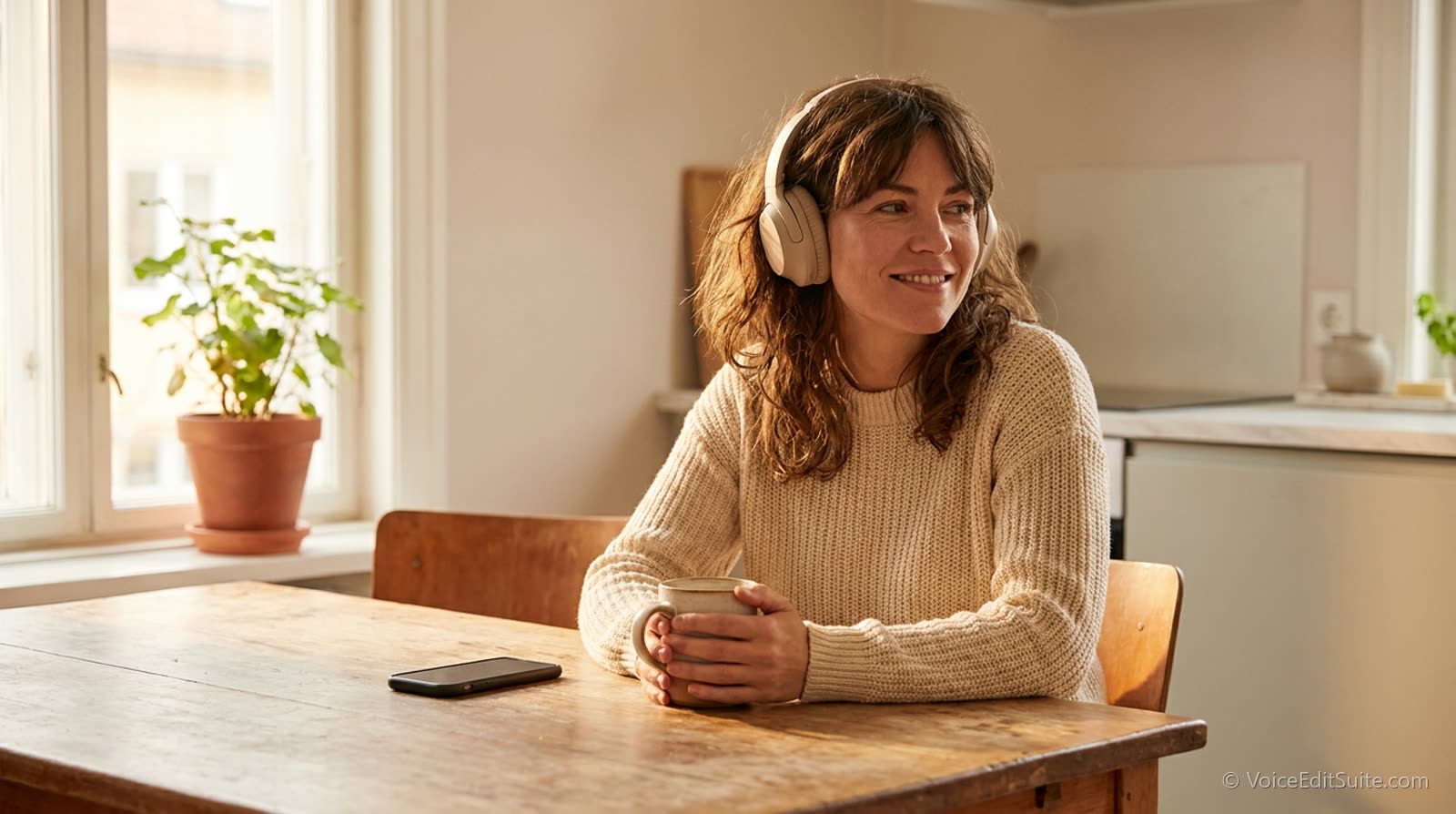
Here is a thing that happens a thousand times a day. Someone presses play on a new show while they wash up, or drive, or walk the dog. There is a fridge somewhere under the host's voice, and a slight ringing sound, because the room is a bedroom and bedrooms ring. The content is fine. Good, even. And about ninety seconds in, without a decision being made anywhere, the thumb drifts to the next show in the list.
Ask that person later why they stopped and they will say "I don't know, it wasn't for me." They are not lying. The thing that made it "not for them" happened in a part of the brain that does not write reports. This article is about that part: what the published research says bad sound does to a listener, how many people are listening in 2026 and how quickly they leave, and the fixes in the order that actually matters, from free to cheap. It is not a gear article. Most of the shows that sound bad own perfectly good microphones.
The Experiment Every Podcaster Should Know About
In 2018, two psychologists, Eryn Newman of the Australian National University and Norbert Schwarz of the University of Southern California, ran a pair of experiments that should be pinned above every podcaster's desk. They took real recordings of scientists talking about their work: conference talks in the first study, radio interviews from NPR's Science Friday in the second. Then they made a second copy of each recording with worse sound, the kind you get from a cheap mic in an untreated room. Same words. Same speaker. Same slides, where there were slides. Only the audio changed.
Then they asked people to rate what they had heard. In the paper's own words, "people evaluated the research and researcher less favorably when the audio quality was low." When the recording was harder to hear, listeners rated the talk as worse, the speaker as less intelligent and less likeable, and the research itself as less important. Not the sound. The research. The identical findings, from the identical scientist, were judged to matter less because a hum had been added to the file.
Schwarz summed up the mechanism for USC's news office in a single sentence: "When you make it difficult for people to process information, it becomes less credible." Psychologists call this processing fluency. The brain uses the ease or difficulty of taking something in as a shortcut for judging it. Smooth feels true, familiar and competent. Effortful feels doubtful, foreign and slightly suspect. It is the same wiring that makes a rhyming proverb sound wiser than a plain one and a clean font seem more honest than a messy one. Your listener is not judging your audio. Their brain is using your audio to judge you.
Why Your Listener's Brain Gets Tired
The second piece of the puzzle comes from hearing science rather than psychology. Jonathan Peelle, then at Washington University in St. Louis, published a 2018 review in the journal Ear and Hearing on what researchers call listening effort. It pulls together behavioural studies, pupil measurements (your pupils dilate when you concentrate, which is how scientists measure mental effort without asking) and brain imaging. The conclusion is not subtle. Understanding speech that is acoustically degraded, by background noise, by a poor recording, by echo, requires extra cognitive support, and that extra work is borrowed from somewhere.
Where it is borrowed from is the part that matters for a show. The review finds that acoustic challenge is associated with more errors in understanding, poorer performance on anything else the listener is doing at the same time, more difficulty with complex sentences, and reduced memory for what was said. Read that last one again. Your listener is probably doing something else while they listen; that is the whole point of the medium. If your recording is hard to hear, they understand less of it, they do the washing up worse, and afterwards they remember less of what you told them. The takeaway they were going to repeat to a friend never made it into storage.
Try it on yourself
Find a podcast you like and a podcast that sounds rough, and listen to five minutes of each while doing a small mental task, say adding up a supermarket receipt. Notice which one you keep having to rewind. That rewind is listening effort, and every listener you have is paying it, silently, on every episode.
Nine in Ten Finish. The Fight Is for the First Minute.
Now the good news, because there is a lot of it. Podcast listeners are extraordinarily loyal once they are in. Edison Research has asked monthly listeners for years how much of an episode they typically consume, and the 2019 answer was that 52 percent listen to the entire episode and 41 percent to most of it, with only 5 percent bailing before halfway and 2 percent stopping at the beginning. By 2026, Edison's Podcast Consumer study puts it more simply: seventy percent of weekly listeners finish all or most of every episode they start, which Edison describes as the highest completion rate of any digital medium.
So the medium does not have a retention problem. It has an entrance problem. The Podcast Study, a September 2025 survey of 1,200 US podcast listeners by Point-To-Point Marketing and Strategic Solutions Research, found that one in three listeners stop an episode early at least half the time, and that three in four want the hosts either to dive straight into the topic or to keep the opening chatter short. The reasons they gave for quitting were repetition, a lack of structure and episodes running too long. Notice what those have in common with bad sound: all of them are forms of effort. A rambling open makes the listener work to find the point. A noisy recording makes them work to find the words. Stack the two and you have built a wall at the front door of a show people would have loved.
Put the two findings together and the shape of the problem is clear. A listener who makes it through your first few minutes will, on average, give you almost everything. A listener who hits hiss, echo or a fridge in those first few minutes is being told, by their own brain, that you are less competent and your ideas matter less, before you have made a single argument. The sound of your opening is doing more persuading than the words in it.
The Three Sounds That Send People Away
Listeners do not hear "bad audio." They hear specific things, and there are only three that do most of the damage. Each has a name, a cause and a measurable target, which means each can be fixed on purpose rather than by buying another microphone.
1. The floor: hiss, hum and the fridge
Every recording has a noise floor, the sound that is there when nobody is talking. In a good recording it is so quiet you only find it by turning the volume up during a pause. In a bedroom recording it is a computer fan, a fridge two rooms away, the hum of a cheap USB cable, and a hiss from a microphone preamp being pushed too hard. Individually none of these is loud. Together they sit under every sentence like a low tide, and the brain has to lift each word out of it. The audiobook industry, which has to care about this, sets the bar at a noise floor of -60 dB or lower, measured in the gaps. A fan in the same room usually puts you around -45. That fifteen decibels is most of the difference between "sounds like a show" and "sounds like a Zoom call."
2. The room: why bedrooms ring
The second sound is your own voice, arriving late. Sound leaves your mouth, hits the wall behind the laptop, the window, the wardrobe door, and comes back to the microphone a few milliseconds after the direct sound. Your ears filter this out in real life; a microphone does not. The result is the slightly hollow, slightly distant tone that says "recorded at home" more clearly than anything else, and it is the one problem no setting on the mic can fix, because it is not in the mic. It is in the room. Soft things fix it: a duvet on a stand behind you, a wardrobe full of coats, the corner of a sofa. This is why so many audiobook narrators work in closets and why, if you have heard "record in the wardrobe" and laughed, the joke is on the rest of us.
3. The jumps: levels, loudness and the quiet guest
The third sound is not a sound at all but a change in volume. The host is close to a good mic; the guest is on a laptop in a kitchen and comes in six decibels quieter. The listener turns it up for the guest, gets blasted by the host, turns it down, misses the guest. Every adjustment is effort, and effort, as we have seen, is read as doubt. The fix has two halves. Within an episode, the voices need to sit at the same level; between episodes, the show needs to land at the loudness the platforms expect. Apple's published spec asks for an overall loudness around -16 LUFS with a tolerance of one decibel and a true peak no higher than -1 dBFS; Spotify normalises to -14. Hit the number and your show plays at the same volume as the one the listener just left, which is the quietest possible way of saying "we know what we are doing." The loudness guide has every platform's target in one place.
The Room You Are Walking Into
Why does this matter more in 2026 than it did five years ago? Because the audience has never been bigger and the shelf has never been fuller. Edison Research's Infinite Dial 2026 reports that 80 percent of Americans aged 12 and over, some 230 million people, have listened to or watched a podcast, that 58 percent (167 million) did so in the last month, a record, and 45 percent (130 million) in the last week. On the other side of the ledger, the Podcast Index, the open directory of every feed it can find, counts about 4.72 million podcasts in 2026, of which roughly 478,000 have published anything in the last 90 days and about 323,000 in the last 30. In other words, a listener can pick from something like a third of a million living shows this month, and most of the four million dead ones died because nobody came back for episode two.
There is an odd comfort in those numbers. Content is hard. Being funnier, better informed or better connected than a third of a million other hosts is a lifetime's work. Sound is not hard. It is a set of three measurable problems with known fixes, and most of the shows you are competing with have not fixed them. A show that simply sounds like it was made on purpose has already jumped a large share of the field before anyone hears a word of the content, because the listener's brain has quietly decided the host is competent. That is the cheapest advantage in the whole medium, and it is lying on the floor.
What Good Enough Sounds Like, With Numbers
"Professional" is not a feeling, it is a short list of measurements, and every one of them can be checked on a thirty-second recording before you commit to an hour-long episode. This is the list:
- Noise floor at -60 dB or lower in the pauses. Fans off, phone out of the room, the fridge unplugged for an hour if it comes to that.
- No audible room echo when you listen to a gap between sentences on headphones. If you can hear the room, the listener can hear the bedroom.
- Both voices within about two decibels of each other across the episode, so nobody reaches for the volume.
- The finished file at -16 LUFS, plus or minus one, with true peaks no higher than -1 dBFS, or -14 LUFS if Spotify is your main home.
- Breaths and pauses that sound like a person, not a robot. Quietened breaths keep the pause; cut breaths make the conversation feel rushed, and listeners notice even when they cannot say why.
↗ Try the tool
Home Studio Analysis
The free room check measures the first two of those from a thirty-second recording: echo, noise floor, hum and sibilance, each with a plain-English fix. No account, no upload of anything longer than half a minute. It is the fastest way to find out whether your problem is the mic, the room, or neither.
Open Home Studio Analysis →A Ten-Minute Fix List for Your Next Episode
None of this needs a budget. In order, cheapest first, this is the routine that moves a show from "recorded at home" to "made on purpose" in a single afternoon.
- Record thirty seconds of silence in your usual spot and listen back at full volume on headphones. Write down what you hear: fan, fridge, hum, traffic. Now you have a list, not a vague worry.
- Kill what you can at the source. Fans off, laptop on a towel, phone in another room, door shut. Free, and it removes more noise than any plugin.
- Soften the room. A duvet over a clothes rack behind the mic, or the mic pointed into a wardrobe full of clothes. Ugly, effective, invisible on audio.
- Get the mic close: a hand's width from your mouth, slightly off to one side so plosives miss it. Closeness is the single biggest lever on room echo, because your voice gets louder and the room does not.
- For the noise you cannot remove, clean it in software after the fact, on each person's track separately, before you mix. Noise removal works best on one voice at a time.
- Level the voices to each other, then take the whole episode to the platform loudness. Loudness is the last step, never the first.
- Listen to the opening minute on cheap earbuds while walking. That is your listener's setup, not your studio headphones. If it passes there, it passes.
If the software steps sound like the part you would rather not learn, that is the part the toolkit was built for: the room check is free, and the cleanup, breath quietening and loudness happen in a browser on your file, in that order, without a timeline in sight.
Quick self-check
Which sound problem is costing you listeners?
Four honest questions. The result points at the one thing to fix first.
Question 1 of 4
Turn the volume right up during a pause in your last episode. What do you hear?
Frequently Asked Questions
Will a more expensive microphone fix this?
Usually not, and often it makes things worse, because a more sensitive microphone hears more of the room. Of the three problems above, only part of the first one (preamp hiss) is about the microphone at all. The room and the levels are untouched by a new purchase. Fix the room and the technique first, then decide whether the mic is the bottleneck; for most shows it is not.
Surely great content beats good sound?
Great content survives bad sound, yes; the biggest shows in the world have rough episodes. But the research says bad sound makes your content seem worse than it is, to the very people you are trying to win, at the exact moment they are deciding whether to stay. You do not have to choose. Sound is the cheap fix; content is the lifetime's work. Do the cheap fix so the lifetime's work gets a fair hearing.
Does any of this apply if my podcast is on video?
More, if anything. Edison's 2026 numbers show most consumers now both listen to and watch podcasts, and video platforms play audio through phone speakers and laptop speakers that flatter nothing. Viewers forgive a mediocre picture far more readily than mediocre sound; the industry rule of thumb that people will watch bad video with good audio but not good video with bad audio holds up in every edit suite.
Does noise removal software make voices sound robotic?
Bad noise removal does, and everyone has heard the underwater, metallic result of pushing it too far. The modern approach separates the voice from the noise rather than filtering frequencies, and measured properly (noise floor before and after, in decibels) it should take a fan out without touching the tone of the voice. The rule is to clean each voice on its own track before mixing, and to listen to three random sentences afterwards for anything hollow. If a tool cannot show you the before and after numbers, be suspicious of it.
Sources and Further Reading
- Newman, E. J., and Schwarz, N. (2018). Good Sound, Good Research: How Audio Quality Influences Perceptions of the Research and Researcher. Science Communication, 40(2), 246 to 257. The two experiments, the quoted finding, and the fluency explanation.
- University of Southern California, Dornsife College, The quality of audio influences whether you believe what you hear, April 2018: the Norbert Schwarz quotation on processing difficulty and credibility.
- Peelle, J. E. (2018). Listening Effort: How the Cognitive Consequences of Acoustic Challenge Are Reflected in Brain and Behavior. Ear and Hearing, 39(2), 204 to 214. The review of behavioural, pupillometric and neuroimaging evidence, and the effects on memory and concurrent tasks.
- Edison Research at SSRS, The Podcast Consumer 2019: the entire, most, less than half and just the beginning figures among US monthly podcast consumers 12 and over.
- Edison Research at SSRS, The Podcast Consumer 2026, as reported by Inside Audio Marketing, June 2026: the seventy percent completion figure among weekly consumers.
- Edison Research at SSRS, The Infinite Dial 2026, March 2026, and the release as carried by Podnews: ever, monthly and weekly podcast consumption and the population estimates.
- Point-To-Point Marketing and Strategic Solutions Research, The Podcast Study, September 2025, 1,200 US podcast listeners, as reported by Inside Radio: the one-in-three and three-in-four findings and the stated reasons for stopping early.
- Podcast Index counts (total feeds, active in 90 and 30 days) as reported by Libsyn, 2026; live totals at podcastindex.org.
- Apple, Audio requirements for Apple Podcasts: the -16 LKFS loudness recommendation, the one-decibel tolerance and the -1 dB true-peak ceiling.
- VoiceEditSuite, Podcast Loudness Standards and Recording a Podcast in a Bedroom: the companion guides on levels and rooms.
Corrections
Study findings are quoted from the published papers and press releases named above; survey figures are as published by Edison Research at SSRS, Point-To-Point Marketing and Strategic Solutions Research, Libsyn and Apple at the time of writing, September 2026, and are revised by their publishers over time. Spot an error or a newer number? Tell us through the contact page and we will correct it with a note.