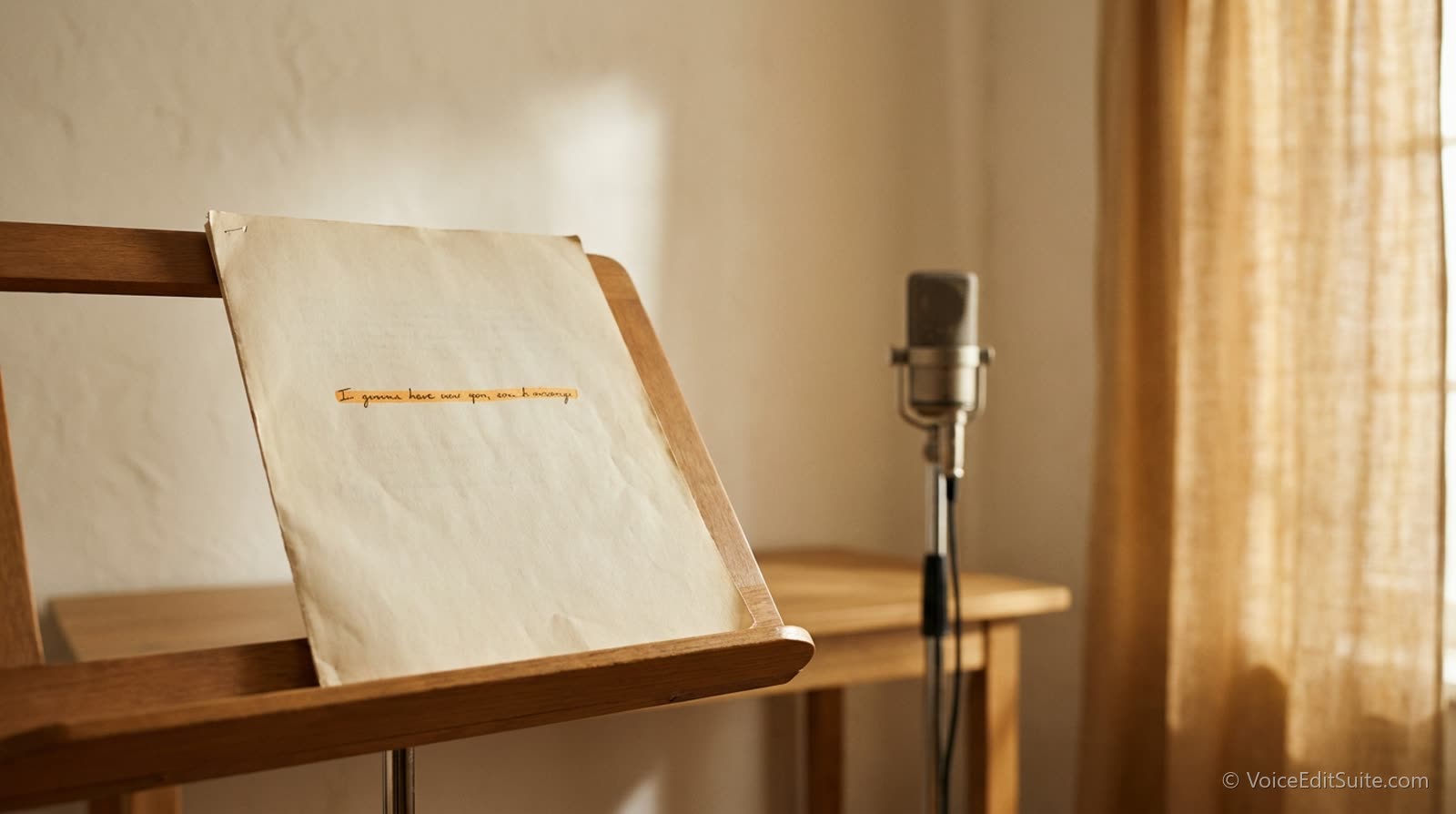
The short answer: a slate is a short spoken label at the start of an audition, usually just your name ("Jordan Avery"), sometimes followed by the role, spot or agency if the brief asks for them. Say it in a natural voice close to the energy of the read, leave a half-second beat, then start the copy. If the brief does not ask for a slate, the safest default for an audio audition is no slate at all, with your full name in the file name and the email instead.
A slate is the smallest part of an audition and, unfairly, one of the most telling. It is two or three seconds of audio. A rushed, mumbled or over-performed slate quietly tells a casting director something about the read they have not heard yet: that this person is nervous, or careless, or trying too hard. None of that is true about your acting, and all of it gets communicated anyway. This guide covers what a slate is for, the exact structures for every common request, when to leave it out, tone and pacing, where it sits in the file, video slates, the SAG-AFTRA self-tape rules, and the mistakes that show up most often. It is written for voice actors auditioning for commercials, animation, games and audiobooks, and for podcasters who slate their tracks, audition for host jobs, and record sample sponsor reads.
What a Slate Is, and Why Casting Asks for One
The word comes from film, where a clapperboard (the slate) is filmed at the start of each take so the editor knows which scene and take the picture belongs to, and the clap lines up the sound. In auditions it does the same job for a person: it attaches a name to a performance. When a casting director plays forty files in a row, then forwards eight of them to a producer, the slate means nobody has to cross-check a file name to know whose voice they just heard.
That is the whole purpose. A slate is admin. It is not a second audition, a personality showcase or a chance to thank anyone. On camera it carries a little more weight, because casting can see you as yourself before the scene starts, and SAG-AFTRA's self-tape workshops quoted casting directors who use slate footage when a director wants to see more of a performer's personality. In audio, it is purely identification, which is why many audio briefs no longer want one: the file name and the submission system already identify you, and a slate is a few seconds the listener has to skip.
It also explains why casting directors often cut slates out. At a 2019 SAG-AFTRA panel of Los Angeles casting directors, the panellists said some casting offices edit slates out before sharing tapes, either because they do not use them or because a slate does not fit the mood of the scene. Their advice was to send the slate and the audition as separate files, so casting can use the slate or drop it without editing anything.
Exact Slate Structures for Every Common Request
Briefs ask for slates in a handful of standard shapes. Learn these and you will rarely meet one you have not rehearsed. The rule that governs all of them: say what the brief lists, in the order it lists it, and nothing more.
Name only
The default when a brief says "please slate" and nothing else. Say your professional name, first and last, once: "Jordan Avery." Do not add "Hi, my name is" or "This is". Those words are not wrong, but they add a second of nothing and they pull the slate toward a phone greeting. If you work under a stage name, slate the stage name, the same one that appears on your demo, your website and any union card.
Name plus role
Common in animation, games and audio drama, where one actor may read for several characters on the same project: "Jordan Avery, for Captain Reyes." Use the character name exactly as the sides spell it. If you are submitting for two roles in one file, slate each role immediately before its read: "Captain Reyes", then the read, then "Officer Lin", then the read. Many briefs prefer one file per role instead, in which case each file gets its own slate.
Name plus spot or length
Commercial briefs often include several scripts or several lengths of the same script. Slate the spot the way the brief labels it: "Jordan Avery, Harbor Bank, thirty." Say lengths as single words ("thirty", "sixty", "fifteen") because that is how they are spoken in sessions, and "thirty seconds" spends more time on the label than it is worth.
Name plus agent
Some agents want their agency named in every slate so casting connects the audition to the right representation. Others specifically do not, because the submission already comes from the agency. Neither is universal, so ask your agent once and write the answer down. When it is wanted, keep it brief: "Jordan Avery, with [Agency Name]." If you are unrepresented and a brief asks for representation, "Jordan Avery, self-represented" is clear and professional. Our guide to working with talent agents covers how agency submissions work more broadly.
Take labels
Some briefs ask for two reads, usually one as written and one with a different choice. Label them only if asked, and only with the take: "Take one" before the first read, "Take two" before the second. The 2019 SAG-AFTRA panel made the same point for on-camera tapes: scene labels are only needed when you are submitting several takes, and few casting directors want several takes in the first place.
Write the slate on the script
Before you record, write the exact slate words at the top of the copy, in the order the brief gives them. You will read them instead of composing them under pressure, and you will never forget the spot name on take three.
When Not to Slate
The most useful slating skill is knowing when to leave it out. A slate nobody asked for is not a disaster, but it costs the listener time, it can sit awkwardly on a file that gets forwarded to a client, and it signals that you did not read the brief closely. Leave the slate out when:
- The brief says no slate. Some briefs say this explicitly, often because the files go straight to a client who wants to hear voices without names, or because casting wants to listen without bias.
- It is an audiobook audition. Audiobook auditions are judged on the narration, are usually shared with authors or rights holders, and are labelled by the platform or by the file name. A spoken slate there is something the author has to sit through before they hear the book.
- The brief asks for the read in character from the first second. Some game and animation briefs want the file to open on the character. Slating would break exactly what they asked for.
- The brief is silent and the audition is audio only. Without a request, a clean file that starts on the read, with your full name in the file name and the email, is the lower-risk choice. If an agent's house format says otherwise, the agent's format wins.
- You are auditioning for a direct client. A business owner choosing a voice for their explainer usually wants a sample they can play to a colleague. Your name is already in the email, the file name and your signature.
The decision is mostly about reading the brief carefully, which is a skill of its own. Our guide to reading a casting brief breaks down where slate instructions usually hide: often in the delivery specs at the bottom, not in the description of the role.
Tone and Pacing: Match the Read, Not a Habit
The most common slating mistake is a register change: a deep, formal, resume-voice slate followed by a warm conversational read. It sounds like two different people, and it is one of the clearest tells of a beginner file. A commercial slate for a friendly brand should sound like the friendly read that follows. A slate before an intense character read can carry a touch more weight. The rule is not "always sound the same". It is "sound like a smooth handoff into whatever comes next", so the file feels like one performance instead of two spliced clips.
Casting directors say the same about on-camera slates. Caroline Liem, quoted in SAG-AFTRA's write-up of its self-tape workshops, said she loves it when "the slate gives me a flavor, a vibe, of what I'm about to see." The 2019 panel put it as a contrast: a slate for a wartime drama should not sound like a slate for a preppy retail commercial. At the same time, the panel warned against overdoing it. The aim is to sound like yourself talking to someone you know, tilted slightly toward the tone of the piece. The slate itself stays out of character unless the brief asks otherwise.
Pacing the slate
- Say your name at conversational speed. Newer actors tend to rush it, because it feels like the boring part. A rushed name is the part casting most needs to catch.
- Land the end of the slate down, not up. A rising inflection on your own name sounds like a question. Finish it the way you would finish a sentence.
- Leave a half-second beat before the copy. That beat separates the admin from the performance. Skip it and the first line of copy sounds like part of the slate.
- Start the read at the read's energy. Do not slate flat and then jump three notches when the copy starts. Bring the slate up to meet the read, or the read down to meet the slate, but close the gap.
If the slate is where your nerves sit, you are not alone. It is unscripted and it is you rather than a character, which makes it oddly harder than the copy. Rehearse it the way cold reading practice works: record ten slates in a row on a day with nothing riding on them. The tenth will sound nothing like the first. For the broader version of the problem, our guide to audition nerves covers breathing and warm-up routines that settle the first seconds of a take.
Where the Slate Goes in the File
Unless told otherwise, the slate goes at the very start of the file. A few briefs ask for it at the end, so casting hears the read first and the name second. A few ask for it as a separate file. Each of these is an instruction to follow exactly, not a style choice.
- Leave a short, clean lead-in. About half a second of room tone before the slate, so the first consonant of your name is not clipped by playback software or a fade.
- Record the slate and the first lines in one continuous take, rather than pasting a slate onto the front of a read later. A stitched slate almost always has a tiny gap or tone change where the edit sits.
- If you flub the slate, restart the whole take. It takes ten seconds. A patched slate rarely sounds as clean as it feels in the moment.
- Trim the end, not the beat. Cut the dead air after the read, but keep the natural half-second between slate and copy.
- Do not process the slate differently. It goes through the same chain and sits at the same loudness as the read, because it is part of the same file.
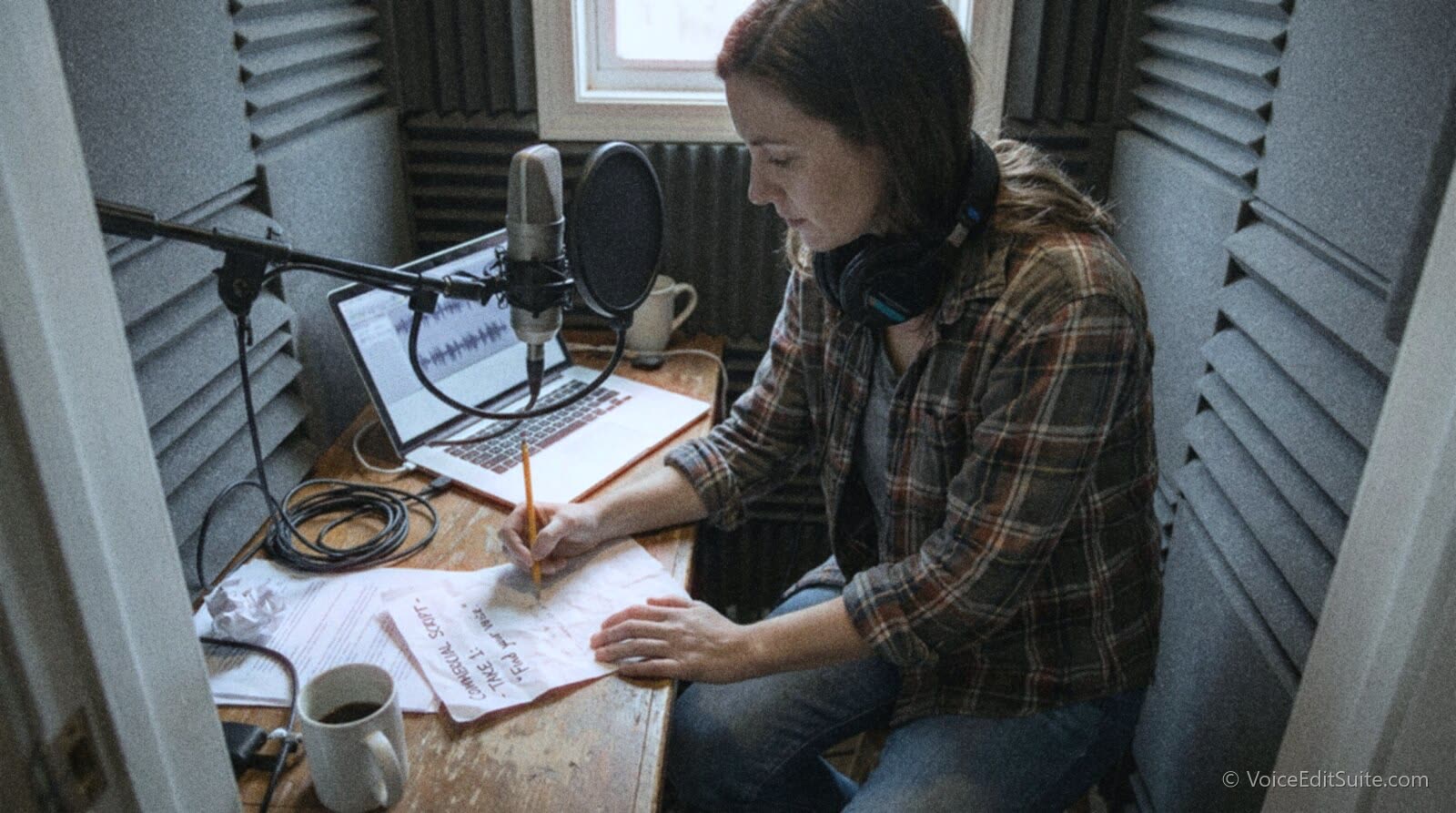
Naming the file
The file name is the slate that never gets cut. If the brief gives a naming convention, copy it character for character, including capitals, spaces and underscores: casting offices often sort files automatically, and a file that breaks the pattern can sink to the bottom of a list or get lost. If no convention is given, use your name, the project and the role or spot, separated by underscores: JordanAvery_HarborBank_30.mp3 or JordanAvery_CaptainReyes.wav.
- Put your full name first, so the file identifies you even when it is moved out of the email it arrived in.
- Avoid extra full stops. "Jordan.Avery.Audition.mp3" can confuse some systems about where the extension starts.
- Leave out take numbers, dates and words like "final" unless the brief asks for them. They mean something to you and nothing to casting.
- Deliver the format the brief asks for. When it does not say, an MP3 is the usual audition choice because it stays inside email and upload limits; save WAV for when it is requested.
The same habits apply to paid delivery, where the file names matter even more. Our guide to voice over file delivery formats and naming covers sample rates, bit depth and naming for finished work.
Video Slates and Self-Tapes
Voice actors are asked for on-camera self-tapes more often than they used to be, especially for commercials where the voice may also appear on screen, for performance capture in games, and for podcast and presenting roles. In the UK the slate on a tape is often called an ident. The principles are the same as audio, with a few additions from the casting directors who spoke on SAG-AFTRA's panels:
- Record in landscape unless the request says otherwise. SAG-AFTRA's self-tape guide is blunt that a tape is not an Instagram video.
- Frame the slate as asked. The 2019 panel's advice was a slate showing full body, a profile and a close-up from the chest up. The union's current TV/Theatrical parameters allow a head-and-shoulders and/or full-body shot in portrait orientation as part of the slate, so read the request for which one it wants.
- Look into the lens, stand still, and say your name the same way you would in audio: plainly, warmly, close to the tone of the scene.
- Send the slate as its own clip when the request allows it. Both SAG-AFTRA write-ups recommend this, because some casting offices cut slates and others use them for other purposes, and a separate file makes either choice easy.
- Skip titles, graphics and transitions. Editing exists to remove unwanted parts, not to add decoration.
Lighting, framing and sound for tapes are covered in our guide to camera and lighting for self-taped voice over auditions.
SAG-AFTRA Self-Tape Rules on Slates
Under the 2023 SAG-AFTRA TV/Theatrical/Streaming Agreement, the union introduced limits on what casting can ask for in a self-tape, and slates are one of them. The union's New England Local set the parameters out in February 2024: the slate can only include name, height, city of residence, current location, age and birthday for minors, information about special skills, and a head-and-shoulders and/or full-body shot in portrait orientation. The union's April 2024 contract bulletin lists the same package of protections, including limits on slates, and notes that they apply when a particular performer is asked to submit a self-tape, as opposed to an open casting notice that accepts self-tape submissions.
The same parameters cap first self-tapes at eight pages (twelve for later tapes, five for a first low-budget tape), require sides at least 48 hours before the deadline excluding weekends and holidays (72 hours for minors), say you cannot be asked to record above 720p or to use paid editing software or specific equipment, and say you cannot be required to memorize. SAG-AFTRA's commercials contracts have separate self-tape provisions: the union's December 2022 announcement listed bans on requiring special equipment or paid services, a requirement that sides arrive 24 hours in advance, and limits on multiple makeup or styling changes, angle changes in a take and multiple locations.
What this means for a voice-only audition
The slate list above comes from the TV/Theatrical/Streaming agreement, which covers on-camera work. Most voice over auditions, including commercial, animation and game work, sit under other contracts or none at all, and the brief is what governs them. The practical lesson still applies everywhere: a slate is identification, and nobody should be asking you for more personal information than they need to cast the role.
Slating for Podcasters
Podcasters meet slates in three places. The first is auditions: networks, production companies and brands casting a host, co-host or narrator often run a voice audition exactly like a voice over one, and the same rules apply. Slate if asked, in the format asked, and put your name in the file name either way.
The second is sponsor reads. If a sponsor or network asks for a sample host read before booking, treat it like a commercial audition: a name-and-spot slate if requested ("Sam Ortiz, Harbor Bank, sixty"), otherwise a clean file that opens on the read. Our guide to host-read podcast ads covers delivery specs for the finished read.
The third is the most practical: slating your own recording tracks. When each person in a remote interview records locally, a spoken slate and a clap at the top of every track ("Sam, episode 48, fourteenth of October", then a clap) does exactly what a film slate does. It tells the editor whose track it is and gives every file a sharp transient to line up on. It costs five seconds and saves the hunt for which "audio_final_2.wav" belongs to whom.
Slate Examples, Written Out
These are the words exactly as they would be spoken. The names, brands and characters are invented. Square brackets mark the pauses.
- Commercial, name only requested: "Jordan Avery." [beat] then the read.
- Commercial, two spots in one file: "Jordan Avery, Harbor Bank, thirty." [beat] read. [two seconds] "Harbor Bank, fifteen." [beat] read. Your name is said once, at the top.
- Animation, two roles requested in one file: "Jordan Avery. Captain Reyes." [beat] read. [two seconds] "Officer Lin." [beat] read.
- Agent submission, house format includes agency: "Jordan Avery, with [Agency Name], for Captain Reyes." [beat] read.
- Two takes requested: "Jordan Avery. Take one." [beat] read. [two seconds] "Take two." [beat] read.
- Slate at the end requested: read. [one second] "Jordan Avery." Keep it as plain as the opening version would be.
- On-camera self-tape, request lists name, height and location: to the lens, "Jordan Avery, five foot ten, based in Chicago." Then the framing the request asks for, as a separate clip if allowed.
- Audiobook audition, or no slate requested: nothing. The file opens on the first line of narration and is named JordanAvery_TitleOfBook.mp3.
↗ Try the tool
Performance Coach
Free to try: run your slate and opening line through Performance Coach and see your pace, energy and pitch measured across the cut. If the slate and the read register as two different deliveries in the data, you will see exactly where the seam is.
Open Performance Coach →Common Slating Mistakes
- Slating when the brief said not to, or not slating when it asked. Both tell casting you skimmed the instructions.
- Adding things nobody asked for: "Hi, thanks so much for listening", your website, your union status, a description of your take.
- A different voice for the slate and the read. The announcer slate followed by a conversational read is the classic version.
- Rushing or swallowing your name, especially the last name, which is the part casting needs to search for you.
- A stitched slate with a jump in room tone or mic distance where it was pasted on.
- Slating in character when the brief did not ask for it. It reads as a gimmick and casting cannot hear your real voice.
- Getting the role or spot name wrong, or using your own label instead of the brief's.
- Changing your format every week. Casting directors who hear you often should hear the same clean slate each time.
A slate that works is one nobody remembers. It does its single job, attaching your name to the read, and gets out of the way of the performance casting actually cares about. The same instinct, handle the mechanical part cleanly and let the read carry the file, is what makes a demo reel land too: the packaging should never be the thing anyone talks about.
Frequently asked questions
Do you slate a voice over audition?
Only if the brief or your agent asks for one. When asked, a slate is usually just your name. When nobody asks and the audition is audio only, start the file on the read and put your full name in the file name and the email.
What do you say in a voice over slate?
Exactly what the brief lists, in its order. The most common requests are your name alone, your name plus the role, your name plus the spot and length, or your name plus your agency. Leave out greetings, thanks and anything else not requested.
Should I say my agency in the slate?
Only when the brief or your agent asks for it. Agents differ: some want the agency named in every slate, others do not because the submission already comes from them. Ask your agent once and use their format every time.
Should I slate in character?
No, unless the brief asks for it. A slate is identification, so casting should hear your own voice. Let the tone lean toward the piece, but keep the character for the read.
Does the slate go at the beginning or the end?
The beginning, unless the brief says otherwise. Some casting directors ask for it at the end or in a separate file, and on-camera tapes often work best with the slate as its own clip. Follow the instruction exactly.
What if I mess up my slate?
Record the whole take again, slate included. Patching a new slate onto an old read usually leaves an audible seam, and re-recording takes seconds.
Sources and Further Reading
The union rules above are taken from SAG-AFTRA's own pages and bulletins as they read in October 2026. Contracts are renegotiated on a cycle, so check the union's current bulletin for your contract type before relying on a specific number.
- SAG-AFTRA Contract Bulletin: Self Tapes, TV/Theatrical/Streaming (April 2024): page limits, 48 and 72 hour turnarounds, no required memorizing, no paid editing software, limits on slates, and when the provisions apply.
- SAG-AFTRA: A Letter From Your New England Local President (February 2024): the full self-tape parameters from the 2023 TV/Theatrical/Streaming Agreement, including the list of what a slate can include and the 720p limit.
- SAG-AFTRA: Self-Tape Anatomy (August 2020): casting directors from SAG-AFTRA self-tape workshops on slates, landscape recording, editing and separate slate files.
- SAG-AFTRA: Casting Directors Dish Self-Tape Tips (September 2019): a Los Angeles casting director panel on slate tone, framing, scene labels and why slates get edited out.
- SAG-AFTRA: Added Self-Tape Protections and Regulations (December 2022): low-budget page limits and the self-tape provisions in the 2022 Commercials Contracts.