What Counts as Ghost Voice Work
Ghost or white-label voice work covers any project where the finished recording goes out under someone else's brand, with no public credit tying it back to you: a course platform that rebrands narration under its own name, a corporate training vendor that resells the same recorded modules to dozens of client companies, or an app that licenses a voice without the end user ever learning who recorded it. None of this is unusual or disreputable; it's a real, steady category of income. It does mean the contract terms matter more here than on credited commercial work, because the thing you'd normally fall back on if a dispute ever arose, a public, attributable body of work establishing what you recorded and when, simply doesn't exist for this kind of job by design.
What Actually Needs Checking Before You Sign
A written agreement specifying exactly how the recording can be reused matters more here than on any single commercial spot, because ghost work is often structured for exactly the kind of broad, ongoing resale that makes vague terms expensive later. Reading and negotiating voice over contracts covers the general skill; on ghost work specifically, it's worth confirming directly whether the client can resell or relicense the same recording to other companies beyond the original one you were hired by, since a training module recorded once and resold to dozens of unrelated client companies is a dramatically different deal than a single company's internal use only, even if the original session fee looked identical on the invoice.
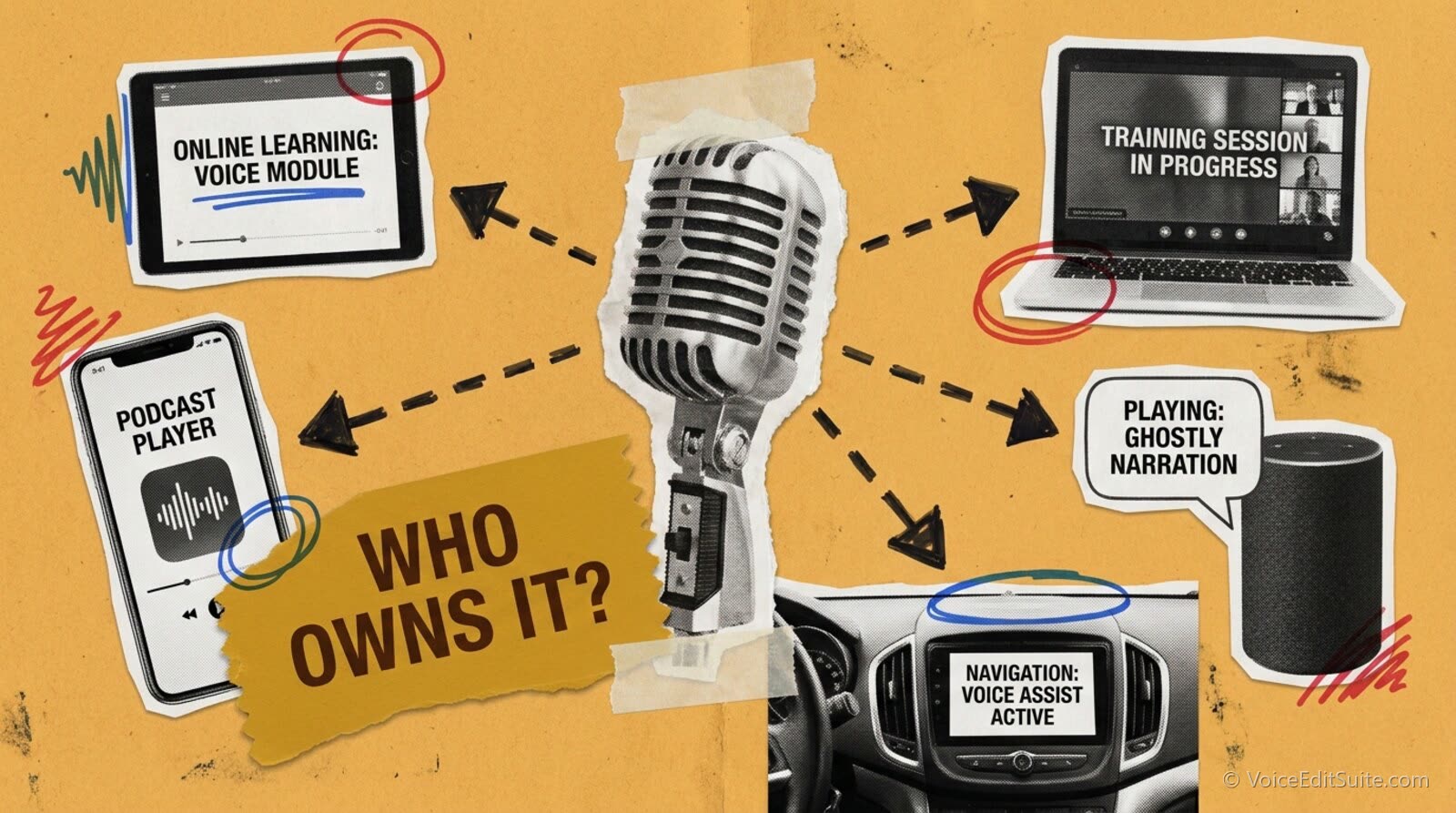
This same logic connects directly to usage fees and buyouts: a ghost-work buyout that covers unlimited resale to an unlimited number of future client companies is worth meaningfully more than one limited to a single company's internal use, and the contract should price that difference explicitly rather than treating all ghost work as one flat, undifferentiated category.
↗ Try the tool
Rate Calculator
A broad resale or relicensing right is worth real money, and it belongs in the quote, not given away by default. The Voice Over Rate Calculator helps you build that into your baseline before negotiating a buyout.
Open Rate Calculator →Why It's Still Genuinely Worth Doing
Ghost work's lack of public credit is also, for a lot of voice actors, exactly what makes it a reliable, steady revenue stream rather than a downside: corporate training vendors, course platforms, and app developers tend to need large volumes of consistent, professional narration on an ongoing basis, which is a genuinely different and often more stable kind of client relationship than a one-off, high-visibility commercial booking. Business structure and taxes for voice actors is worth reading if ghost work becomes a significant share of your income, since a steady volume of recurring, similarly structured contracts changes some of the practical bookkeeping compared to occasional, varied project work.
It's also worth deciding, before you need the answer under pressure, whether you're comfortable with a client using an AI voice clone of a recording you did under a ghost-work contract, since the absence of public attribution can make this kind of use harder to detect than it would be on credited work. Finding direct clients without a marketplace covers building the kind of direct relationship where these questions get asked and answered in a real conversation up front, rather than buried in boilerplate contract language neither side reads closely.
Frequently Asked Questions
Can I still use ghost work in my own demo reel or portfolio?
Only if the contract specifically allows it, and many ghost-work contracts don't, precisely because the client is paying partly for the anonymity itself. It's worth asking for that permission explicitly during negotiation if portfolio use matters to you, rather than assuming it and finding out otherwise later.
Does ghost work typically pay less than credited work?
Not necessarily, and sometimes the opposite, especially on higher-volume corporate or e-learning contracts, since the client is often paying for a large volume of consistent work rather than a single high-visibility placement. The fair price depends on the actual usage and resale terms, the same as any other voice over work.
Should AI training use be addressed separately from ordinary resale and relicensing?
Yes, explicitly. A general resale or relicensing clause written before AI voice cloning was a common concern may not clearly cover or exclude using your recording to train a voice model, so it's worth adding specific language addressing that use directly rather than assuming an older, general clause settles the question.