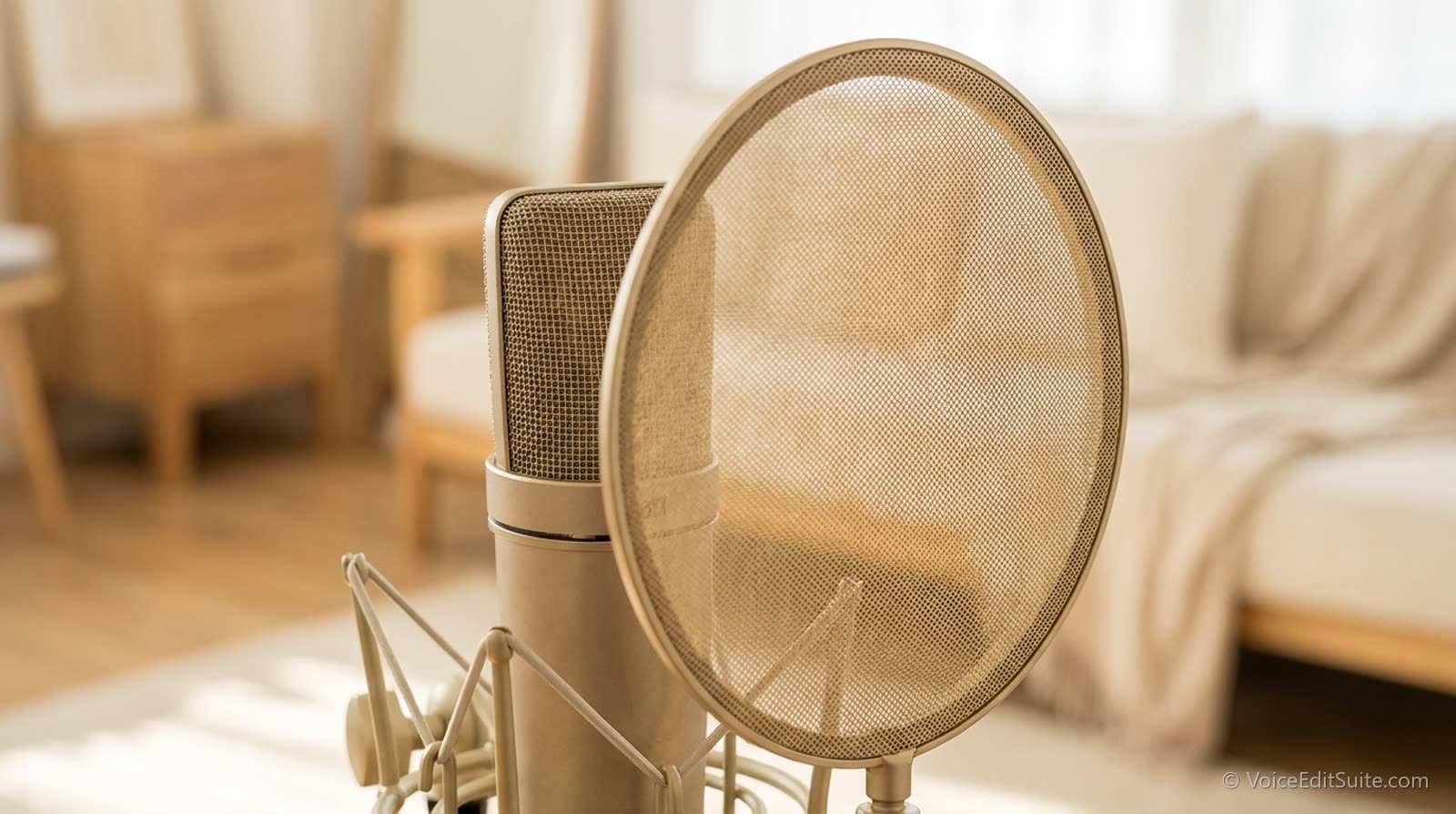
There is a moment every new podcaster has. The microphone arrived, the box said "studio quality", the unboxing was thrilling, and the first recording sounds like it was made in a bathroom by someone standing in the doorway. The natural conclusion is that the microphone is wrong. It almost never is. A microphone is a passive, honest thing: it reports what arrives at it, and what arrives at it is decided by five other things first.
This guide ranks those five by how often they turn out to be the culprit when a recording comes through our free room check, gives you the giveaway sound for each so you can diagnose your own by ear, and then the fix. Four of the five cost nothing. The fifth costs about ten dollars. The microphone is at the bottom of the list, and the section about it is mostly about why you probably do not need a new one.
1. The Room (Hollow, Distant, Ringing)
The giveaway: your voice sounds like it is coming from slightly behind you, a little hollow, and words with hard endings seem to hang in the air for a moment. If you clap once in the room and hear a short ring, that ring is on every syllable of your recording. Acousticians measure it as RT60, the time it takes a sound to die away by 60 decibels, and the published recommendation from NTi Audio, who make the meters, is 0.3 seconds for a recording studio against 0.4 to 0.6 for a classroom and 0.5 to 1.1 for an office. A bedroom with a window, a wardrobe door and a painted wall sits between the classroom and the office. A syllable lasts about a quarter of a second, so at 0.8 seconds the room is still saying your last two syllables while you say the next.
Why it tops the list: it is the one problem that cannot be fully fixed afterwards, because the echo is your own voice arriving late, mixed into the same frequencies as the direct sound. Software can reduce it and the best voice-separation tools do reasonably well, but a bare room at arm's length never becomes a booth in post. It has to be fixed at the take, and that is the good news, because the fix is soft things: a duvet over a clothes rack behind you, curtains drawn over the glass, a wardrobe opened so the clothes face you, a rug on a hard floor. Thick and heavy beats thin and foam every time; a box of thin acoustic tiles absorbs the frequencies that were never the problem.
There is also a cheat, and it is the single most effective thing on this page: get closer. Which brings us to cause two.
2. Distance (Thin, Far Away, More Room Than Voice)
The giveaway: the voice sounds small and the room sounds big, as if the microphone is listening to the room and you happen to be in it. This is the most common mistake in home recording and it comes from good manners: people sit back from a microphone the way they would sit back from a person. Radio presenters do the opposite. They work with the mic a hand's width from the mouth, and there is physics behind the habit.
Sound falls off with the square of the distance, which means every time you halve the gap between your mouth and the mic, your voice arrives 6 decibels louder. The room's reflections do not care where the mic is; they fill the space at roughly the same level everywhere. So going from forty centimetres (arm's length, where most people start) to ten centimetres (a hand's width) gains your voice 12 decibels over the room, for free, with the same microphone in the same bedroom. It is worth more than any purchase on this list, and it turns cause number one from a disaster into a footnote. Sit closer, angle the mic slightly off to one side so your breath goes past it rather than into it, and most "my mic sounds bad" complaints end here.
3. Gain (Hissy When Quiet, Crunchy When Loud)
The giveaway comes in two flavours. Turned too low, the recording is faint, and when you boost it afterwards a wash of hiss comes up with it, because you have amplified the microphone's own noise as much as your voice. Turned too high, the loud words crackle and flatten, because the signal hit the top of what the interface can capture and was clipped off. Clipping is permanent; there is no plugin that puts back a waveform that was never recorded.
The fix is a single number. Set the input gain so that your normal speech peaks around -12 dB on the meter, with the loudest, most excited moments never touching 0. That leaves headroom for a laugh and keeps the quiet words well above the hiss. If your interface has a gain knob, this is the only thing it is for; if it is a USB mic with a dial on the front, same rule. Set it once, speak at the volume you actually use on the show (not the polite test voice), and leave it alone.
The one-minute gain check
Record twenty seconds of your real speaking voice, including one laugh. Look at the peaks: around -12 dB is right, above -3 dB is too hot, below -24 dB is too low. Adjust, repeat. Two minutes, once, and it is done for the life of the setup.
4. The Floor (A Fan, a Fridge, a Hum Under Every Word)
The giveaway: turn the volume up during a pause and listen. A steady hiss, a low hum, a fan's whoosh, traffic, the fridge two rooms away. That is the noise floor, the sound of your recording when nobody is talking, and the listener hears it under every word whether they notice it or not. The audiobook industry, which grades thousands of home recordings a year, sets the bar at -60 dB or lower in the pauses; a bedroom with a laptop fan running typically measures around -45. That 15-decibel gap is the difference between a pause that sounds like silence and a pause that sounds like a kitchen.
Unlike the room, this one has a two-part fix and both parts work. First, at the source, before you record: laptop on a towel or a book so the fan is not coupling into the desk, phone in another room, fridge door checked, heating off for the hour, window shut. Most of the 15 decibels is things you can switch off. Second, in software, after the take: modern noise removal separates the voice from the noise rather than filtering frequencies, and done well it takes the floor down by 20 decibels or more without touching the tone of the voice. The rule is to demand numbers from whatever you use: the floor before and after, measured, so you are not trusting tired ears at the end of an edit.
5. Technique (Pops, Harsh S Sounds, Loud Breaths)
The giveaway: a thump on every "p" and "b", a hiss that spikes on every "s", and inhales as loud as the words. These are not room problems and not gain problems; they are what happens when a mouth is close to a microphone, which is where cause two just told you to put it. The fixes are the cheapest on the page. Speak past the mic rather than into it, so the puff of air from a plosive misses the capsule: an angle of thirty degrees or so is plenty. A pop filter, the mesh disc on a bendy arm, costs about ten dollars and stops the rest. Harsh "s" sounds respond to the same angle and to a slightly lower mic position, and the last of them can be softened in software with a de-esser.
Breaths are their own subject. Close-mic recording makes every inhale audible because a speech inhale is quick and sharp: research on breathing during speech finds people take about 14 breaths a minute while talking, each one squeezed into the pause before a phrase. The right treatment is to quieten them afterwards while leaving the pauses their full length, which is covered in Removing Breaths From a Podcast Without Making It Sound Robotic. Do not try to breathe less. Everybody who tries that sounds worse.
The Two-Minute Diagnosis
You can guess which of the five you have from the giveaways above, or you can measure it. Record thirty seconds of your normal speaking voice in your normal spot and run it through the free room check. It reports the echo tail, the noise floor, hum and sibilance as numbers, each with a plain-English fix, so instead of buying foam for a hum problem or a hum eliminator for an echo problem (both of which happen constantly) you spend the afternoon on the thing that is actually wrong. Then record the same thirty seconds again after the fix and see the number move. That before-and-after is the only proof that matters.
↗ Try the tool
Home Studio Analysis
Home Studio Analysis is free and needs no account: thirty seconds of your voice, a measured report on echo, noise floor, hum and sibilance, and a fix for each. It is the fastest way to find out whether the problem is the mic, the room, or neither.
Open Home Studio Analysis →What Each Fix Costs, and What It Moves
Put the fixes in order of cost and effect and a pattern appears that most people find hard to believe until they hear it: the free fixes are the big ones and the expensive fix is the small one.
Why does this matter beyond saving money? Because the research on what bad sound does to a listener is unusually clear. In a 2018 experiment published in Science Communication, psychologists Eryn Newman and Norbert Schwarz played people identical recordings of scientists in good and poor audio quality, and the poor-audio versions were rated as less intelligent, less likeable and less important, on identical content. Your listener's brain is using your sound to judge you before it judges your ideas. A free afternoon on the room and the mic distance is the cheapest credibility you will ever buy.
When It Actually Is the Microphone
It does happen, and there are three honest signs. First, the sound is clean, close and quiet but the tone is wrong for your voice: thin and bright on a deep voice, or muddy on a light one. That is a matching problem and a different mic, or a different pattern on the same mic, can fix it. Second, the microphone is a laptop's built-in or a headset designed for calls; those are built to make speech intelligible over a network, not to record it, and any dedicated mic is a step up. Third, the noise floor stays high after the room is quiet and the gain is right, which points at a cheap preamp or a broken cable rather than the capsule.
Even then, be careful what you buy. A more sensitive condenser microphone hears more of the room, which is the opposite of what a bedroom needs. For untreated spaces, a dynamic microphone that rejects sound from behind and the sides is usually the better tool, and it is often the cheaper one. Whatever you choose, run the free check before and after; if the numbers do not move, the money did not either.
Quick self-check
Which of the five is yours?
Three quick questions. The result tells you which cause to chase first.
Question 1 of 3
Clap once in your recording spot. What do you hear?
Frequently Asked Questions
Is a USB mic the reason I sound bad?
No. USB versus XLR changes how the mic connects, not how it sounds in a bad room at arm's length. A well-placed USB mic in a soft room beats an expensive XLR setup on a desk in a bare one. Fix the five causes first; the connector is not on the list.
Should I buy a condenser or a dynamic mic for a bedroom?
For an untreated room, dynamic. It hears less of the room and less of the fridge, and it forgives a hand's-width working distance. Condensers are more detailed and that detail includes every reflection off the wardrobe door. If you already own a condenser, the answer is closer and softer, not a swap.
Can software make a bad recording sound good?
It can make a noisy recording quiet and a quiet recording level, reliably and measurably. It can reduce echo but not remove it, and it cannot un-clip a recording that was too hot. Room, distance and gain are take-time problems; noise floor and technique can be rescued after. That is the whole reason for the order of this list.
Sources and Further Reading
- NTi Audio, Reverberation Time Measurement (RT60): the recommended RT60 figures by room type (studio 0.3 s, classroom 0.4 to 0.6 s, office 0.5 to 1.1 s).
- Newman, E. J., and Schwarz, N. (2018). Good Sound, Good Research: How Audio Quality Influences Perceptions of the Research and Researcher. Science Communication, 40(2): identical content rated less favourably in poor audio.
- Abrol, A. and colleagues (2025). Measuring Respiration Rate from Speech. Digital Biomarkers, 9(1): about 14 breaths per minute while speaking.
- The 6 dB per halving of distance figure is the inverse square law; the -60 dB noise-floor bar is the audiobook submission standard, see our ACX guide. The ranking of the five causes is our reading of recordings submitted to the free room check, not a formal survey.
- VoiceEditSuite, Recording a Podcast in a Bedroom and Does Bad Audio Make People Stop Listening?: the companion guides.
Corrections
Acoustics figures are NTi Audio's published recommendations; the study is quoted from the published paper; the cause ranking is ours and is labelled as such. Spot an error? Tell us through the contact page and we will correct it with a note.