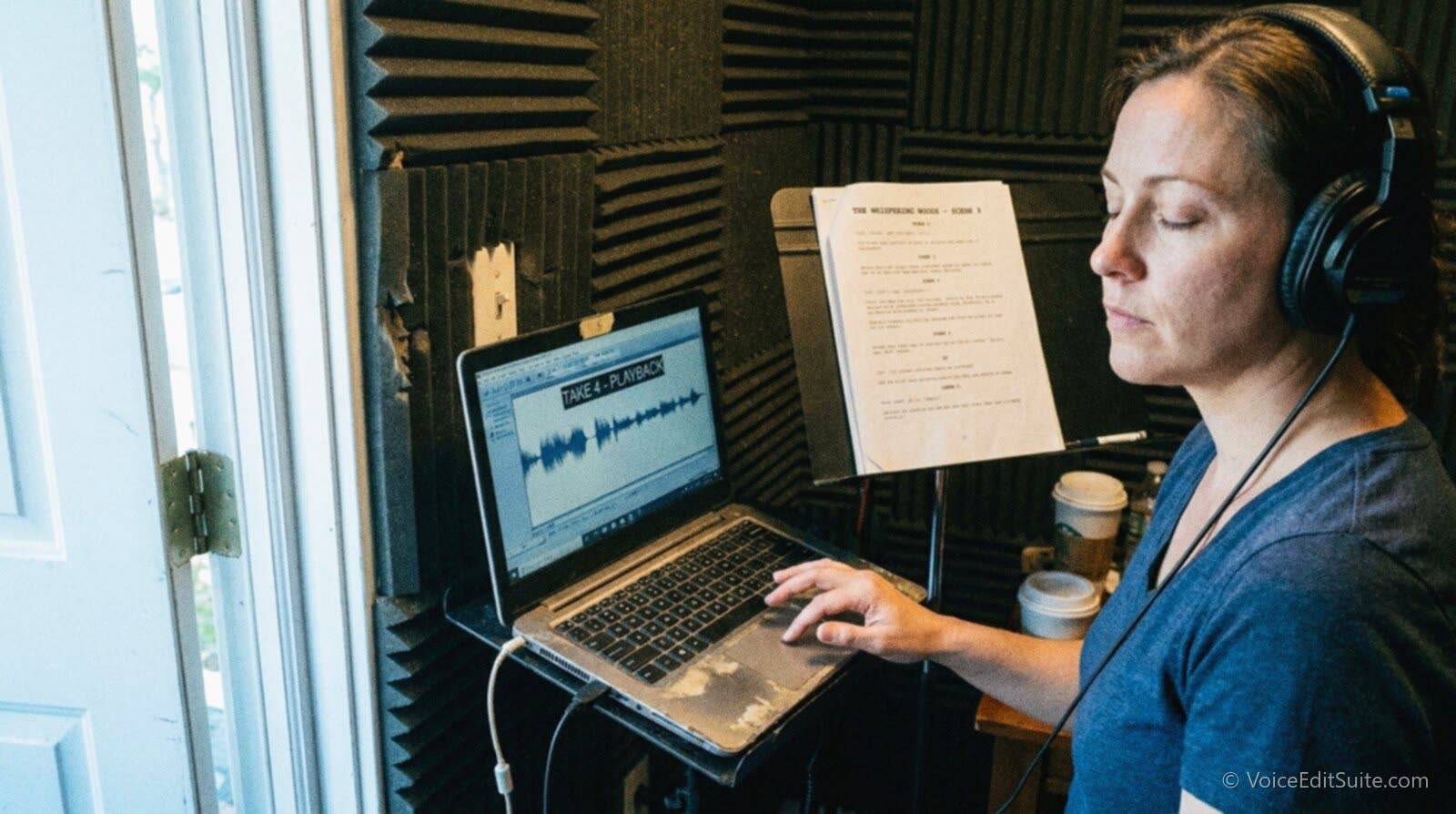
A large and growing share of voice over work gets recorded with no director on the call at all: a self-recorded audition, an e-learning module delivered against a written brief with no live feedback, an audiobook chapter produced entirely alone from first take to final file. In every one of those situations, you're doing two jobs at once, performing and directing, and the second job is genuinely harder to do well than most voice actors expect, because it requires judging your own work with the same honesty and specificity an outside director would bring, without the benefit of someone else's fresh ears.
The Two Opposite Ways This Goes Wrong
The first failure mode is being too easy on yourself: accepting a take because it's technically clean and you're tired of doing another pass, even though something about the read was a little flat or slightly off the brief. The second, less commonly discussed failure mode is being too harsh: endlessly re-recording a take that was already perfectly good, because an inner critic that's primed to find fault keeps manufacturing problems that a neutral outside listener, or even you yourself a day later, wouldn't actually notice. Both failure modes waste real time and energy, and most self-directed voice actors lean consistently toward one or the other rather than landing in the middle.
What Actually Fixes This
Listening back the next day, not the same day you recorded, is the single most effective fix for both failure modes at once, because a full night's distance genuinely changes what you notice; fatigue amplifies the harsh-critic mode in the moment, and familiarity with your own recent choices dulls the easy-acceptance mode just as much. When a next-day listen genuinely isn't possible because of a deadline, listening with a specific, narrow question in mind, "does this match the brief's tone," rather than a vague overall impression, produces a far more reliable judgment than an open-ended "does this sound good" pass.
Where Self-Judgment Actually Goes Wrong
The pattern that shows up consistently is that technical cleanliness, mouth noise, timing, obvious mistakes, is the easiest thing to judge accurately in your own work, because it's objective and doesn't depend on taste. Energy level, pacing, and emotional authenticity are much harder to judge fairly in yourself, because you were inside the performance as you gave it and that proximity distorts the judgment in ways a true outside listener wouldn't experience. Taking direction remotely is useful to revisit here specifically because it describes what a good outside director actually listens for; borrowing that same checklist for your own self-review closes a lot of this gap.
↗ Try the tool
Performance Coach
An outside, consistent read on your own takes is exactly what self-directed work is missing. Performance Coach's breakdown of every take gives you that second set of ears when there's genuinely nobody else on the call.
Open Performance Coach →Making Self-Direction a Repeatable Habit
Keeping a short, specific log of patterns you've caught yourself in before, a tendency to rush the ends of sentences, a habit of going too big on comedic reads, turns self-direction from a vague, mood-dependent judgment call into a checklist you can actually run against. Character bible and voice consistency applies the same logic to tracking a character's choices over a project; self-direction benefits from the same kind of written record applied to your own recurring tendencies instead.
Practicing self-direction deliberately on lower-stakes material, a practice script with nothing riding on it, rather than only ever doing it under the pressure of a real deadline, builds the skill in a calmer context where it's easier to actually notice what your judgment gets right and wrong. How to get better at cold reading is a good source of that kind of low-stakes practice material to self-direct against.
Frequently Asked Questions
Does performance anxiety make self-direction harder?
Often yes, since anxiety tends to push judgment toward the harsh-critic failure mode specifically. Performance anxiety before auditions is worth reading alongside this, since managing the anxiety itself often does as much for self-direction as any specific judgment technique.
Is it worth getting an occasional outside opinion even on self-directed work?
Yes, periodically, from a trusted peer, a coach, or any tool built for exactly this. An occasional outside check recalibrates your own internal judgment over time, so your unsupervised self-direction gets more reliable the more often it's checked against a genuine outside perspective.
How many takes should I realistically record before trusting my own judgment to pick one?
There's no fixed number that works for everyone, but a useful rule of thumb is to stop once two consecutive takes sound genuinely interchangeable to you, since that's a sign you've reached diminishing returns rather than genuine improvement with each additional pass.