
Audio description, sometimes called described video, narrates the visually essential action of a television show, film, or video, timed carefully into the natural pauses between dialogue lines, for viewers who are blind or have low vision. It is a real, specific voice-over discipline with its own technical constraints, and unlike most of the niches covered on this site, its demand is not driven primarily by market trend or client preference; it is driven substantially by federal regulation, with a legally mandated expansion schedule that runs for another decade.
What the FCC Actually Requires
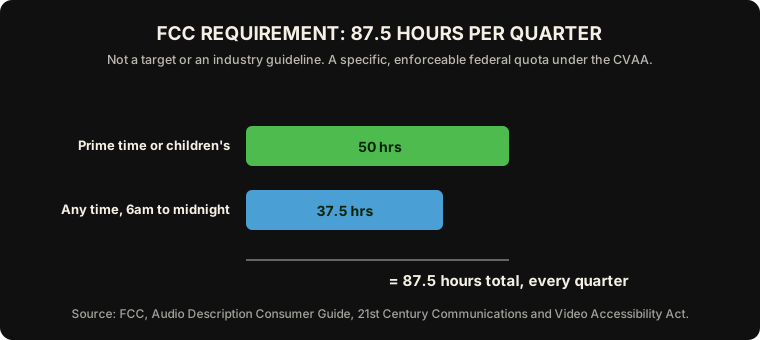
Under the 21st Century Communications and Video Accessibility Act, the FCC requires local ABC, CBS, Fox, and NBC affiliates in the largest television markets, plus cable and satellite systems serving 50,000 or more subscribers, to provide 87.5 hours of audio-described programming per calendar quarter. Of that, 50 hours must air during prime time or children's programming, and the remaining 37.5 hours may air any time between 6am and midnight. Five additional national non-broadcast networks are also designated for the requirement on a rotating basis reset every three years; as of the most recent reset (effective July 1, 2024), those networks are TLC, HGTV, Hallmark, TNT, and TBS, with TNT and TBS granted a limited waiver from the requirement through June 30, 2027.
A Rule That Expands Every Year Through 2035
What makes this niche unusually stable as a source of demand is the FCC's own phase-in schedule. Under its 2023 Second Report and Order, the agency is expanding the market-coverage requirement by 10 additional television markets (DMAs) every year, reaching the top 111 through 120 markets on January 1, 2026, and continuing at that pace until all 210 U.S. television markets are covered by January 1, 2035. Every single year for roughly the next decade, by federal rule already on the books, more local television markets will be legally required to carry a specific volume of audio-described programming than were required the year before, a demand curve set by regulation rather than by anyone's marketing budget or subscriber growth.
This is a real regulatory schedule, not a projection
Unlike a market-research growth forecast, this expansion schedule is an existing federal rule with specific dates already set. It is the kind of demand driver almost no other voice-over niche can point to with this much certainty.
What Access Advocates Have Said About It
The American Council of the Blind (ACB), through its Audio Description Project, has advocated for exactly this kind of expansion for years. When the FCC last significantly increased the requirement, in 2017, ACB President Kim Charlson said the organization was "excited the FCC adopted new rules providing a 75 percent increase in the number of hours of audio-described programming available," adding: "Every day, ACB strives to increase the equality of opportunity for people who are blind or visually impaired, and access to audio-described programming gives those of us who are blind a chance to enjoy entertainment with sighted friends and colleagues." ACB's then Executive Director Eric Bridges called it "a step forward for equal access," adding that the organization would "continue to seek out new pathways forward for further expansion of audio description wherever possible." In a survey of its own audio description program's users, ACB found that roughly three quarters of respondents, most of them blind or with low vision, said strongly that more audio-described programming is needed, a demand signal from the actual audience this regulation exists to serve.
What Makes the Performance Itself Different
Audio description is not simply reading a description script aloud; it is a specific narration discipline built around not competing with the program's own dialogue and sound design. Dr. Joel Snyder, founding director of ACB's Audio Description Project and one of the field's earliest describers, has described the work as "a way of making the visual verbal," using language that is "succinct, vivid, imaginative, to convey the visual image that's not fully accessible to a significant segment of the population: people who are blind or have low vision." SOVAS-recognized audio description narrator Kelly Brennan put the actual performance goal in similarly precise terms: "Audio Description works best when you barely notice it. That's the point. Its job is to support the story without steering it. To match the moment without overshadowing it. To be clear, steady, and present, without taking the spotlight."
- Scripts are timed to the frame, into gaps as short as a few seconds between lines of dialogue. There is no flexibility to run long; a description that does not fit the available gap gets cut or rewritten, not delivered slower.
- The read has to stay genuinely neutral, clear, and unhurried despite the tight timing, which is a real technical skill closer to precise, timed corporate and e-learning narration than to expressive character work, even though the visual content being described might be highly dramatic.
- Consistency across an entire series matters as much as it does in any long-running narration project, since the same describer and the same vocal choices often carry a show across many episodes or seasons.
An honest gap: no reliable market-size figure exists
Several figures for the size of the audio description services market circulate online, differing from each other by a factor of roughly twenty. None traced back to an established, credible market-research firm for this article, and none is repeated here. What is verifiable and cited above is the regulatory demand driver itself; a trustworthy independent market-size estimate for audio description specifically does not yet appear to exist publicly.
Breaking Into This Niche
Audio description work typically flows through specialized description studios and vendors who contract with broadcasters and streaming platforms to meet these requirements, rather than through general voice-over casting channels. A demo built specifically to show the neutral, precisely timed AD register, distinct from a general narration or commercial demo, is what these studios actually screen for, alongside genuine comfort working against a strict, unmovable timing constraint. It rewards many of the same instincts covered in a look at what makes medical and legal narration different: precision and neutrality over expressive range, and comfort with a highly specific, regulated production standard rather than open creative interpretation.
↗ Try the tool
The Cold Read
Free to try: audio description asks you to deliver precise, timed information inside a fixed, unforgiving window, exactly the muscle The Cold Read trains daily with a fresh script and a real time target.
Open The Cold Read →
Why This Niche Is Worth Taking Seriously
Most niches covered on this site respond to market trend, client budget, or platform growth, all of which can slow or reverse. Audio description is unusual in having its core demand driver set in advance by federal rule for the next decade, independent of advertising cycles or streaming subscriber counts. That does not make it easy to break into, the craft is genuinely specific and the client base is narrower than general commercial or corporate work, but it makes it one of the more legitimately regulation-stable corners of the profession, a distinction worth knowing whether or not it is a niche you actively pursue, especially set alongside the broader concern voice actors have raised about hearing and long-term vocal health across a long career built on many different kinds of narration.
Regulation as a Demand Floor
Audio description narration exists because a specific federal rule requires it, at a volume that expands every year through 2035 by a schedule already written into law. That is a genuinely different foundation than most of what drives demand elsewhere in this industry, and it is worth understanding on its own terms rather than filing it away as a small, niche curiosity.
Sources and Further Reading
- Federal Communications Commission, Audio Description Consumer Guide: the 87.5 hours per quarter requirement and its 50/37.5 hour split.
- Federal Communications Commission, FCC Reminds Broadcasters of Expansion of Audio Description to Additional TV Markets: the 10-DMA-per-year phase-in reaching all 210 markets by January 1, 2035.
- Federal Communications Commission, DA 24-184: Audio Description Non-Broadcast Network Designations: the current five designated non-broadcast networks and the TNT/TBS waiver.
- American Council of the Blind, Audio Description Project: background on ACB's advocacy and the Charlson, Bridges, and Snyder material referenced above.
- 3Play Media, Audio Description With Dr. Joel Snyder: the "making the visual verbal" quote.
- Kelly Brennan, kellybrennansvoice.com: the narrator's own description of the craft's performance goal.
- VoiceEditSuite, Medical and Legal Narration: What Makes This Niche Different: the companion piece on another precision-first narration niche.
Corrections
The ACB quotes above date to 2017, the last time the FCC significantly increased the audio description hourly requirement, and are presented as historical advocacy context rather than current statements. No credible, verifiable market-size figure for audio description services was found and none is claimed here. If you spot an error, tell us through the contact page and we will correct it.