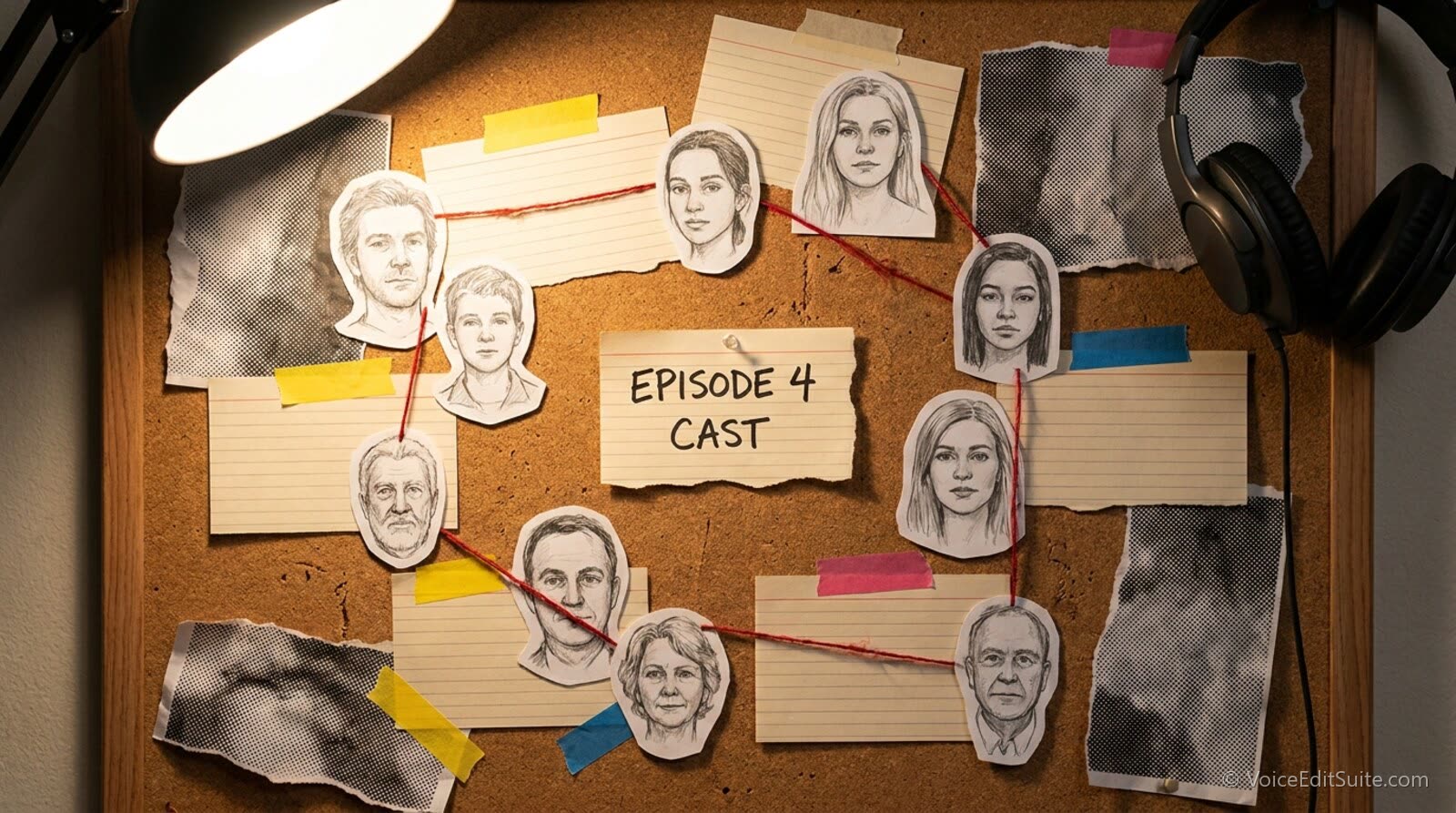
Producing an audio drama or fiction podcast means building a scripted, serialized story from the ground up: a cast of voices playing distinct characters, sound design and music carrying everything a narrator would otherwise describe, released as episodes in a podcast feed rather than one long audiobook file. That is a different job from full-cast audiobook narration, where the text already exists as a novel and the cast is reading an author's prose aloud. An audio drama has no narrator safety net. Every piece of exposition, every location change, every emotional beat has to be dramatized through performance and sound, which means casting, direction, and the soundscape all carry more structural weight than they do on a narrated book.
The obstacles for an independent producer are specific and solvable: finding and directing enough voice actors to fill a cast without a studio budget, keeping dialogue, effects, and music consistent across dozens of episodes recorded months apart, and deciding whether a serialized story should drop all at once or hold an audience weekly with a cliffhanger. For a voice actor on the outside looking in, this niche also works differently from booking commercial or corporate work. This guide works through all of it, built on what is actually documented about the format's growth and the awards bodies now recognizing it.
Casting Multiple Roles on an Indie Budget
A full ensemble is the single biggest line-item difference between an audio drama and almost any other kind of voice work, because you are not casting one voice, you are casting a world. The instinct on a tight budget is to either cast as few actors as possible, doubling everyone up, or to open one enormous casting call for every part at once and sort through the flood. Neither works well in practice. Doubling too aggressively makes scenes with three or four speaking characters sound thin and confusing, since a listener relies on vocal distinction alone to track who is talking. Casting everything at once wastes effort on parts that will not record for months, and it buries the roles that actually matter right now.
Tier the Cast Before You Post Anything
The fix is to separate the cast into tiers and treat each one differently, the same way the chart above lays it out. Leads, the one to three characters who carry most scenes, get cast first and their availability gets protected for the whole season; losing a lead mid-production is the single most disruptive thing that can happen to a serialized show. Recurring supporting roles can be recorded in blocks, several episodes' worth of lines in one or two sessions, which is both cheaper on studio time and kinder to an actor's schedule. Guest and one-off characters, the new faces a serialized story introduces almost every episode, are cast fresh and fast, usually through a short, specific casting call rather than a general search. A swing or multi-voice actor who can cover background lines, crowd murmurs, and one-line characters absorbs a surprising amount of a season's casting need without adding a new name to track at all.
- Write the casting brief around the tier, not the character alone. A one-off role needs a short, clear brief an actor can read in thirty seconds; a lead needs a fuller character breakdown, since you are asking for a season-long commitment, not one session.
- Cast leads with a longer audition, everything else with a shorter one. Asking a guest-role actor to prepare the same depth of audition as a lead wastes their time and yours, and it slows a casting process that should move fast for small parts.
- Decide your swing actor's limits up front. A swing voice working well does not mean asking them to carry a scene against a lead; keep them to genuinely small, interchangeable parts so the audience never notices the doubling.
Casting constraints at the start of a production are the norm, not a sign of doing it wrong. Rusty Quill's own account of how The Magnus Archives began describes a production that leaned on friends, family, and whatever recording space was on hand before the show built an audience able to support anything bigger. Most long-running indie audio dramas start exactly there: a small, resourceful cast making do, not a fully staffed studio from episode one. Character work for animation and games covers the two-dial system, pitch and pace, that makes one actor's two or three background voices read as genuinely distinct rather than as the same person doing a slightly different pitch.
↗ Try the tool
Audition Director
Casting four, six, or a dozen roles at once means comparing dozens of auditions against the same brief without losing track of who read what. Audition Director marks up each role's script with the read approach you're after, so every actor you invite is reading against the same clear brief, and you can line their takes up side by side instead of reconstructing context from memory for each one.
Open Audition Director →Building a Consistent Soundscape Across Episodes
A fiction podcast's sound has three layers that each need their own kind of consistency: the dialogue itself, the sound design, meaning Foley and ambience, and the music, usually built from stems rather than one finished track. Dialogue consistency is the hardest of the three on a remote production, because every actor is recording in a different room on different gear, and a listener's ear detects a change in room tone or mic character far faster than it detects a change in acting choice. A baseline standard the whole cast is asked to meet, even a basic one like recording in a small, soft-furnished room with a consistent distance from the mic, closes most of that gap before it ever reaches the mix.
Two well-known shows illustrate opposite but equally coherent approaches to the other two layers. The Magnus Archives built its early identity around a deliberately rough, found-footage sound, a recorder's close, slightly degraded voice against sparse, careful music, which suited both its budget and its concept as a set of statements being reviewed by an in-world archivist. The Penumbra Podcast, by contrast, leans on more consistent scoring and simpler, clearly signified sound effects, where each recurring object or location gets its own identifiable cue. Neither approach is more correct than the other; the point is that each show picked a sound-design logic early and applied it consistently, rather than letting the soundscape drift episode to episode based on whoever was mixing that week.
Keep a Living Character Bible for the Whole Production
The single habit that protects consistency across a long season, across a cast that may change mid-run, and across a production team that will not remember every decision from thirty episodes ago, is a written character bible. Character bible and voice consistency covers the practice in depth for an individual performer tracking their own choices; an audio drama needs the same discipline applied at the production level, covering not just each character's vocal choices but the sound design rules, the music themes tied to specific characters or locations, and the mix chain applied to every actor's dialogue.
- Record a short reference clip for every character at the end of every session, not just the lead roles, so a returning guest character three episodes later sounds like the same person.
- Keep stems, not just a final mixed music bed, so a cue can be rebalanced under a noisier scene later without re-composing it from scratch.
- Apply the same processing chain to every actor's dialogue, regardless of how clean or noisy their raw recording was, so the cast reads as one world rather than a patchwork of different rooms.
- Write down sound-design rules the first time you make them, such as which reverb means 'this scene is a memory' or which cue means a specific character has entered, since an inconsistent rule is worse than no rule at all.
Directing Remote Voice Actors Who Never Meet in Person
Most indie audio drama casts never share a room, and often never meet at all beyond a brief video call, if that. That changes what directing even means. In a studio, a director can let two actors play a scene off each other in real time and simply capture what happens. Scattered across time zones and home setups, a director has to manufacture that same sense of a scene partner being present, or the performances come back flat, each actor reading into a void with no one to react to.
A repeatable workflow is what actually solves this, because improvising a new process every episode is where remote casts fall apart: notes get lost, actors record against outdated context, and continuity drifts without anyone noticing until the mix.
The step that matters most, and the one new productions most often skip, is the guide track: a rough recording of the scene partner's lines, read by the director or by whichever actor recorded first, sent to the next actor before their own session. It is not a performance, just a placeholder with the right timing and the right emotional shape, but it gives an actor something real to react to instead of empty space on a page. Remote duet recording techniques go further for scenes where two actors genuinely need to be heard reacting to each other in real time, which is worth the scheduling cost for a handful of pivotal scenes even on an otherwise fully asynchronous production.
Building Chemistry Without a Shared Room
- Send a short assembled reference clip before a new actor's first session, cutting together the scene partners' guide-track reads so the new actor hears roughly how the scene will sound, not just how it reads on the page.
- Give scene context, not just lines. A one- or two-sentence synopsis of what just happened and what the character wants in this scene closes most of the gap a shared room would otherwise provide for free.
- Review and send notes the same day, before the actor has moved on mentally to the next role in their own schedule; a redirect that arrives a week later costs far more of everyone's time than a timestamped note sent within hours.
- Keep a short pickup session genuinely short. Scope it to the specific lines that need a redirect, not a full re-record, so a remote actor can fit it in without re-blocking their whole day.
None of this requires expensive tools, just discipline about sending the right material in the right order, every time, for every actor. A production that does this consistently across a season sounds like a cast that rehearsed together in a room. One that improvises it episode by episode sounds exactly like what it is: a set of strangers reading pages alone.
Release Schedule and Episode Structure for Serialized Fiction
Whether to release weekly or drop a full season at once is a real creative decision for scripted fiction, not just a scheduling preference, and the two formats reward different kinds of storytelling. A weekly release with a strong cliffhanger at the end of nearly every episode keeps a story in the public conversation between episodes and matches how serialized fiction has worked in every medium, radio drama included, for a century. A full-season drop treats the whole run as one long piece a listener can consume at their own pace, which works best for a tightly plotted, binge-friendly story where momentum matters more than week-to-week anticipation.
Edison Research's genre data on binge-listening gives a real, documented reason to take the binge option seriously for fiction specifically: fiction podcast fans have the highest binge-listening rate of any tracked genre, with 93 percent of weekly fiction listeners saying they have consumed multiple episodes of a podcast in one sitting, ahead of true crime at 90 percent and well ahead of news or technology listeners. That does not mean every fiction podcast should drop its whole season at once. A practical middle path many indie productions use is to release the first two or three episodes together, enough to let a new listener fall into the binge habit the data says fiction audiences already have, then settle into a weekly cadence for the rest of the season so the show stays in front of listeners between episodes.
- Build a hook into the end of nearly every episode, not just season finales; a mid-episode cliffhanger that resolves by the next scene teaches a listener the show rewards staying through to the end.
- Pick an episode length the story actually needs, rather than a round number; most serialized fiction podcasts settle somewhere in the twenty-to-forty-five-minute range, long enough to build a scene properly but short enough to finish in one sitting during a commute or a chore.
- Plan the season's structural turns before recording the first episode, since a full cast locked into a recording schedule has far less flexibility to rewrite around a plot problem discovered halfway through than a single narrator would.
- Release consistently once you start, whichever cadence you pick; the broader 2026 podcast numbers make clear that consistency, not any particular schedule, is what separates an active show from one of the many that goes quiet after a handful of episodes.
How a Voice Actor Actually Breaks Into This Niche
For a voice actor on the outside, audio drama and fiction podcasts reward a different kind of preparation than commercial or corporate booking does. Casters in this space are listening for character distinction, timing precision against other voices that are not in the room, and the ability to self-record a clean, consistent take without a studio engineer managing the session. A generic commercial demo tells a fiction producer almost nothing useful about any of that.
The most useful single thing a newer voice actor can build is a short, specific sampler, ninety seconds or less, voicing two or three clearly distinct characters rather than one polished generic read. It does not need to be a fully produced professional demo reel; indie fiction producers casting a guest role on no budget are not expecting one, and a clearly labeled sampler that shows real range is more useful to them than a single, expensively produced thirty-second spot that only proves you can read an ad well.
Education built specifically for this niche now exists, which is itself a sign the work has matured past a hobbyist corner of podcasting. Voice Over Atlanta, an established voice acting conference, runs a dedicated track called Getting Cast and Performing in Ensemble and Remote Sessions for Audio Drama, led by audio drama and audiobook director Sue Zizza, covering exactly the casting and remote-performance mechanics this guide has walked through. That a conference now devotes a standalone session to this specific skill set, separate from general voice acting or general audiobook narration, says something about how distinct the work has become.
- Say yes to small, one-off roles early. A guest part in someone else's show is a low-stakes way to prove you can deliver clean, consistent remote takes on someone else's schedule, and producers remember an actor who made their job easy.
- Follow the awards and nominees in this specific space. The Ambies, the Podcast Academy's annual awards, added a dedicated Best Fiction Podcast category; its 2025 winner, Tales of Fists & Fireballs from ADHx2, and the long-running, community-voted Audio Verse Awards, which has recognized audio fiction specifically since 2013, are both genuinely useful places to see who is actively producing and casting in this niche right now.
- Treat self-direction as a core skill, not a workaround. On a remote production, nobody is listening live to catch a flat line before it goes in the file; self-directing when nobody is on the call is worth building deliberately rather than leaving to instinct.
- Keep your room consistent, even on a budget. A producer tiering a cast, as covered above, will cut a guest actor whose room tone keeps changing before they cut one with a slightly less polished performance; consistency is easier to fix and harder to fake.
It is also worth being clear about what this niche is not. Full-cast audiobook narration is a related but separate specialty, reading an existing novel's prose rather than performing an original script, and it is having its own well-documented moment right now; the ensemble audiobook trend is worth reading alongside this guide if you are weighing which of the two related fields actually fits the work you want to do, since the preparation and the casting relationships that matter differ between them even though both put several voice actors in the same production.
Frequently Asked Questions
Can one voice actor play every role instead of casting a full ensemble?
For a short piece or a single scene, yes, using the pitch-and-pace system covered in the character voices guide linked above. For a full serialized season with multiple characters talking to each other in the same scene, a full cast reads far more convincingly to a listener than one actor switching voices, since the audience relies entirely on vocal distinction to track who is speaking with no visual cue to help.
How long should an audio drama episode be?
There is no fixed industry standard, but most serialized fiction podcasts land somewhere between twenty and forty-five minutes, long enough to build a real scene and a hook, short enough to finish in a single commute or chore. Let the scene structure decide the length rather than forcing every episode to a round number.
Should a new fiction podcast release weekly or drop the whole season at once?
Both work, and fiction audiences are unusually comfortable with bingeing: Edison Research found 93 percent of weekly fiction podcast listeners have binged multiple episodes in one sitting, the highest rate of any tracked genre. A common middle path is releasing the first two or three episodes together to let that binge habit kick in, then settling into a steady weekly cadence for the rest of the season to stay in front of listeners between releases.
What do I actually need to direct a remote audio drama cast well?
Nothing exotic: a clearly marked-up script sent ahead, a rough guide track so an actor has something to react to, a same-day review habit so notes arrive while the session is still fresh in the actor's mind, and a written character and sound-design bible so decisions made in episode three are still followed in episode thirty.
How does a voice actor actually get cast in these productions?
Mostly through relationships built by taking small, one-off roles well, rather than a single big open search. Producers tiering a cast, as covered above, tend to go back to actors who delivered clean, consistent remote takes on a guest role before trusting them with anything recurring. Following who is winning and nominated at the Ambies' fiction category and the Audio Verse Awards is also a genuinely useful way to see which producers are actively casting.
What does casting multiple roles cost an indie producer?
There is no published industry-wide rate for indie audio drama specifically, and budgets vary enormously by production. Tiering the cast, as covered above, is as much a cost-control decision as a creative one: a show with a handful of protected lead actors and a rotating set of cheap, fast-to-cast guest roles spends very differently than one trying to pay a large named cast for every episode.
Sources and Further Reading
- Edison Research, Not Just Netflix: Podcasts Bring the Binge to Audio, January 2024, as reported by Radio Ink and Inside Radio: the 93 percent fiction binge-listening figure and the genre comparison.
- Edison Research, Top Podcasts in Fiction, Music, and TV & Film Genres Based on U.S. Reach, March 2023: the top-ranked U.S. fiction podcasts by weekly reach, Welcome to Night Vale, Steeple Chase, and The NoSleep Podcast.
- The Podcast Academy, The Ambies 2025 Winners, March 2025, as reported by Reel Chicago and Audio Drama News: the Best Fiction Podcast category and its 2025 winner, Tales of Fists & Fireballs from ADHx2.
- Audio Verse Awards, About the Awards: the annual, community-voted awards for audio fiction and audio drama, running since 2013, and its eligibility rules requiring a fictional, performed production.
- Rusty Quill, The Magnus Archives production history: the show's own account of starting as a do-it-yourself production using whatever people and recording spaces were available.
- Voice Over Atlanta, Getting Cast and Performing in Ensemble and Remote Sessions for Audio Drama/Podcasts & Multi-Voice Audiobooks: a conference session dedicated to this specific casting and performance skill set, led by director Sue Zizza.
Corrections
Figures above are reproduced with their original attribution from Edison Research, the Podcast Academy, and the other named sources; where a source's own reporting changes, this guide will be updated with a note. Spot an error? Tell us through the contact page and we will correct it.