
This is not legal or tax advice, and nothing here substitutes for a conversation with a licensed accountant or attorney who knows your specific numbers and state. What follows is the shape of the decision most working voice actors eventually face, so that conversation starts from an informed place rather than a blank one.
You Are Already a Sole Proprietor
Anyone earning voice over income without having formally registered a different business structure is, by default, a sole proprietor in the eyes of the tax system. That means business income and personal income are the same thing legally: no separation, no liability shield, and taxes handled through a Schedule C attached to a personal return. It is the simplest structure, it costs nothing to maintain, and it is genuinely fine for a lot of early-career and part-time voice work, which is exactly why most people never revisit it.
The Self-Employment Tax Surprise
The single most common shock for a newer freelance voice actor is discovering that self-employment tax, covering the Social Security and Medicare contributions an employer would normally split with you, runs on top of regular income tax, not instead of it. That combined rate is a meaningfully larger bite out of freelance income than most people expect coming from a W-2 job, and it is exactly why setting rates that account for it matters, and why quarterly estimated payments exist in the first place.
- Quarterly estimated taxes exist because nobody is withholding for you. A regular job's employer withholds tax from every paycheck automatically; freelance income has no equivalent unless you pay estimated amounts yourself through the year.
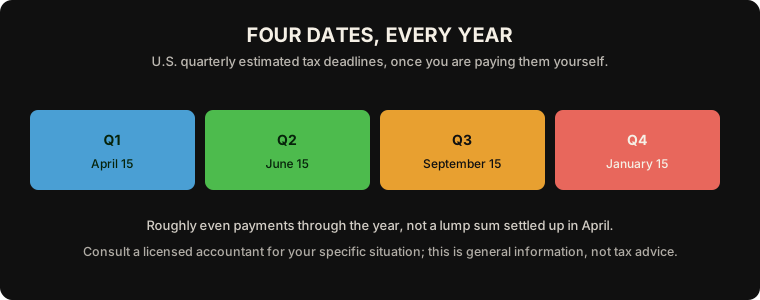
- Underpaying quarterly can trigger a penalty even if the full amount is paid at filing time. The requirement is roughly even payments through the year, not a lump sum settled up in April.
- Setting aside a fixed percentage of every payment as it arrives, into a separate account you do not touch, is the simplest system most working voice actors land on after the first surprising tax season.

When an LLC or S-Corp Actually Starts to Matter
An LLC (limited liability company) creates a legal separation between business and personal assets, which matters most if a client dispute or a contract issue ever escalates; it does not, by itself, change how you are taxed. An S-corp election is a tax classification, not a separate legal entity, and it becomes worth the added accounting overhead, payroll processing, more complex filing, generally once income reaches a level where splitting it between a salary and a distribution meaningfully reduces the self-employment tax owed. That threshold is genuinely specific to each person's numbers and state, which is exactly the point where a real accountant's advice is worth paying for rather than guessed at from a blog post.
The paperwork is not the hard part
Forming an LLC is a relatively simple filing in most states. The part worth real professional advice is the tax election and bookkeeping structure that follows it, since getting that wrong can cost more in accounting overhead than it saves.
Tracking Deductible Business Expenses
A home studio, interface and microphone purchases, a portion of home office space used exclusively for recording, software subscriptions, and professional development are all commonly deductible business expenses for a working voice actor, and keeping receipts and a simple running log through the year makes filing dramatically less painful than reconstructing a year of purchases in March. A separate business bank account and card, even as a sole proprietor with no legal requirement to have one, makes this bookkeeping far easier from day one.
↗ Try the tool
Rate Calculator
Free to try: the Rate Calculator builds a quote that accounts for real business costs, useful context to have on hand when you are deciding how much of your income actually needs to be set aside for taxes in the first place.
Open Rate Calculator →Set Up the System Once
The unglamorous, non-creative side of this business rewards a system built early: a separate account for tax savings, quarterly estimated payments on the calendar, and a running log of deductible expenses. None of it is complicated once it exists; almost all of the pain comes from not having it in place before the first tax season that actually matters.