
Children's audio work spans a wider range than it looks from outside: picture books meant to be read aloud alongside a physical copy, middle-grade chapter books meant to be listened to independently on a long car ride, and classroom or app-based educational audio meant to hold attention through a comprehension exercise. Each has its own real constraints, and treating all of it as "the same job, just for kids" misses what actually makes this niche distinct from general audiobook narration.
Pacing Runs Slower, Deliberately
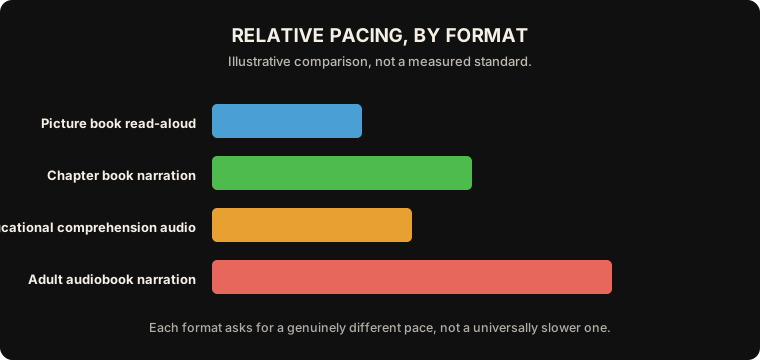
A picture book narrated for a read-aloud experience needs real space for a young listener, or a parent reading along, to look at the illustration on the page before the next line arrives. That is a fundamentally different pacing decision than an adult audiobook, where dead air is trimmed aggressively. Chapter books for slightly older listeners tighten this up but still generally run slower and with clearer sentence-ending emphasis than adult fiction, because comprehension, not just enjoyment, is part of the job.
- Picture books need real pause room for page-turns, whether or not the final product includes an audible chime cue for the transition.
- Sentence structure gets read more clearly, not more slowly overall. The goal is comprehension-friendly pacing, not a monotone crawl; energy and warmth still matter enormously to a young listener's attention.
- Character differentiation matters even more than in adult work, because young listeners rely on vocal distinction to track who is speaking far more than adult listeners, who can lean on narrative context clues an early reader has not developed yet.

Educational Audio Is Its Own Format Again
Audio built for a classroom or a learning app, listening comprehension passages, vocabulary exercises, guided reading prompts, asks for extremely clean, precisely paced, neutral-accent delivery, closer in some ways to corporate e-learning narration than to storytelling. Publishers and edtech producers in this space often specify exact timing between sentences to match a printed worksheet or an app's interaction points, which means precision matters as much as warmth here, and pickups have to match that timing exactly, not just the tone.
Know which register a project actually needs
A picture book publisher wanting a warm, animated bedtime-story voice and an edtech company wanting a neutral, precisely timed comprehension read are asking for genuinely different performances, both inside the broad category of "children's audio." Ask which one a project is before auditioning, rather than assuming.
Character Voices Return Across a Long Series
Children's chapter book series frequently run for many volumes recorded months or years apart, which makes keeping a character bible genuinely essential rather than a nice-to-have; a young reader who has heard a series' character voices dozens of times will notice an inconsistency an adult listener would miss entirely. Publishers in this space also tend to be more particular about strict fidelity to a house style guide for recurring character names and invented-world vocabulary, since a mispronounced fictional name in book four of a beloved series draws complaints in a way it rarely would in adult fiction.
↗ Try the tool
ACX Audiobook Prep
Free to try: ACX Audiobook Prep checks your files against the technical specs publishers and platforms require, useful for children's audio too, where a distributor's loudness and noise-floor requirements are just as strict as any adult title.
Open ACX Audiobook Prep →Breaking Into This Niche
Children's and educational publishers audition specifically for warmth, clarity, and character range rather than the grittier, adult-register reads that dominate general audiobook demo reels, so a demo built specifically for this niche matters more than trying to stretch a general fiction demo to cover it. A short, well-produced sample, one picture-book-style read and one clean educational-register read, demonstrates the specific range publishers in this space are actually listening for.
A Distinct Skill, Not a Softer Version of Narration
Children's and educational audio rewards a genuinely different set of choices than adult narration: deliberate pacing, sharper character distinction, and strict consistency across a long series. Treating it as its own discipline, worth its own demo and its own preparation, is what separates work that lands with young listeners from work that merely talks down to them.