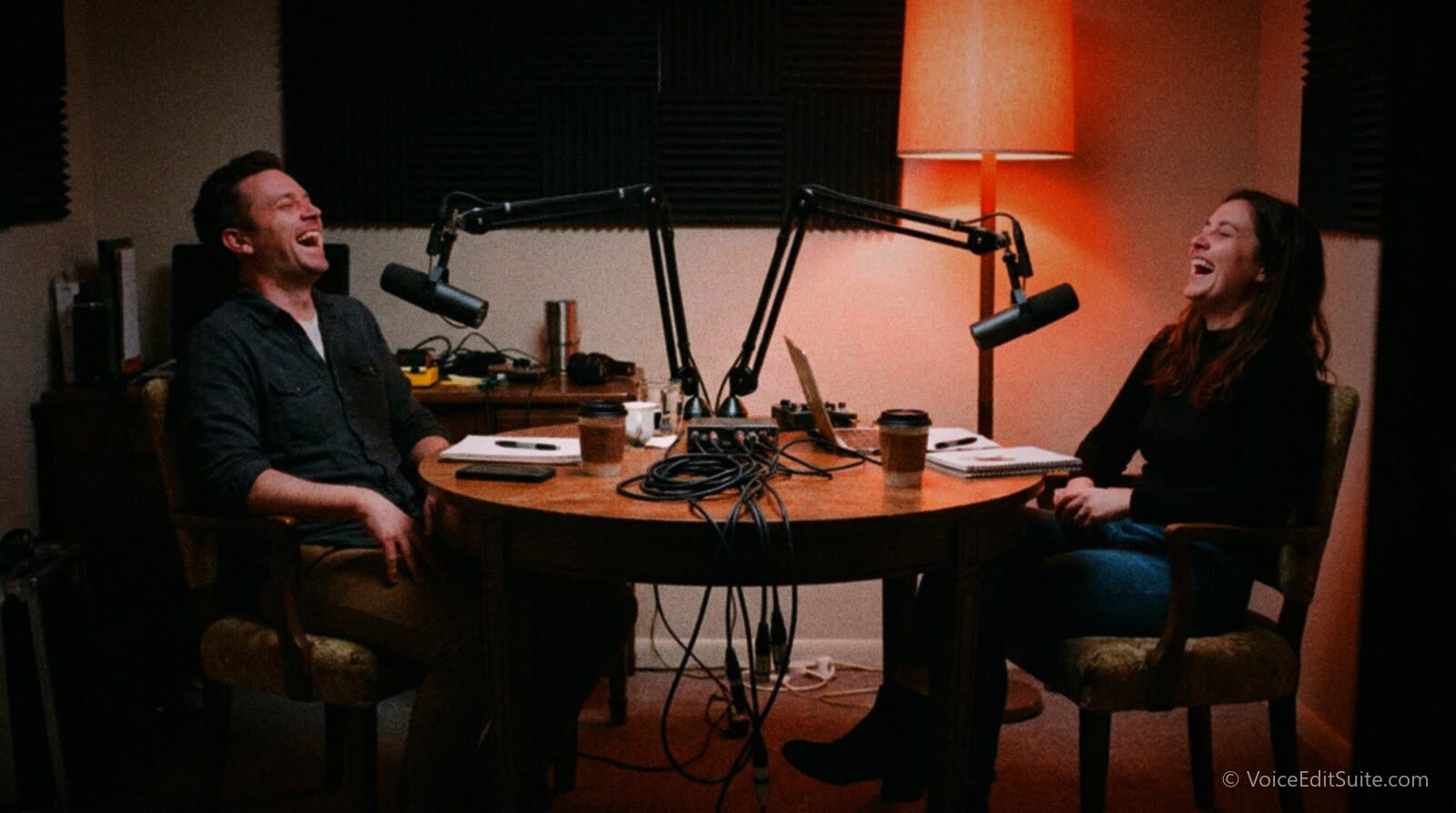
The short answer: a good podcast co-host pairing comes down to complementary on-air roles, not similar personalities, and a good two-host show survives long-term only if the production labor, the revenue, and the exit terms are written down before the first episode goes out, not negotiated after the first sponsorship check arrives. Chemistry gets a show started. A simple written agreement, settling who edits, who pitches sponsors, how revenue is split, and who owns the feed if one person walks away, is what keeps it running once there's actually money and a built-in audience at stake.
Chemistry and Complementary On-Air Roles
The strongest two-host podcasts rarely pair two people who sound alike. They pair complementary functions: one host who drives structure, keeps the show moving through its segments, and asks the questions that keep a guest on topic, and a second host who supplies color commentary, tangents, and reactions that make a show feel like a conversation rather than an interview script read aloud. Sports and talk radio have run this pairing for decades for a reason: a single host carrying both jobs at once, driving structure while also supplying spontaneous reaction, tends to sound more like a solo narration with pauses than an actual back-and-forth, and listeners notice the difference even when they can't name what's missing.
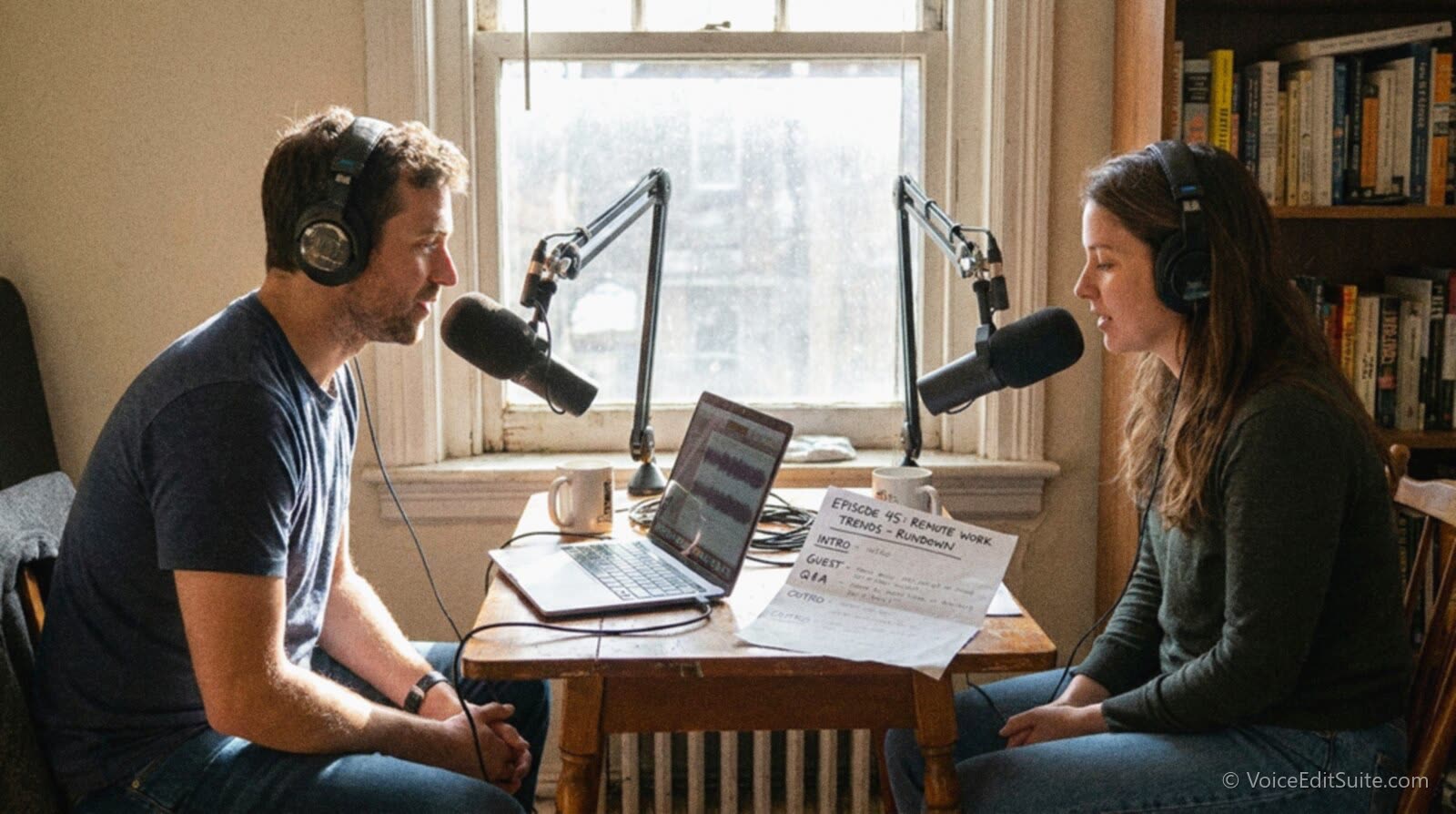
When you're choosing a co-host rather than inheriting one from an existing show, audition the working relationship before the public one. Record three or four full-length practice episodes, on a real topic you'd actually publish, before committing to a long-term arrangement, and listen back specifically for whether one person is doing most of the structural work while the other only reacts, or whether both default to the same role and end up competing for the same lane. A mismatch here is far easier to fix before a single episode goes public than after a few hundred listeners have already learned your show's rhythm. It's also worth testing the relationship under mild disagreement, not just easy agreement, since a pairing that only works when both hosts agree tends to fall apart the first time a guest or a topic actually divides them.
Splitting Production Labor and Revenue Fairly
Most co-host disputes don't start with an on-air disagreement. They start with an uneven, undiscussed split of the unpaid work that keeps a show running between episodes: who books guests, who edits the raw recording, who handles the RSS feed and hosting account, who pitches and manages sponsors, and who answers listener email. Two hosts splitting ad revenue evenly while one of them quietly does all the editing and sponsor outreach is a stable arrangement right up until it isn't, and by the time it becomes a problem, the resentment usually predates the actual argument by months. Naming each recurring task and who owns it, even informally in a shared document, does more to prevent a blowup than any amount of good faith between two people who are each assuming the other sees how much they're doing.
The Informal Partnership Risk
Two people who regularly create a show together, split its proceeds, and present themselves publicly as a joint venture can meet the legal definition of a general partnership whether or not they ever intended to form one and whether or not either of them ever signed anything calling it that. Cornell Law School's Legal Information Institute describes a general partnership as a voluntary association of two or more people carrying on a business for profit as co-owners, a description that fits most two-host podcasts with a shared feed and a shared sponsorship check more closely than either host probably realizes. The practical risk is not abstract: in a general partnership formed this way, each partner can typically be held personally liable for obligations the other partner enters into on the show's behalf, and in the absence of any written agreement, default state partnership rules, not whatever verbal understanding the two of you have, decide how profits, losses, and an eventual split actually get handled if the relationship sours. That default can mean an even split regardless of who did more of the editing, sponsor outreach, or production work, since the law generally assumes equal shares among partners unless a written agreement says otherwise.
A Simple Written Co-Host Agreement
A co-host agreement doesn't need to be a complicated legal document to do its job, and it doesn't need a lawyer's hourly rate behind every clause for a small show with modest sponsorship income. Nolo's legal encyclopedia, a widely used plain-language legal reference, makes the point plainly: you aren't legally required to have one, but without a written agreement your state's default partnership rules take over automatically, and those one-size-fits-all fallback rules are rarely a good fit for the specific arrangement two co-hosts actually want. What the agreement does need is a handful of things settled in writing before any real money or audience is at stake: who legally owns the show's name, RSS feed, and social accounts, which matters enormously if one host ever wants to leave and the other wants to keep the show running under the same name; exactly how revenue is split, gross or after expenses, and which expenses count against the split; who is responsible for which recurring production tasks, so neither person is quietly carrying more of the unpaid labor than the pay split reflects; how decisions get made when the two of you disagree about direction or a guest booking; and what happens if one host wants to leave, including whether the remaining host can keep the show under the same name and whether the departing host is owed anything for the audience and brand equity they helped build. Writing these five things down costs an afternoon. Resolving them without anything written down, after a disagreement has already soured the relationship, routinely costs the show itself.
Scheduling and Recording Logistics for Two People
A two-host show adds a real logistics problem that a solo show never has to solve: two calendars, two availability windows, and two people's energy levels have to line up at a consistent cadence for the show to actually ship on schedule. Recording in the same room, the approach covered in recording two voices in one room, tends to produce the most natural back-and-forth timing and the fewest technical headaches, since both hosts are reacting to the same live sound rather than to a slightly delayed feed, but it only works if both hosts can realistically get to the same physical space on a predictable schedule. Where that's not realistic, because co-hosts live in different cities or simply keep incompatible schedules, remote duet recording is the standard workaround: each host records locally on their own high-quality input while a video call carries the live conversation for timing and reaction, and the two local tracks get synced afterward rather than relying on a compressed call recording as the final audio.
Whichever setup you choose, lock in a recurring recording slot rather than scheduling episode by episode. A show that negotiates a new recording time every single week, around two increasingly busy calendars, tends to lose cadence first and consistency second, and an irregular publishing schedule is one of the more reliable ways to lose a growing audience's habit of showing up. A standing weekly or biweekly block, treated as a real commitment by both hosts rather than a flexible suggestion, does more for a show's long-term survival than almost any production upgrade.
On-Air Dynamics: Avoiding One Host Dominating Airtime
Even a well-matched pair of co-hosts can drift into an imbalance where one person ends up talking noticeably more than the other, usually without either of them noticing in the moment. It tends to happen gradually: a more naturally talkative host fills silences by default, a quieter host learns to wait for an opening that keeps getting smaller, and six months in, the balance has shifted in a way neither host actually chose. A quick, honest fix is a periodic listen-back specifically for airtime, not content, timing how much each host actually speaks across a full episode rather than trusting a gut impression of how the conversation felt. A pre-show rundown that assigns rough segments or questions to each host, rather than leaving every segment open to whoever jumps in first, also helps distribute airtime more evenly without making the conversation feel rehearsed. The goal isn't a rigid fifty-fifty split in every episode, since some topics genuinely favor one host's expertise, but a consistent pattern where one host dominates nearly every episode is usually a structural problem worth naming directly rather than a personality difference to work around indefinitely.
Level-Matching Two Distinct Voices in Post
Two people rarely produce the same raw loudness into a microphone, even with identical gear and identical mic distance. Vocal projection, proximity to the capsule, and natural speaking volume all vary person to person, which means a two-host episode almost always arrives at the edit with one track reading louder than the other before any processing happens at all. That's a different and more common problem than the one covered in when a podcast guest is quieter than the host, since a recurring co-host pairing has to solve the same balance problem every single episode rather than once per guest, which makes a repeatable, not just a one-off, leveling process worth setting up properly from the start.
Recording each host to a separate track, the practice covered in multi-track podcast recording, is what makes real level-matching possible in the first place, since a single mixed-down track gives you no way to adjust one host's level without also moving the other's. Once each voice is isolated, match loudness rather than peak volume: a brief glance at a peak meter tells you almost nothing about how loud a voice actually sounds to a listener, while a perceptual loudness measurement in LUFS reflects what an ear actually hears. Apple Podcasts' own published audio requirements call for an overall loudness target of around negative 16 LUFS, and several podcast hosting platforms' own publishing guidance, including Buzzsprout's, recommend a separate negative 19 LUFS target specifically for mono files, since a mono recording tends to read louder to the ear than a stereo one at the same technical level and needs to be brought down slightly to sound equivalent.
↗ Try the tool
Loudness Normalizer
Matching two co-hosts' levels by ear, episode after episode, is exactly the kind of repetitive technical task that drifts out of consistency over a long run, especially once a show is recording weekly and neither host has time to A/B test levels by hand before every upload. The Loudness Normalizer tool brings each host's track to a consistent, platform-ready loudness target automatically, so a guest segment, a solo cold open, and a full two-host conversation all land at the same perceived volume without a manual pass through every episode.
Open Loudness Normalizer →Loudness is only half the leveling job. Two distinct voices usually also need separate equalization and compression settings, since a deeper voice and a brighter one rarely respond the same way to one identical processing chain applied uniformly across both tracks. Treat each host's track as its own instrument during the mix, matched to sit at the same perceived loudness as the other, but each shaped individually first, rather than running both tracks through one shared preset and hoping the loudness match alone smooths over any remaining tonal mismatch.
Frequently Asked Questions
What if we start a show together and realize the chemistry just isn't there?
Address it directly and early rather than hoping it improves with more episodes, since audiences tend to notice a forced or uneven dynamic faster than the hosts themselves do. Sometimes the fix is structural, assigning clearer, more complementary roles rather than leaving both hosts to compete for the same interviewer lane, rather than a sign the partnership itself was a mistake. If a handful of honest conversations and a deliberate role adjustment don't change the dynamic, it's better for both the show and the friendship to end the arrangement on good terms early than to keep publishing a show that doesn't work and let resentment build.
Does any of this change with three or more co-hosts instead of two?
The same principles apply with more moving parts. Complementary roles become more important, not less, since three hosts all playing color commentary with no one driving structure tends to produce a chaotic, hard-to-follow show, and airtime imbalance is easier to fall into with more people competing for the same conversational space. The written agreement becomes more important too, since a three-way revenue and labor split has more ways to feel unfair than a two-way one, and default partnership law treats every additional partner the same way it treats the first two: as an equal co-owner unless a written agreement says otherwise.
One of us does most of the editing and production work. Should the revenue split reflect that?
That's a legitimate way to structure a split, and plenty of successful co-hosted shows don't divide ad revenue fifty-fifty specifically because the production labor isn't even. What matters is naming the imbalance honestly and agreeing on a split that accounts for it in writing, rather than defaulting to an even split by default inertia and letting the uneven workload quietly breed resentment. A common approach is paying a separate production fee to whichever host does the editing and technical work, off the top, before splitting the remaining revenue evenly, which compensates the labor directly rather than folding it invisibly into an equal split.
Do we need to form an LLC just to run a two-host podcast?
Not necessarily, but it's worth understanding the tradeoff rather than skipping the question entirely. Operating without any formal business structure defaults you into a general partnership once you're both contributing to and splitting the proceeds of the same show, which carries personal liability for obligations either of you enters into on the show's behalf. Forming an LLC adds a liability shield and some administrative overhead, while a written co-host agreement alone, without forming an entity, still lets you override the state's default partnership terms on splits, ownership, and exit without the added cost and paperwork. Many two-host shows start with just a written agreement and consider an LLC later once sponsorship revenue grows enough to justify it.
Is remote co-host recording actually as good as recording in the same room?
It can sound nearly as good technically, since each host records locally on their own equipment rather than through a lossy call connection, but the conversational timing is usually a little different, since there's a small amount of latency even on a fast connection that in-person recording never has. Most listeners won't consciously notice the difference in a well-produced remote episode, but hosts who've recorded both ways often describe in-person sessions as easier to find natural overlap and interruption timing in. If your schedules allow it, recording in person periodically, even if most episodes are remote, can help keep that chemistry sharp.
Sources and Further Reading
- Cornell Law School Legal Information Institute, Partnership (Wex): the definition of a general partnership and the personal liability that attaches to partners by default, cited in this guide's section on informal partnership risk.
- Nolo, Creating a Partnership Agreement: why a written partnership agreement is recommended even though it isn't legally required, and how state default rules fill the gap when there isn't one.
- National Public Media, Audio Continues to Break Listening Records: 2026 Infinite Dial Report: coverage of Edison Research's Infinite Dial 2026 study on U.S. podcast listening reach.
- Apple Podcasters, Audio Requirements: Apple's own published loudness and technical specifications for submitted podcast audio.
- Buzzsprout, Audio Quality and Volume Help: a podcast hosting platform's own published guidance on mono versus stereo loudness targets.