
A direct client is any business or individual that hires you without a casting platform, an agent, or a producer in between. The advantage is real: no commission, no algorithm deciding whether your profile gets seen, and a relationship you control end to end. The trade-off is equally real: you have to find these people yourself, and that means treating client development as an ongoing part of the job rather than something that happens automatically once you have a demo up somewhere.
Cold Email, Done to a Specific Person
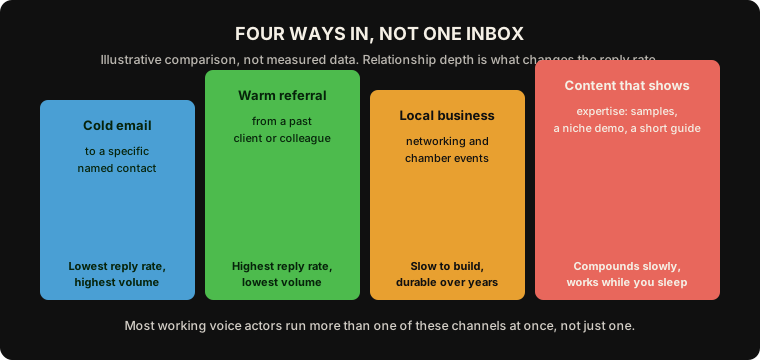
Cold outreach has a bad reputation because most of it is generic: a form letter sent to a general inbox, mentioning nothing specific about the recipient's actual business. The version that gets replies is slower to send and much more specific: a named contact, usually a marketing manager, a founder, or whoever owns content decisions at a small or mid-sized company, and a message that references something real about their current audio, an outdated explainer video, a training program that still uses text-to-speech, a podcast intro that sounds thin. Specificity is what separates outreach from spam in the recipient's mind, even though both technically arrive the same way.
- Send fewer, better-targeted emails rather than a large batch of generic ones. Ten emails that reference something specific about the recipient will outperform two hundred that do not.
- Lead with their problem, not your resume. A sentence about what sounds off in their current audio does more work than a paragraph about your experience.
- Attach or link one short, relevant sample, not a full demo reel. A thirty-second clip that sounds like what they need is a much smaller ask than a link to click.
- Follow up once, politely, after a week or two. Most replies to cold outreach come on the second contact, not the first.
Warm Referrals: The Highest-Converting Channel by Far
A referral from a past client or a colleague in an adjacent field, a video editor, a podcast producer, a marketing consultant, converts at a far higher rate than any cold approach, because the trust transfer already happened before you ever said a word. The practical version of this is simple and easy to skip: ask. At the end of a project that went well, a direct question, do you know anyone else who might need this, costs nothing and surfaces work that would never have come through a search. A written contract on the original project that clearly defines scope also makes referring you easier, since the person doing the referring can describe exactly what you do.
Local Business Networking: Slow, but It Compounds
Chambers of commerce, small business meetups, and local marketing groups are unglamorous and slow, and they are also where a meaningful share of long-term direct-client relationships actually start, particularly for corporate narration, local advertising, and explainer video work. Nobody hires a voice actor on the spot at a networking breakfast. What happens instead is that six months later, someone remembers the person who explained what a professional voice recording actually involves, and calls when the need finally shows up. This is a channel that rewards consistency over any single event.
Bring a business card that says what you actually do
"Voice actor" means little to a small business owner outside entertainment. A line describing what you record for businesses like theirs, training videos, phone systems, ads, does more work than a job title.
Content That Does the Introducing While You Are Not There
A short, focused piece of content, a niche demo built specifically for one industry, a one-page guide to writing a script for narration, a short video explaining what makes a training video sound professional, keeps working after you publish it, showing up in a search or getting shared by someone who found it useful. This channel compounds slowly and rewards specificity: a demo built for medical device training or audio description work reaches exactly the right small audience far better than a general demo aimed at everyone.
Whichever channel brings a lead in, the conversation that follows works the same way either way: a specific, defensible quote rather than a guess, and terms confirmed in writing before the session starts. Starting a voice over business without a finished demo reel yet does not block any of these channels either; a short, honest sample built for the specific outreach is often more persuasive than a polished but generic reel.

↗ Try the tool
Rate Calculator
Free to try: know your number before the first reply comes in. The Rate Calculator gives you a defensible, industry-grounded quote so a promising lead does not stall while you work out what to charge.
Open Rate Calculator →Run More Than One Channel at Once
No single channel above is reliable enough to build a business on alone; cold email is a numbers game, referrals depend on past work existing, networking takes months to pay off, and content takes even longer. Together, run consistently rather than in a single burst, they replace dependence on any one source of work with a handful of smaller, more durable ones, which is a genuinely different and steadier position to build a business from.