
The short answer: a dynamically inserted ad is not recorded into the podcast episode you are listening to. It is a separate audio file, held on the hosting platform's ad server, and it gets stitched into a marked slot in the episode at the exact moment your app or browser requests that episode to play or download. Two listeners who open the same episode an hour apart, in different cities, can hear two completely different ads in the same mid-roll break, and a five-year-old back-catalog episode can carry an ad for a sale running this week. That is the whole trick behind dynamic ad insertion (DAI), and it is also why podcast advertising now runs on auctions, targeting rules and measurement pipelines borrowed from the rest of digital advertising, layered on top of a format that used to be as simple as a host reading a script into a microphone.
This is a different question from how much a host-read ad pays or how to deliver one, which this guide to host-read pricing and delivery already covers in detail, and it is a different question from how big the podcast ad market has gotten, which the piece on the podcast ad boom covers. Here the question is mechanical: what actually happens inside the ad server when an episode is requested, what data that server is allowed to use to decide which ad to play, how an ad gets bought and sold programmatically rather than negotiated by email, how an industry with no cookies and no click-throughs measures whether any of it worked, and what all of that means for the person whose voice ends up in the read, whether that is a host, a hired voice actor, or increasingly, a cloned version of a host's own voice reading copy a human never spoke.
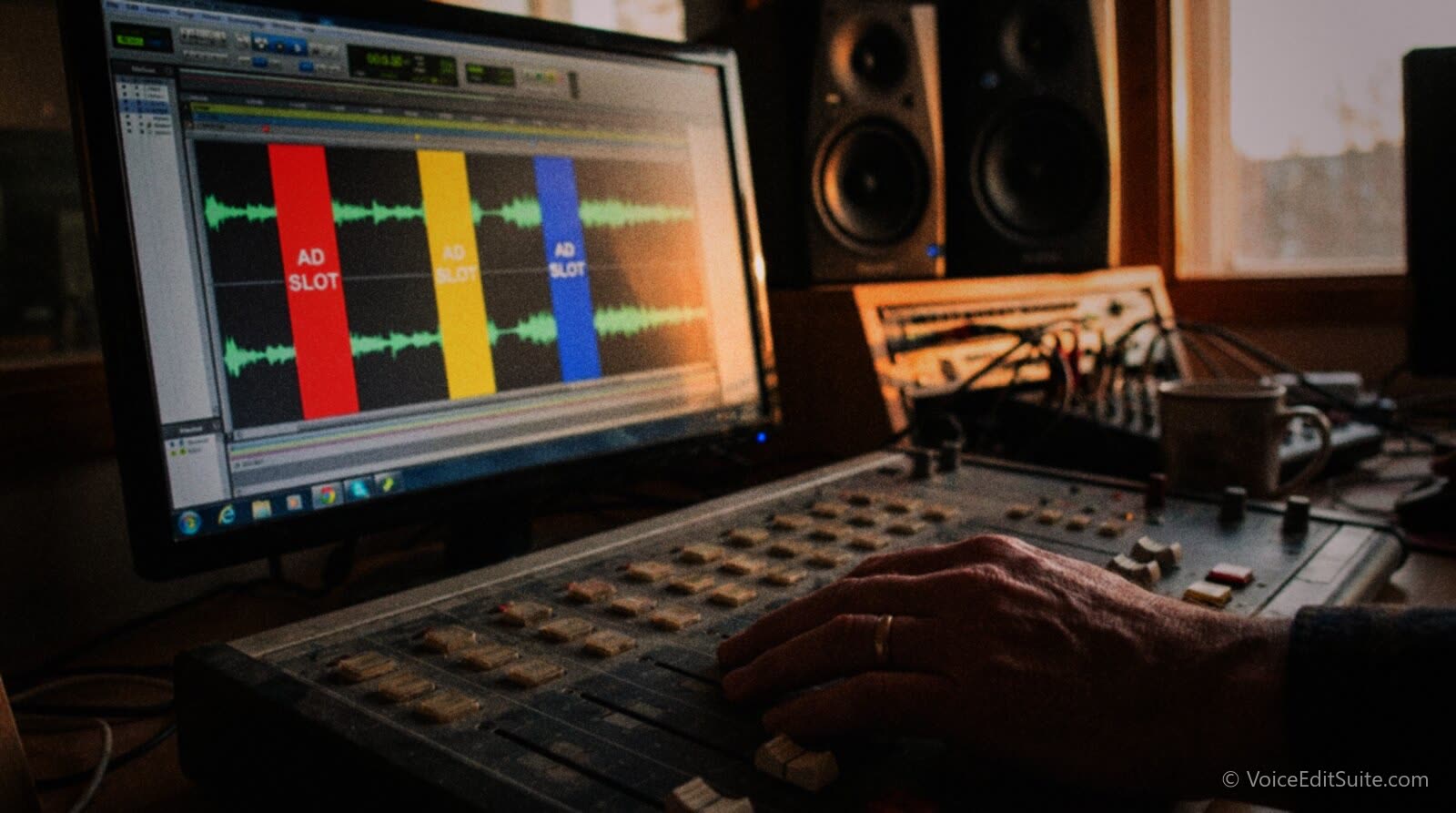
Inside the Ad Server: How a Dynamic Ad Actually Gets Inserted
Every episode built for dynamic insertion is really a template with deliberate gaps cut into it. Those gaps, the ad slots, get marked one of two ways. The common method is manual: whoever uploads the episode enters timecodes for where each slot sits, pre-roll, mid-roll, post-roll, when they publish it. The less common but increasingly automated method has the hosting platform detect the slot itself, either from an inaudible marker tone dropped into the file at export or by recognising the waveform of a standard sweeper or jingle that always precedes a break. Either way, the episode file that actually gets published rarely contains any ad audio at all. It contains silence, or a short placeholder, where the ad will later go.
The insertion itself happens almost entirely server-side. When a listener's app requests an episode, that request is not a simple file download; it is a request to the hosting platform's ad server, which reads a handful of signals off the request before it ever serves a byte of audio: the requester's IP address, a user-agent string that identifies the app and device, and the exact time the request arrived. The server checks which campaigns are currently live for that show, runs whatever targeting and pacing rules those campaigns carry, picks a winning ad for each marked slot, and stitches a complete, continuous audio file, episode plus ads, on the fly before handing it back. Client-side insertion, where the listening app itself does the stitching after being told which ad to fetch, exists but is far less common, mainly because it depends on the app's own code rather than the platform's server, which is harder to guarantee across every podcast app in use.
Why the same ad keeps showing up: caching
Stitching a unique file for every single request would be expensive at podcast scale, so ad servers cache. Once a particular combination has been assembled, a specific ad, in a specific slot, for a specific campaign targeting profile such as a region and a time window, the server can save that already-stitched segment and hand the same cached copy to the next matching request rather than rebuilding it from scratch. This is the practical reason a listener sometimes hears the same ad twice in close succession: not a bug, but a cache serving the same pre-built match to a device that looks, from the server's point of view, like the one it served a minute ago.
Contrast that with a baked-in read, which sits inside the master audio file exactly the way the episode's theme music does. No decision happens at play-time at all; the file a listener downloads in five years is byte-for-byte the file published on day one, ad included. That permanence is precisely why baked-in reads command the highest published rates, and the trade-offs of that format, including what it means for discount codes that expire while the episode lives on forever, are covered fully in the host-read pricing guide. What matters here is the opposite case: a dynamic slot is refilled independently every time it is requested, which is also why a read meant for dynamic insertion has to be able to stand completely alone, a point this guide returns to below.
One consequence worth sitting with: because the decision is made per request rather than per episode, dynamic insertion turns a podcast's entire back catalog into sellable inventory. An episode published four years ago, which nobody is actively promoting, can still carry a live, current campaign to anyone who finds it today, through exactly the same slot-and-stitch mechanism as a brand-new release. That is a large part of why dynamic insertion grew to dominate podcast ad revenue so quickly: it monetizes listening that would otherwise generate nothing at all.
What Data Actually Decides Which Ad You Hear
Podcast ad targeting is coarser than most people assume, because a podcast app generally cannot see inside itself the way a website can see inside a browser. The dominant, most reliable signal available at the moment of request is the IP address, which maps to a rough geographic area, a city or a region, not a street address, and is the backbone of basic geo-targeting: a national brand running different offers in different markets, or a local business buying inventory only within driving distance. On top of geography, the request itself reveals the device and app in plain text through its user-agent string, which lets a campaign target, say, listeners on a specific podcast app or a specific platform, and the timestamp of the request supports simple daypart or day-of-week pacing.
Audience demographic and interest targeting, the kind that sounds like it should require knowing who is actually listening, is almost always modeled rather than known. Most podcast platforms do not run persistent, logged-in profiles the way a social app does, so a campaign bought against "listeners likely to be interested in personal finance" is typically matched against a show's declared genre, survey-panel data extrapolated across its download base, or contextual signals pulled from an episode's own transcript and metadata, not against a verified fact about the individual device making the request. Vendors in this space are explicit that an IP address alone is reliable at household level but unreliable for anything as specific as an individual's age or gender, which is one reason the industry has been moving toward contextual targeting, inferring likely audience fit from a show's own content and RSS feed data, paired with anonymized, aggregate signals, rather than from any identifier tied to a person. AdsWizz's targeting partnership with NumberEight is explicit about the motivation: device identifiers are becoming less reliable as platforms and privacy regulation filter them out, so the targeting layer has to work without exchanging personally identifiable information at all.
"Programmatic audio is entering a new phase of maturity, where context and transparency are critical to unlocking its full potential."
That framing matters because it cuts against the popular image of podcast ad targeting as something uncomfortably close to surveillance. In practice, the signals an ad server actually has to work with at the moment of insertion are closer to what a radio station has always known about its audience, roughly where they are and roughly what they listen to, with a layer of statistical modeling on top, than to the individual browsing history a web ad exchange trades on. The targeting got more automated. It did not get as personal as the web.
Baked-In, Dynamic and Programmatic: Three Different Products, Not One
Trade coverage, and more than a few sponsors, talk about "podcast ads" as though they are one thing with one price. They are not. Baked-in, dynamically inserted episodic, dynamically inserted back-catalog and programmatic produced spots are financially and technically distinct products that happen to come out of the same microphone, and the difference changes what a sponsor is actually buying and what the person recording the read has to deliver.
- Baked-in host-read. Permanent, tied to one specific episode, can reference the episode's topic or guest, and commands the top published rate because of it.
- Dynamic episodic host-read. A separate file, inserted only into new episodes as they publish, cheaper per thousand downloads than baked-in because it is less permanent, but still tied to a live, current run of the show.
- Dynamic back-catalog or full-run. The same kind of separate file, but eligible to be inserted into any episode in the feed, old or new, which is why it is priced lowest per thousand even though its total reach, summed across years of catalog, can be enormous.
- Programmatic produced spot. Usually not read by the host at all. A professionally produced, announcer-style or voice-actor-read spot, bought through an auction and run across many shows in a network rather than negotiated with one host, which is where outside voice talent most directly enters the picture.
What recording for dynamic insertion actually requires
The mechanics above translate directly into a recording brief. A read meant for dynamic insertion has to assume nothing about where it will land: no "today", no mention of the episode's topic or guest, no reference to anything on either side of it in the break, because the ad server will drop it into a slot without knowing or caring what surrounds it. It needs a clean half-second of room tone at the head and tail so the stitch point is inaudible regardless of which episode it lands in. It needs to match the loudness not of one episode but of the show's average, since it may run across dozens of episodes with slightly different levels. And where a campaign buys multiple durations, 15, 30 and 60 seconds are the common lengths, that usually means recording genuinely separate reads rather than one script simply trimmed, because a trimmed 60 rarely lands as a clean, complete thought at 15.
That performance gap is worth taking seriously rather than waving away. Magellan AI's Q1 2026 measurement, reported by the trade outlet PPC Land, put the aggregate response rate for host-read ads at 2.45 percent against 1.93 percent for programmatic placements, a real but modest difference, not the wipeout a casual read of "host-read wins" headlines might suggest. Format mix data from Magellan's Q2 2025 benchmarks tells a similar story from the spend side: host-read ads took 46.7 percent of podcast ad spend that quarter, while "scale" executions, Magellan's term for programmatic and run-of-network buys, took 26.8 percent. Both formats are large; neither has displaced the other.
How Programmatic Podcast Ad Buying Actually Works
Dynamic ad insertion is the plumbing. Programmatic buying is what runs through that plumbing once it exists, and the two get conflated constantly because one is a precondition for the other: a show cannot be bought programmatically unless its inventory is dynamically insertable, but plenty of dynamically inserted inventory is still sold the old way, by a sales rep, not through an automated auction. On the sell side, a hosting platform or network exposes its inventory through a supply-side platform (SSP); audio-specific examples include Triton Digital and AdsWizz. On the buy side, an agency or brand bids on that inventory through a demand-side platform (DSP), either an audio specialist or a general-purpose one such as The Trade Desk. Triton describes itself as connected to roughly 30 different DSPs, meaning a single ad slot can draw 30 simultaneous bids in one real-time auction, with the highest bid winning the impression.
Three distinct routes exist inside that structure, and buyers choose among them depending on how much control they want. The open marketplace is a real-time auction on unreserved inventory, available to any DSP. Private marketplace (PMP) deals are curated and invite-only: a publisher packages specific inventory, often a premium show or a genre bundle, and hands a buyer a deal ID to bid against inside their own DSP, which keeps the auction mechanics but removes the uncertainty of the open market. Programmatic guaranteed sits closest to a traditional direct buy, reserving specific inventory at a fixed price but still transacting through the programmatic pipes rather than a manual order form. Buyers are not obligated to take everything routed to them; they bid only on inventory that clears their own targeting and suitability rules.
"While many advertisers will still continue to focus on host endorsement, nearly all advertisers I'm speaking to are exploring programmatic opportunities at a minimum to expand their direct relationships."
That caution from a buyer's perspective is not new, and it has not fully gone away. Buyers quoted in earlier trade coverage described going through a DSP for podcast inventory as, in one agency executive's words reported by Digiday, simply "not appealing" compared with calling a network directly, largely because podcast content is harder to pre-screen for brand suitability than a web page: a keyword and category filter can comb a page of text in milliseconds, but parsing thousands of hours of audio transcripts for brand-unsafe content at the same speed is a newer, less mature capability, one that specialist pre-bid suitability vendors have only recently started to offer at scale. Ad load is the other live worry. Reporting this year around the IAB's Podcast Upfront and the Sounds Profitable Business Summit cited Podscribe's warning that impression-based programmatic buys can expose a single listener to more than 15 ads across a campaign's run, compared with roughly one ad per episode in a typical direct-sold deal, precisely the kind of ad-load creep that has dogged programmatic display advertising for a decade and that podcast buyers are now trying to get ahead of rather than repeat.
Political advertising leans on this programmatic, geo-targeted layer especially hard, since a campaign's entire value proposition depends on reaching specific districts and media markets rather than a national audience, which is covered in more detail in the piece on 2026 midterm political ad spending. The same auction-and-targeting machinery that lets a sneaker brand run a city-specific promo is exactly what lets a state House candidate buy inventory only in their own district.
Measuring an Ad Nobody Clicked On
Podcast advertising has one structural problem that the rest of digital advertising mostly solved decades ago: there is no click. A listener hearing a mid-roll ad while driving or walking the dog cannot tap anything, and a podcast app has no cookie to drop and no pixel to fire the way a web page does. Attribution vendors have built around that gap rather than through it, using what the industry calls exposure matching instead of click tracking: the advertiser's own website carries a tracking pixel that logs every visit, the podcast platform or hosting network separately logs which devices downloaded or streamed the episode carrying the ad, and the two lists get matched, usually at the household or device level through IP address, so that a visit arriving from the same household shortly after a known ad exposure can be credited to that ad. Podscribe, one of the most detailed vendors in this space, layers household-level IP matching with pixel-based web attribution and describes itself as IAB-certified, a vendor claim worth noting as such rather than treating as independent verification.
Exposure matching alone cannot answer the harder question, whether the ad caused the visit or merely preceded it, so the more rigorous attribution vendors run incrementality tests on top: synthetic control groups built to resemble the exposed audience statistically, randomized holdouts where a portion of otherwise-eligible listeners is deliberately withheld from the campaign, and PSA (public service announcement) controls, where a neutral message runs in place of the real ad for a comparison group, so any lift in the exposed group above the control can be attributed to the ad itself rather than to whatever those listeners were already going to do. This is slower and more expensive than a click-through report, but it is the only way to separate a genuine causal effect from the simple fact that people who already like a brand also tend to listen to certain kinds of podcasts.
Programmatic buying added its own, narrower measurement problem on top of the attribution question: transparency about where an ad actually ran. For years, an advertiser buying podcast inventory through a DSP typically saw only DSP-level aggregated delivery data, not which specific publisher or show had served any given impression, an opacity industry coverage has literally called a black box. Podscribe's publisher-level reporting update, released in mid-2025, was built specifically to close that gap, giving DSP buyers visibility into exactly which shows served their programmatic impressions rather than a single pooled number. That kind of plumbing work, unglamorous compared to the targeting story, is arguably more consequential for whether programmatic podcast spend keeps growing, because buyers who cannot see what they bought tend not to keep buying it.
What This Means for the Voice in the Read
Trade coverage of programmatic and dynamic insertion often frames the shift as a threat to the host-read format generally, and by extension to anyone whose income depends on a human voice reading an ad. The more precise read of the data above is narrower than that framing suggests. The pressure concentrates on the generic, interchangeable produced spot, the kind that was never going to pay a premium rate anyway, while a strong, trusted host-read holds up well enough that Magellan's own numbers still show it taking the largest single slice of podcast ad spend. What dynamic insertion and programmatic buying actually do is open a real, if narrower, lane for professional voice talent on the produced side of the business: as one agency specializing in produced podcast spots has argued, programmatic's lower buy-in cost can free up budget that goes toward professional voice talent, sound design and music rather than toward a bare-bones read, and because the spot is fully scripted rather than improvised by a host, the brand retains total control over exactly which voice represents it and exactly what gets said.
The genuinely new wrinkle, and the one worth watching closely, sits at the intersection of dynamic insertion and voice cloning rather than at voice-over work generally. In mid-2025, Triton Digital's Spreaker platform partnered with the voice-AI company ekoz.ai to sell programmatic host-read inventory built on cloned host voices: a participating host records a voice sample and opts in, an advertiser supplies talking points rather than a finished script, the system drafts copy in that host's style and voice, and the host reviews and approves the finished read before it airs. Triton has said the product is already delivering millions of impressions through private marketplace deals with selected shows. It is worth being precise about what this is and is not: it clones a consenting host's own voice for that host's own show, which is a different proposition from an outside voice actor losing a booking to a synthetic read, but it is also ad-tech explicitly industrializing the one format, the host-read, that has always been sold on the premise that a real person is actually talking. Where that leaves the premium for an authentic, unscripted host endorsement is an open question the market has not settled yet.
For voice actors specifically, the practical upshot is to know which of the four products above you are actually being booked for before you quote it. A programmatic produced spot is ordinary voice-over work: price it with normal usage terms, the way you would any commercial, since it is scripted, standalone, and likely to run across many shows rather than build a personal relationship with one host's audience. Independent and small shows increasingly monetize their entire back catalog through exactly this kind of dynamic, programmatic inventory rather than through direct sponsor relationships, which is a meaningful new source of produced-spot demand even from shows too small to ever negotiate a bespoke host read. And local and regional advertisers, who used to have to find and pitch individual shows one at a time, can now buy geo-targeted programmatic inventory across a whole network in one purchase, which is good news for voice talent who can deliver a clean, standalone, properly tagged read fast, since that read may need to clear review and start running within days of being bought.
↗ Try the tool
Auto Clean Up
A read built for dynamic insertion has to be a clean, standalone segment: no episode references, a clean half-second of room tone at each end, and levels matched to your other inserts rather than to one particular episode. Auto Clean Up transcribes the read, lets you trim it to exactly that shape, and quietens breaths and fillers in place without touching the pacing, so the file you deliver drops into any ad server's slot without a seam.
Open Auto Clean Up →The Money Behind the Shift
None of this mechanics would matter commercially if the dollars behind it were small, and they are not. The IAB and PwC's Internet Advertising Revenue Report for full-year 2025, published in April 2026, put US podcast advertising revenue at $2.862 billion, up 17.6 percent year over year, extending a run that started at just $105.7 million in 2015. The IAB's own forecast puts 2026 past $3 billion domestically and global podcast ad spend past $5 billion. Dynamic insertion is not a side feature of that growth; it is close to the whole engine of it. The IAB and PwC's 2021 podcast-specific study, the most recent edition we could find that breaks the figure out this way, found dynamically inserted ads already made up 84 percent of podcast ad revenue that year, with 84 percent of host-read ads themselves served dynamically rather than baked in. Every more recent figure available suggests that share has only grown since.
Those two panels are measuring genuinely different things, and conflating them is a common source of confusion in coverage of this market. The IAB and PwC figure is a census-style revenue estimate, built from data the IAB's member companies and PwC's survey report in, meant to capture total US podcast advertising dollars however they were sold. Magellan AI's figures come from a different method entirely: an ad-tech company's own monitoring of actual spots detected running across tracked shows, extrapolated into a spend estimate and a format mix. Both are real, defensible numbers from credible sources, and both get cited constantly in trade coverage as though they are measuring the identical thing. They are not, which is worth remembering any time a single blog post stacks an IAB total next to a Magellan percentage and presents the arithmetic as though it adds up cleanly.
Frequently Asked Questions
What is dynamic ad insertion in a podcast, in plain terms?
It is a way of putting an ad into an episode at the moment a listener requests it, rather than recording the ad permanently into the file. The hosting platform's ad server reads signals off that request, mainly the listener's IP address, device and the time, picks an ad for each marked slot in the episode, and stitches a complete file together on the spot. The same slot in the same episode can carry a different ad for the next listener, or for the same listener next month.
Does everyone who downloads an episode hear the same ad?
Not necessarily. Because the ad is chosen per request rather than baked into the file, two listeners in different regions, on different platforms, or hearing the episode at different times can be served different ads in the identical slot, depending on which campaigns are live and which targeting rules each one carries.
What listener data actually gets used to target a podcast ad?
Mainly the IP address, for rough geographic targeting, plus device and app information and the time of the request. Most platforms do not have individual-level demographic data to work with, so audience and interest targeting is usually modeled from a show's declared genre or content and survey data, not matched to a specific person. The industry is moving further toward contextual targeting, inferred from a show's own content rather than from device identifiers, partly because privacy regulation and platform changes have made persistent identifiers less reliable.
Is programmatic podcast advertising the same thing as dynamic ad insertion?
No, though they are closely related. Dynamic ad insertion is the technical capability that lets a slot be filled with different audio at request time. Programmatic buying is a way of purchasing that inventory through an automated auction, via a supply-side platform on the publisher's side and a demand-side platform on the buyer's side. A show has to support dynamic insertion to be sold programmatically, but plenty of dynamically inserted inventory is still sold the traditional way, through a direct sales conversation rather than an auction.
Does dynamic ad insertion threaten voice-over work in podcasting?
Not in a simple, one-directional way. It pressures the cheapest, most generic produced spots toward automation and scale, and it has enabled at least one real product, Triton's Spreaker and ekoz.ai partnership, that clones a consenting host's own voice to generate programmatic ad copy that host never actually spoke. But it also grows the total pool of produced, professionally voiced ad inventory that needs a real voice actor, since that inventory is bought and sold at a scale a single host could never personally deliver. The honest read is that the mix of work is shifting, not simply shrinking.
How does anyone measure whether a podcast ad worked if there is no click to track?
Through exposure matching rather than click tracking: a pixel on the advertiser's own site logs visits, the podcast platform logs which devices were served the ad, and the two records are matched at the household or device level, usually through IP address. More rigorous measurement adds incrementality testing on top, comparing the exposed audience against a synthetic control group, a randomized holdout, or a neutral public-service-announcement control, so a real causal lift can be separated from simple coincidence.
Sources and Further Reading
- IAB and PwC, Internet Advertising Revenue Report, Full-Year 2025, April 2026, as reported by Radio Ink: US podcast ad revenue of $2.862 billion, 17.6 percent growth, and the 2026 forecast.
- IAB and PwC, U.S. Podcast Advertising Revenue Hits $1.4 Billion in 2021, May 2022: the 84 percent dynamic-insertion revenue share and the 84 percent of host-read ads served dynamically.
- PPC Land, reporting on Magellan AI's Q1 2026 podcast advertising benchmark report: the 2.45 percent host-read versus 1.93 percent programmatic aggregate response rates, and the 28 percent year-over-year spend growth.
- Magellan AI Q2 2025 podcast advertising benchmarks, as reported in industry trade coverage: the 46.7 percent host-read and 26.8 percent scale/programmatic shares of quarterly spend.
- Libsyn Ads, Featured ad reads and ad-unit rate table, accessed October 2026: published CPM ranges for baked-in, dynamic episodic, back-catalog and programmatic ad units.
- Acast, How to buy podcast ads programmatically: the open marketplace, private marketplace and programmatic guaranteed buying routes.
- AdsWizz and NumberEight, reported in trade coverage of podcast dynamic ad insertion: the ID-less, contextual targeting approach built to avoid exchanging personally identifiable information as device identifiers decline.
- Triton Digital, press release on the Sounder.AI and The Trade Desk integration, May 2026: the Sharon Taylor quote above and Triton's roughly 30-DSP auction connectivity.
- The Current, coverage of programmatic podcast advertising: the Bryan Barletta, Sounds Profitable, quote above.
- Triton Digital, Spreaker partners with ekoz.ai to bring AI-generated host-read podcast ads to market, July 2025, also reported by Podnews and Radio Ink: the voice-cloned programmatic host-read product, host opt-in and approval, and the private marketplace launch.
- Podscribe, press release on programmatic publisher reporting, June 2025: the publisher-level visibility update for DSP buyers, and Podscribe's exposure-matching and incrementality-testing methodology as described on its own site.
- AdExchanger and eMarketer coverage of the 2026 IAB Podcast Upfront and Sounds Profitable Business Summit: the ad-load comparison between impression-based programmatic buys and direct-sold deals.
- Digiday, earlier reporting on agency hesitance toward buying podcast inventory through a demand-side platform, and on the brand-suitability challenge of screening audio content at the scale web content is screened.
- VoiceEditSuite, Host-Read Podcast Ads: Rates, Pricing and Delivery and The Podcast Ad Boom and What It Actually Means for Voice Talent: companion reports on the pricing and market-size side of this subject.
Corrections
Revenue and growth figures are from the IAB and PwC's Internet Advertising Revenue Report for full-year 2025, published April 2026, which is a census-style estimate drawn from IAB member and PwC survey data. The dynamic-insertion revenue share (84 percent) is from the IAB and PwC's own 2021 podcast-specific study, the most recent edition we could find that reports that particular figure; more recent overall IAB reports do not appear to restate it. Format-mix and response-rate figures (host-read versus programmatic spend share and performance) are from Magellan AI, an ad-tech company that builds its estimates from its own monitoring of detected ad spots rather than from a revenue census, so its percentages should not be averaged or compared directly against the IAB's revenue totals. The Triton Digital and Bryan Barletta quotes are reproduced as published by Triton Digital and The Current respectively. Spot an error or a newer figure? Tell us through the contact page and we will correct it with a note.