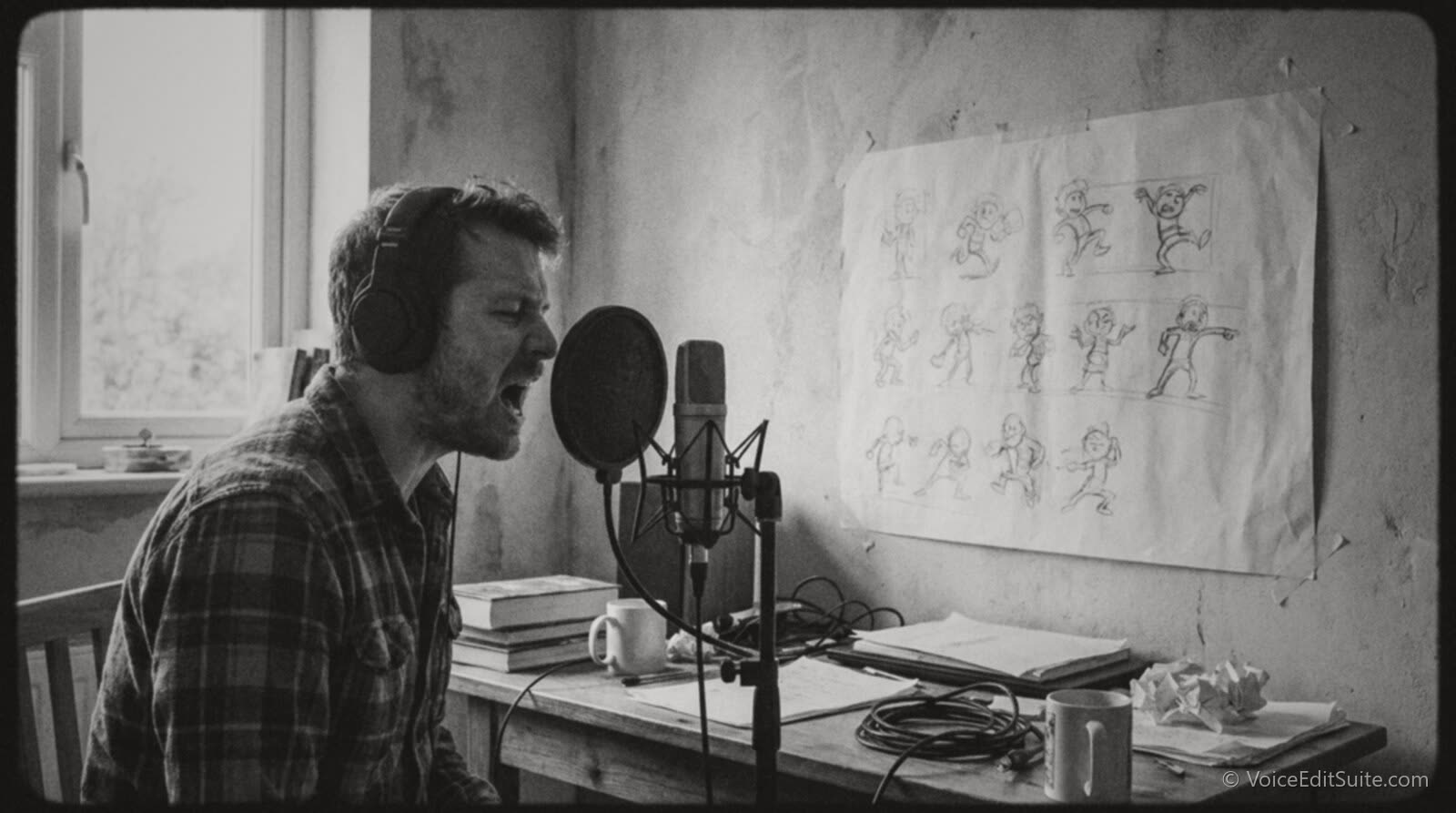
Temp voice-over, also called scratch or placeholder dialogue, is work recorded early in an animated film, TV show, or game's production so a director or editor has a working soundtrack to cut a storyboard pitch, an animatic, or a previs sequence against before the final cast is locked. It is a real, paid professional niche, not an unpaid favor animators trade among themselves, though plenty of productions still try to treat it that way. The honest version includes a real risk: temp work is sometimes offered unpaid or badly underpaid on the promise of a first right of refusal on the eventual role, and that promise is worth far less than it sounds unless written down with actual terms attached. This guide covers what a session looks like, how temp performances end up in the released product by accident or by design, and how to scope an agreement and find this work.
This niche sits upstream of the casting most voice actors already know. A final-cast booking means a character has been approved and a contract signed, and the words you record are the words audiences will hear. A temp or animatic booking means none of that has happened: the script is still moving, and the lines you read today may be cut by the end of the week. The two jobs can look nearly identical from behind a microphone, but they run on different expectations around money, usage, and whether your voice is the one the audience eventually hears. Knowing which kind of booking you are in before you say yes is the single most useful habit to build in this niche.
What an Animatic Actually Is, and Why It Needs a Voice
An animatic is a film's storyboard cut together in sequence and set to time, usually with placeholder sound design and dialogue, so a director can watch something close to the finished scene's pacing years before a single frame of final animation exists. The format traces back to Walt Disney's own studio, widely credited with building the first animatics to pitch films to executives before committing to full production. A silent storyboard tells you almost nothing about whether a scene works: a joke needs a real reading to land, and an action sequence needs a performer genuinely selling a fall before an editor can judge whether the cut holds. That is what temp voice-over is for, giving the storyboard a soundtrack real enough to judge against something other than silence.
What an Animatic Recording Session Looks Like
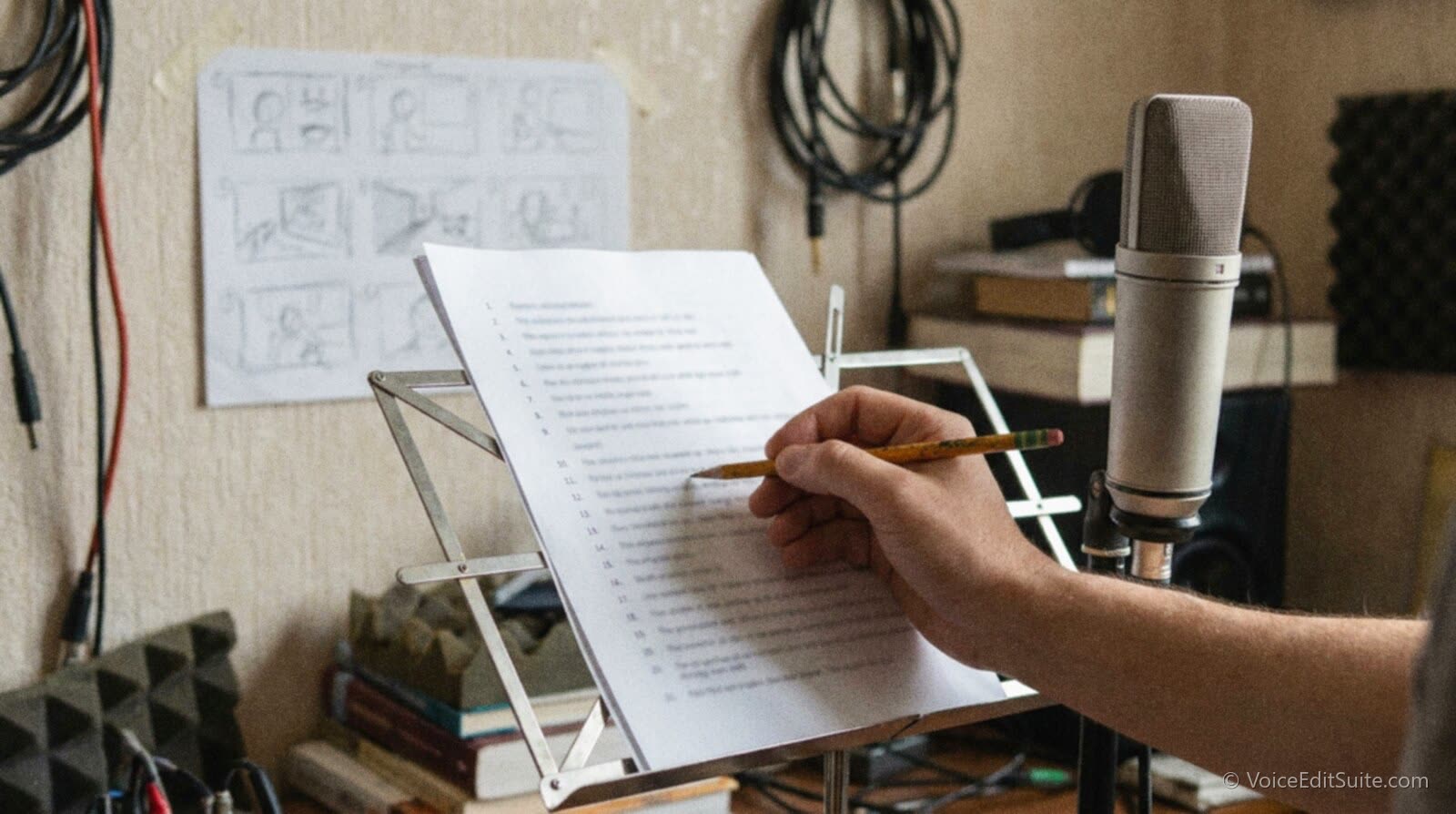
A temp or animatic session rarely looks like a normal booking. The script is often a loose stack of storyboard panels with scrawled dialogue under each frame, or a spreadsheet of numbered lines matched later to panel numbers, not a polished shooting script. Direction frequently comes from a story artist or the director rather than a dedicated voice director, and the note is as likely to be "try it faster, we need to see if the cut holds" as any character note. Alternate reads of the same line are normal, because the team does not yet know which version will survive the next round of revisions. Double Fine's sound designer Paul O'Rourke described this on Psychonauts 2: scratch dialogue was recorded early so programmers could hook lines into the engine and designers could block cutscenes against a real voice, with final files overwriting the scratch recordings once a scene was approved.
Animatics in Film and TV, Previs in Games
Film and TV animation calls this stage an animatic. Games use related terms: previs, short for previsualization, for cinematic sequences built before final motion capture, and pitch voice-over for dialogue a small team records to sell a concept before a game has a real budget. The mechanics are nearly identical, lines recorded fast against unfinished art, but the scale differs: studios already know roughly how many lines a shipped game will need, since the line counts major studios have published run into the hundreds of thousands, so a previs session is often a small sample of a script that does not fully exist yet. The character craft overlaps closely with voicing consistent characters across animation and games.
The Honest Pay Problem: Unpaid Work on the Promise of a Final Role
Here is where this niche gets genuinely risky. Temp and animatic work is sometimes offered unpaid, or paid at a token rate far below a normal session fee, with the dangled incentive that the performer who voices the scratch track gets a first right of refusal on the final role if the project moves forward. Sometimes that offer comes from a genuinely small, pre-funded project that cannot pay anyone yet. Sometimes it comes from a for-profit studio that simply knows framing the ask as an opportunity gets a cheaper yes than framing it as a job.
A first right of refusal is not an offer of the role. At its strongest, it is a promise that if the production proceeds to final casting, and nobody more bankable has entered the picture, the temp performer gets asked first. That is real and sometimes valuable, but unenforceable unless written down, and even in writing it rarely covers the rate or the timeline, which matter once real money is behind the project. Actors have genuinely won the role this way: Pixar story artist Joe Ranft staying on as Heimlich the caterpillar in A Bug's Life, after being cast only to test lines against the animation, is proof the path is real. But folklore survives because exceptions are memorable. Just as often, the studio casts a more established name, while the actor who voiced the character through two years of revisions gets a credit, if that, and no further pay.
The pattern of an early-recorded performance not surviving to release is well documented. Disney recorded Chloe Moretz as Penny for Bolt before replacing her with Miley Cyrus partway through production, and Pixar's The Good Dinosaur went through such a significant overhaul that most of its original cast, including its young dinosaur protagonist, was replaced rather than asked to re-record. These are high-profile examples because the recasting became public; the more common version happens quietly on smaller projects that never reach a theater, where a scratch performer's work gets absorbed into a pitch deck that goes nowhere, with no announcement and no further obligation to anyone.
First right of refusal is not a contract for the role
Treat a verbal promise of "first dibs" on the final casting like any other unpaid or underpaid offer: a nice gesture with no binding value until it is written into the agreement, with your rate, your usage, and what happens to your temp recordings spelled out.
Why Usage Rights Matter More Than the Promise Does
Two separate things can put a temp recording into the finished, money-making product: accident and intent. The accidental version happens when nobody flags that a "placeholder" line never got swapped before the build locked, and a scratch file ships without anyone meaning it to. The intentional version is more common on tight budgets: a director decides the scratch pass is good enough and never books a separate final session, treating a one-time animatic recording as the released performance. Both versions create the same problem: disposable, preparatory work has quietly become the finished product, carried by whatever usage terms, or lack of terms, were attached to the original low-rate session.
This is not a hypothetical concern. SAG-AFTRA's 2022 Audio Commercials Contract already addresses a related situation: audition material cannot be used as a scratch track in the finished production without triggering minimum compensation. That covers commercials, not animation or games, but the principle transfers: once a recording made for one limited purpose starts doing the job of final work, it has to be paid like one. Non-union temp work has no such rule automatically, which is why it has to be written in by hand, the same distinction usage fees and buyouts in commercial voice-over work are built around.
Scoping a Temp-Work Agreement in Writing
Experienced actors who work this niche treat an unpaid or low-paid temp booking as negotiable on paper even when the budget is zero, because the paperwork, not the fee, is what protects you later. A short email thread with the key terms restated and both sides replying "agreed" is enough to turn a verbal promise into something you can point to months later.
- Scope: the recording is for animatic, previs, or pitch use only, not licensed for broadcast, release, or retail distribution.
- First right of refusal with a deadline: the studio contacts you within a set number of business days of moving to final casting, before offering the role elsewhere.
- Final-casting rate: a pre-agreed rate, or a commitment to negotiate at prevailing rates then, not the temp rate.
- A for-profit clause: if the studio or publisher is commercial rather than an unfunded student or passion project, the temp rate reflects that.
- An airing clause: if the recording is used in any released or shipped version of the project, by design or oversight, it converts to a final-use booking, paid and credited as one.
- No further use without a new agreement: if not cast, the temp recording is used only for its original purpose and not kept or resold elsewhere.
Some studios no longer treat the line between temp and final use as an accident waiting to happen. A growing number of agreements now say outright that a scratch recording may become part of the released product if the team is satisfied with it, rather than treating that as an unplanned exception. That is legitimate for a studio to ask for, but it means your rate and usage terms need negotiating as though the recording might ship. A temp session quoted at a throwaway rate because "it's just for the animatic" is priced wrong the moment the contract also says the studio may keep it.
↗ Try the tool
Rate Calculator
A temp or animatic booking and a final-cast booking are not the same product, even when they ask for the same lines in the same voice. The Voice-Over Rate Calculator lets you build two separate numbers side by side: a fair rate for scratch, animatic-only use with no further usage rights, and the real commercial rate the same recording would carry if a studio's contract says it might end up in the finished, released product. Work out both before the session, not after someone tells you the scratch track is staying in.
Open Rate Calculator →How to Actually Find This Work
This work almost never moves through an open casting marketplace, because by the time a studio needs a temp voice, the project itself is still internal and often confidential. Animation studios route it through the story department: story artists are frequently the first people asked to read a line, which is why one glossary notes a scratch track is "often done by non-professional voice actors" rather than a trained performer. Game studios run a more formal version of the same pipeline. Larian Studios, for one documented example, lists an in-house Associate VO Producer role to schedule voice-over and motion-capture bookings across its internal studios, and has advertised for an Internal Voice Director to keep casting aligned with its cinematics teams. That internal structure is exactly where animatic, previs, and pitch voice work lives: inside a studio's own departments, not a public casting board.
Breaking in follows the same logic as finding direct clients without going through a marketplace: the buyers are a short, identifiable list of story and audio departments, not an open pool of anonymous clients. Local actors who can get into a studio's building for a same-day, no-prep scratch session have a real advantage, since this work gets booked on short notice. Agents sometimes field these requests directly from a story department, and performers already building a reel around sustained character work are assembling exactly the sample a story department wants to hear.
Frequently Asked Questions
Is temp or animatic voice work supposed to be paid?
Usually, yes, though rates vary widely and unpaid arrangements persist on genuinely unfunded student films and early pitch decks with no budget at all. The distinction that matters is whether the studio behind the request is a for-profit entity that could pay something. A commercial studio asking for free temp work on the promise of future consideration is a different situation than a film student asking classmates for a scratch read.
What does a "first right of refusal" actually guarantee?
On its own, almost nothing enforceable. Spoken informally, it means the studio intends to ask you before offering the role to someone else, but it carries no guaranteed rate, no deadline, and no legal weight unless written into a signed agreement with those specifics attached. Treat it as a goodwill gesture worth asking to have formalized, not as a booking you can count on.
Can I be replaced after recording the temp track?
Yes, and it happens often enough that it should not be read as a reflection of your performance. Disney recast Bolt's Penny after Chloe Moretz had already recorded as the character, and Pixar's The Good Dinosaur replaced most of its cast after a major overhaul. A temp performer's work surviving every revision, the way Joe Ranft's did as Heimlich in A Bug's Life, is the exception, not the rule.
What if my temp recording accidentally ends up in the final release?
This is exactly what an airing clause in your temp-work agreement should cover before the session, not after. It should say that if the recording ships in any publicly released or sold version of the project, it converts to a paid, final-use booking at a commercial rate, with credit, regardless of whether the use was planned or accidental. Without that clause in writing, you are relying on the studio's goodwill to notice and fix the underpayment itself.
Is this different for games than for animated film and TV?
The mechanics are close: games call it previs or pitch voice-over rather than an animatic, and both let a team judge timing before final production commits. The main difference is that larger game studios tend to formalize the internal pipeline more visibly, with in-house roles like an Associate VO Producer or Internal Voice Director coordinating scratch and final recording, while animation studios more often route temp requests informally through the story department.
How should I price a temp or animatic session?
Price it below a full final-cast session but not at zero, unless the project is a genuinely unfunded passion project. Factor in the studio's commercial status, whether the contract reserves the right to keep the recording if it is good enough, and whether a first-refusal promise is written down. Our 2026 voice-over rate benchmarks are a useful starting point for what a comparable final-cast session would carry.
Sources and Further Reading
- Wikipedia, Scratch vocal: the definition of scratch voice recording in animation, and Joe Ranft kept as Heimlich's final voice in A Bug's Life after starting as its placeholder.
- Double Fine, Scratch That: sound designer Paul O'Rourke on using scratch voice-over on Psychonauts 2 to block scenes before final recording.
- Edge Studio, Scratch Track (or Rough Track): a glossary noting scratch tracks are often recorded by non-professionals before a pro records the final take.
- Cinemablend, Why Pixar's The Good Dinosaur Got Rid Of Its Voice Cast: coverage of the recasting after a major production overhaul.
- Looper, Animated Movie Actor Replacements That Probably Slipped By You: recasts in animated film, including Disney's Bolt, where an actor recorded before being replaced.
- Hitmarker, Larian Studios Internal Voice Director: a listing showing how an in-house voice director role aligns casting with a studio's own teams.
- Larian Studios, Associate VO Producer: a listing describing in-house scheduling of voice-over bookings, evidence this work runs through a studio's pipeline, not an open marketplace.
- David Mullich, How Video Game Voice-Overs Are Produced: a producer's account of preparing numbered line scripts for sessions.