The short answer: the video game voice over market sits inside a games industry Newzoo forecasts at $213.9 billion in 2026, up 6.1 percent on 2025. Big console and PC games record enormous amounts of dialogue (Rockstar put Red Dead Redemption 2 at about 500,000 lines), and the 2024-25 SAG-AFTRA strike ended with a contract that raised union scale by 15.17 percent, adds 3 percent each November through 2027, and requires written, specific consent before any AI digital replica of a performer is made or used. The growth is real, the AI pressure is real, and most new actors start in non-union and indie work.
This Guide pulls together what is actually documented about game voice work in 2026, with a date and a source on every figure: market size from Newzoo and the Entertainment Software Association, dialogue counts published by the studios themselves, the strike timeline and the terms of the 2025 Interactive Media Agreement, what non-union and indie game work looks like, why localisation is the quiet growth story, how far AI voices have actually spread into shipped games, and a practical route in. It is written for voice actors first, and for podcasters with trained voices who are curious whether game work is a realistic second line of income.
How Big Is the Video Game Market in 2026?
Newzoo, the games analytics firm most often quoted on market size, shared preliminary 2026 figures at Gamescom in August and published its full Global Games Market Report in September 2026. It forecasts $213.9 billion in consumer spending on games this year, up 6.1 percent, from 3.70 billion players, of whom 1.65 billion pay for something. By platform, mobile takes $121.1 billion (57 percent), console $46.9 billion (22 percent) and PC $45.9 billion (21 percent). By region, Asia-Pacific leads with $100.7 billion, then North America at $56.9 billion, Europe at $38.5 billion, Latin America at $9.3 billion and the Middle East and Africa at $8.5 billion, the fastest-growing region at 10.3 percent. The two biggest single countries are China ($58.1 billion) and the United States ($53.5 billion).
Newzoo names one game as the largest single driver of that growth: Grand Theft Auto VI, which Rockstar has scheduled for 19 November 2026. Newzoo expects full-game console spending to rise 17.5 percent this year, the strongest growth of any business model it tracks, largely on that one launch. That concentration is worth noticing. Voice-heavy productions are a small number of very large projects, and when one of them ships, slips or changes plans, the effect on casting is felt across the whole field.
For the United States specifically, the Entertainment Software Association reported in February 2026 that consumer spending on video games reached $60.7 billion in 2025, up 1.4 percent and second only to the 2021 pandemic peak of $61.7 billion. The ESA has since noted that its data partners Circana and Sensor Tower restated their figures in March 2026, which moved the 2025 total to $60.8 billion ($52.4 billion on content, $5.4 billion on hardware, $2.9 billion on accessories). Newzoo's $53.5 billion figure for the US is a different measure from a different firm, so do not set one against the other: compare each firm's numbers only with its own earlier years.
What these numbers do not tell you
No research firm publishes a reliable figure for how much of a game's budget goes to voice. Market size tells you how much money flows through games, not how much reaches performers. Treat any article that quotes a precise "voice over share of game budgets" with suspicion unless it names the study behind it. We could not find one.
How Much Dialogue a Modern Game Actually Records
The clearest way to see the demand is the line count, and several studios have published theirs. In an October 2018 interview with Vulture, Rockstar co-founder Dan Houser said Red Dead Redemption 2 had about 500,000 lines of dialogue, 1,200 actors in motion capture (all SAG-AFTRA members), 700 of whom had speaking parts, and a main-story script of roughly 2,000 pages. In a Starfield Q&A in October 2022, Bethesda showed a count of 252,953 lines, and Bethesda had earlier announced that Fallout 4 wrapped voice recording at around 111,000 lines. Guinness World Records recognised BioWare's Star Wars: The Old Republic as the largest entertainment voice-over project, with more than 200,000 recorded lines performed by several hundred actors. CD Projekt Red's localisation team told GDC in 2023 that Cyberpunk 2077 needed voice-over recordings for more than 80,000 lines in 11 voice-over languages, alongside more than a million words of text.
Baldur's Gate 3 is often quoted too. Larian itself said the game has 174 hours of cinematics, and performance director Aliona Baranova said 248 actors voiced it, with every NPC performer wearing a motion-capture suit. The widely shared figure of more than 114,000 lines comes from a player's own count of the game files, reported by GamesRadar+, not from Larian, so we treat it as a good estimate rather than an official number.
What does that mean for one actor? Bethesda's own feature on Fallout 4's cast gives the best worked example. The two actors who voiced the player character, Courtenay Taylor and Brian T. Delaney, each recorded more than 13,000 lines over roughly two years. That is a starring role measured not in pages but in spreadsheets: every line a separate file with an ID, often recorded out of order, with no picture and several reads per line so the audio team can choose. Lead game roles are stamina jobs, and so are many supporting ones, because combat efforts, deaths and shouted barks are recorded in bulk.
That stamina point has a number attached in the UK. When Equity published its first recommended minimum rates for game performers in August 2024, it included a two-hour maximum for vocally stressful sessions such as screaming and combat work. If you are new to game sessions, our Guide to the research on vocal strain explains why that limit exists and what it protects.
The 2024-25 SAG-AFTRA Video Game Strike
SAG-AFTRA members authorised a strike in September 2023 with a 98.32 percent yes vote, and the union's video game performers walked out at 12:01 a.m. on 26 July 2024 against the companies signed to the Interactive Media Agreement, including Activision Productions, Disney Character Voices, Electronic Arts Productions, Epic Games, Formosa Interactive, Insomniac Games, Take 2 Productions, WB Games and others. The agreement covers more than 2,500 off-camera voice performers as well as on-camera motion capture and stunt performers, singers, dancers and puppeteers. The companies said 24 of the 25 proposals were already agreed. The one that was not was the one that mattered: protection against AI being used to replicate performers' voices and movements without consent or pay.
Not every game was struck. A side letter exempted titles already in development before the previous contract expired in August 2023, and the union offered interim agreements that let other productions keep working if they accepted its AI terms. By October 2024, more than 120 games from 49 companies had signed interim or tiered-budget deals. Meanwhile AI kept making headlines on its own. In March 2025 footage leaked of an internal Sony prototype of an AI-driven Aloy, the Horizon heroine, using a generic synthetic voice; her actor, Ashly Burch, said she was worried for the art form. In May 2025 the union filed an unfair labour practice charge with the National Labor Relations Board against Llama Productions, the Epic Games subsidiary behind an AI-generated Darth Vader voice in Fortnite, arguing that bargaining-unit work had been replaced without notice or negotiation.
A tentative agreement was announced on 9 June 2025 and the strike was suspended on 11 June 2025, after 320 days. Members ratified the new contract on 9 July 2025 by 95.04 percent to 4.96 percent, with the result certified by an outside firm, Integrity Voting Systems. SAG-AFTRA's national executive director, Duncan Crabtree-Ireland, said the deal put in place AI guardrails that defend performers' livelihoods. It was the union's second long game strike in a decade: performers also struck from October 2016 to September 2017, over secondary payments and vocal stress.
What the 2025 Interactive Media Agreement Pays and Promises
The full contract is formally the 2022-2028 Memorandum of Agreement and runs from 8 November 2022 to 31 October 2028. A January 2026 analysis of the full text by the law firm Frankfurt Kurnit Klein and Selz confirms it matches what SAG-AFTRA announced at ratification. The headline terms fall into two groups: money, and AI.
Pay and benefits
- 15.17 percent compounded increase to minimum scale on ratification, then 3 percent on 1 November 2025, 1 November 2026 and 1 November 2027.
- Extra pay for principal sessions seven to ten on a project rises from $275 to $285 per session.
- Employer pension and health contributions rise to 17 percent on ratification and 17.5 percent from 31 October 2026.
- Overtime for performers paid double scale or more is capped at double scale.
- Performers must be paid within 12 business days of the work or the paperwork, whichever is later, with liquidated damages for late payment.
SAG-AFTRA's own January 2024 summary of its Replica Studios voice deal used the Interactive Media Agreement's four-hour session minimum of $956.75 as its base. As a worked example only: if that was still the minimum at ratification, a 15.17 percent rise takes it to about $1,102, and the November 2025 step to about $1,135. The union's rate sheet is the authority, and the 1 November 2026 step will move it again, so check the current sheet before you quote anyone a union rate.
AI consent and digital replicas
- Written, clear and conspicuous consent, as a separate document or a specifically signed rider, before a digital replica of a performer is created or used.
- A reasonably specific description of the intended use, including whether the replica will be used for real-time generation (an AI chatbot character, for example) and whether it will be asked to perform sensitive content such as profanity or slurs.
- For most uses, consent cannot be collected at hiring for future games. The studio has to come back and ask.
- Separate payment for the time spent creating a replica, with vocal replica pay tied to the lines generated (the agreement treats a line as roughly ten words).
- A usage report within 90 days of release, naming which characters used a replica and how the performer's pay was worked out.
- Performers can suspend consent for replica use during a strike.
- Ordinary audio processing, such as noise reduction and pitch adjustment, and "traditional" AI used for things like character animation, are excluded from these rules.
Read the rider before the session, not at it
If a booking includes an AI or digital replica rider, ask for it in advance and check three things: exactly which game and characters it covers, whether real-time generation is included, and how generated lines are paid. Union or not, those three answers are what the strike was about. Our Guide to voice over contracts and usage rights covers the rest of the paperwork.
Non-Union and Indie Game Work
Most game projects never come near the Interactive Media Agreement. SAG-AFTRA's answer for smaller studios is the Tiered-Budget Independent Interactive Media Agreement, launched in 2024 with three tiers and expanded to four: $250,000 to $1 million, $1 million to $5 million, $5 million to $15 million, and $15 million to $30 million in all-in production budget. Session rates are set per tier, the language is simpler than the main contract, and AI consent and replica pay apply at every tier. Performers are hired as employees, not contractors. In November 2024 the union added an Independent Interactive Localization Agreement for English dubs of games first scripted in another language whose owner is based outside the US.
Below $250,000, and anywhere outside these agreements, the work is non-union, and that is where most new game actors start: small studios, game jams, visual novels, mobile titles and crowdfunded indies. SAG-AFTRA members are bound by Global Rule One, which bars them from working for a producer who has not signed a union agreement, so a non-union game is off limits to members however small it is. Our SAG-AFTRA membership basics Guide explains when joining makes sense.
In the UK there is no collective agreement between Equity and the games trade body Ukie, so rates are recommendations, not contract terms. Equity's August 2024 guidance for AAA titles set £300 an hour for voice-over and £1,000 a day for ensemble recording, plus the two-hour cap on vocally stressful work. An earlier Equity agreement with the recording studio OMUK, which ran to April 2023, used a sliding scale of £300 an hour for games budgeted over £5 million, £200 for indie games of £0.5 million to £5 million, and £175 for micro games under £0.5 million. Worked example: a two-hour AAA combat session at Equity's recommended rate is £600; a four-hour dialogue session is £1,200.
There is no union rate card for non-union game work, and we will not invent one. What you can control is the scope. Before quoting, find out the line count or word count, the number of characters, whether efforts and screams are included, how many sessions, whether the client wants a raw or edited delivery, and what the contract says about AI. Then price the hours and the strain, not just the finished minutes. Our 2026 voice over rates Guide sets out the published benchmarks across genres.
The clause to look for in a non-union game contract
Watch for wording that grants rights to your voice "in all media now known or hereafter devised, including synthetic or generated voice". On a union job that use needs separate written consent. On a non-union job, your contract is the only protection you have, so strike the clause or price it separately before you sign.
Localisation: the Quiet Growth Story
Look again at the regional split: almost half the world's game spending is in Asia-Pacific, and the top two countries speak different languages. Big releases are dubbed or subtitled into many markets, which is why the language industry trade publication Slator calls game localisation the language industry's fastest-growing vertical. Sizing it is harder. Precedence Research, in a report last updated in October 2026, estimates the game localisation services market at $3.47 billion in 2026, rising to $7.46 billion by 2035, a compound annual growth rate of 8.87 percent, with voice-over and dubbing growing faster than the whole at 10.15 percent a year and rising from 19.4 to 21.8 percent of the market. Other firms define the market differently and get very different totals, so treat any single figure as one estimate.
For context, Nimdzi's 2025 report put the entire language services industry at $71.7 billion in 2024 and projected $75.7 billion for 2025, while trimming its long-term growth outlook to about 5 percent a year, partly because of generative AI. Game voice localisation is a small but growing slice of that. For English-speaking actors, the opportunity runs both ways: localising Western games is work for actors in other languages, and English dubs of games first written in Japanese, Korean or Chinese are work for English speakers, now with their own SAG-AFTRA agreement. The craft is closer to dubbing than to animation, so our Guides to ADR and dubbing sessions and to AI dubbing in 2026 are useful preparation.
How Much AI Voice Is Actually in Games?
Developers are using generative AI more, and liking it less. GDC's 2026 State of the Game Industry survey of more than 2,300 industry professionals found 52 percent say generative AI is having a negative impact on the industry, up from 30 percent in 2025 and 18 percent the year before; only about 7 percent said it was positive. At the same time, 36 percent said they use generative AI tools in their own work. The most negative groups were visual and technical artists (64 percent), game design and narrative staff (63 percent) and programmers (59 percent).
On the storefront, Valve requires developers to disclose generative AI use on Steam. An analysis of Steam data by Ichiro Lambe of Totally Human found that as of 13 July 2025, 7,818 of roughly 114,126 Steam games, about 7 percent, disclosed generative AI use, and about one in five games released in 2025 did. Around 60 percent of disclosed use was visual assets; audio, including voice, was a smaller share. Disclosure is self-reported, so these are minimums.
"A real professional actor is better than AI; that's just how it is."
The most instructive case is Embark's Arc Raiders, which launched in October 2025 with text-to-speech voices for some lines and drew criticism from players for them. By March 2026 Söderlund said the studio had re-recorded some of those lines with actors, uses text-to-speech mainly to test lines before recording them, and pays actors to license their voices for the remaining, less immersive lines such as ping callouts. That is roughly where the market is: AI is used for prototyping, placeholders and low-stakes system lines, while lead and story performances are still recorded by people, under contracts that now say exactly what may be done with the result. Our Guide to AI voice cloning in 2026 covers the wider picture outside games.
How to Break Into Video Game Voice Acting
Nothing below is a shortcut, and there is no published figure for how many people earn a living from game voice work, so be wary of anyone who promises one. What the evidence above does tell you is where the work is, what clients expect, and what to protect. Here is a route that fits it.
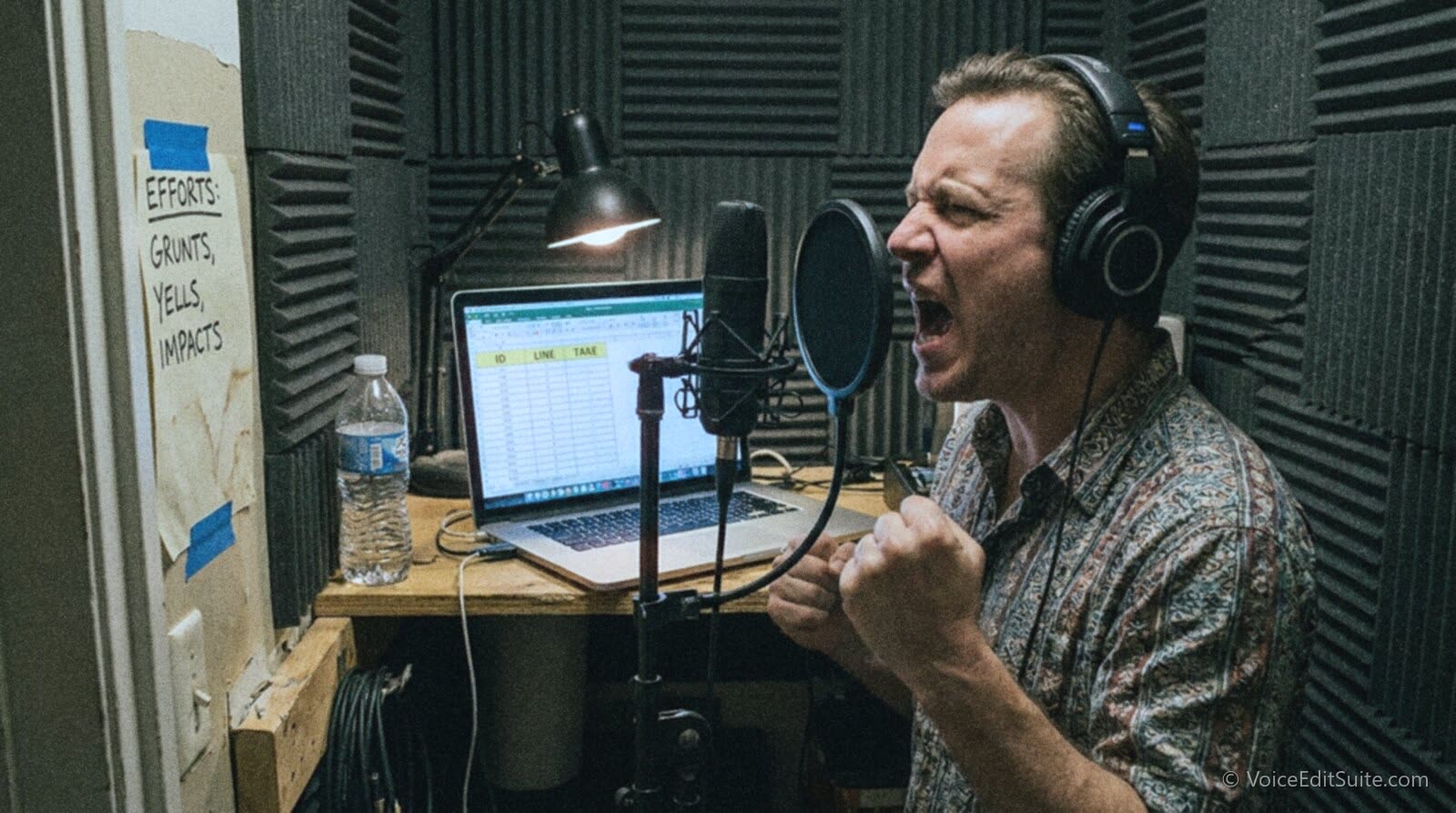
- Learn how game sessions work. Lines arrive as a spreadsheet with IDs, context notes and character direction, usually without picture, recorded out of order with several takes each. Practise reading from that format, not from a screenplay.
- Build a game-specific demo. Sixty to ninety seconds of short, contrasting character moments, with at least one action or combat beat and one quiet emotional beat. Our demo reel Guide covers structure and production.
- Develop characters you can hold for hours. A voice that collapses after forty lines is not a game voice. Our Guide to character voices and accents for animation and games covers building and sustaining them.
- Start with indie and non-union projects if you are not a union member: game jams, student games, visual novels and small studios. Credit, clean files and reliability lead to the next booking.
- Protect your voice. Record efforts and screams last, take Equity's two-hour guide for stressful work seriously even when nobody enforces it, and speak up if a session plan ignores it.
- Read every AI clause. Union work gives you consent rights in writing. Non-union work gives you whatever you negotiate.
- Price the job by scope. Line count, characters, efforts, sessions and usage decide the fee. Know your number before you reply.
Podcasters have more of a head start than they might think. Hours of mic time, consistent levels, clean home recording and self-editing are exactly what a remote indie session asks for. The gap is character range and stamina, which is practice, not equipment. Whichever direction you come from, make your delivery spotless: file names that match the line IDs, consistent loudness from the first file to the last, and no room noise.
↗ Try the tool
Rate Calculator
Free, no account: price a game voice over job, from a handful of NPC barks to a larger character contract, with usage and session structure scoped the way this industry actually buys the work. Know the number before you email a developer or studio back.
Open Rate Calculator →Frequently asked questions
Is the SAG-AFTRA video game strike over?
Yes. The strike began on 26 July 2024, was suspended on 11 June 2025 after 320 days, and ended when members ratified the 2025 Interactive Media Agreement on 9 July 2025 by 95.04 percent. That agreement runs to 31 October 2028.
How much do video game voice actors get paid?
Union pay is set by the Interactive Media Agreement rate sheet: scale rose 15.17 percent on ratification in July 2025 and rises 3 percent each November through 2027. Working from SAG-AFTRA's own earlier figure of $956.75 for a four-hour session, that comes to roughly $1,135 after November 2025, but check the current sheet. In the UK, Equity recommends at least £300 an hour for AAA voice work. Non-union indie rates vary widely and have no published benchmark.
How many lines of dialogue does a video game have?
It ranges from a few hundred in a small indie game to hundreds of thousands in an open-world role-playing game. Developer-published figures include about 500,000 for Red Dead Redemption 2, 252,953 for Starfield, more than 200,000 for Star Wars: The Old Republic, about 111,000 for Fallout 4 and more than 80,000, recorded in 11 languages, for Cyberpunk 2077.
Do video games use AI voices now?
Some do, mostly for prototypes, placeholder lines and minor system callouts. About 7 percent of all Steam games disclosed some generative AI use by July 2025, most of it visual. Under the 2025 union contract, studios need a performer's written, specific consent and must pay for and report any use of a digital replica.
How do I become a video game voice actor with no experience?
Train in acting and character work, build a short game-specific demo, and start with indie, student and game jam projects that accept non-union actors. Learn the spreadsheet-and-line-ID session format, protect your voice on effort-heavy sessions, and read every contract's AI clause before you sign.
Can SAG-AFTRA members do non-union video games?
No. Global Rule One bars members from working for producers who have not signed a union agreement. Small studios can sign the Tiered-Budget Independent agreement, which covers budgets from $250,000 to $30 million, so that members can work on their projects.
Sources and Further Reading
- Global Games Market to Reach $213.9 Billion as Player Base Hits 3.7 Billion: Newzoo Report (MediaNews4U, September 2026)
- Global players could reach 4 billion by 2029: Newzoo (GamesBeat, 2026)
- 2025 U.S. Consumer Spending on Video Games Nears Pandemic-Level Peak at $60.7 Billion (Entertainment Software Association, February 2026, with March 2026 restatement note)
- Red Dead Redemption 2 Is 65 Hours Long, Story Script Almost 2,000 Pages (GamingBolt, reporting Dan Houser's Vulture interview, October 2018)
- Todd Howard: Starfield Has Over 250,000 Lines of Dialogue (Pure Xbox, October 2022)
- The Team Bringing Fallout 4 to Life (Bethesda.net, 2015)
- Largest voice-over project in the entertainment industry (Guinness World Records)
- Localization of Cyberpunk 2077: Technology, Tools, and Approach (GDC Vault, CD Projekt Red, 2023)
- Baldur's Gate 3 player does the math and finds 236 hours of recorded dialogue (GamesRadar+)
- SAG-AFTRA Members Approve 2025 Video Game Agreement (SAG-AFTRA, 9 July 2025)
- Inside the New SAG-AFTRA Interactive Media Agreement: New Standards for AI and Digital Replicas (Frankfurt Kurnit Klein and Selz, January 2026)
- Video game actors' strike ends after tentative deal is reached (NBC News, 11 June 2025)
- SAG-AFTRA Suspends Video Game Strike After 320 Days (TheWrap, June 2025)
- Video game actors are going on strike. Here's why (Associated Press via ABC News, July 2024)
- SAG-AFTRA game strike explainer (Inverse, October 2024)
- SAG-AFTRA video game strike ends (The Hollywood Reporter, September 2017)
- Horizon actress worried for the future of gaming after Sony's AI Aloy controversy (Creative Bloq, March 2025)
- SAG-AFTRA files unfair labor practice charge over Fortnite's AI Darth Vader (Shacknews, May 2025)
- Summary of Replica Studios Agreement for Digital Voice Replicas (SAG-AFTRA, January 2024)
- Tiered-Budget Independent Interactive Media Agreement (SAG-AFTRA)
- SAG-AFTRA Introduces New Independent Agreement for Video Game Localization (MultiLingual, November 2024)
- UK entertainment union Equity recommends minimum rates for game performers for the first time (VGC, August 2024)
- Game Localization Services Market (Precedence Research, updated October 2026)
- Slator Game Localization Report (Slator)
- Nimdzi 100 2025 (Nimdzi Insights, 2025)
- GDC 2026 State of the Game Industry reveals impact of layoffs, generative AI and more (GDC, 2026)
- Steam games disclosing generative AI use are up 800% this year (VGC, July 2025)
- Arc Raiders has been cutting back its AI voices (PCGamesN, reporting a GamesIndustry.biz interview, March 2026)