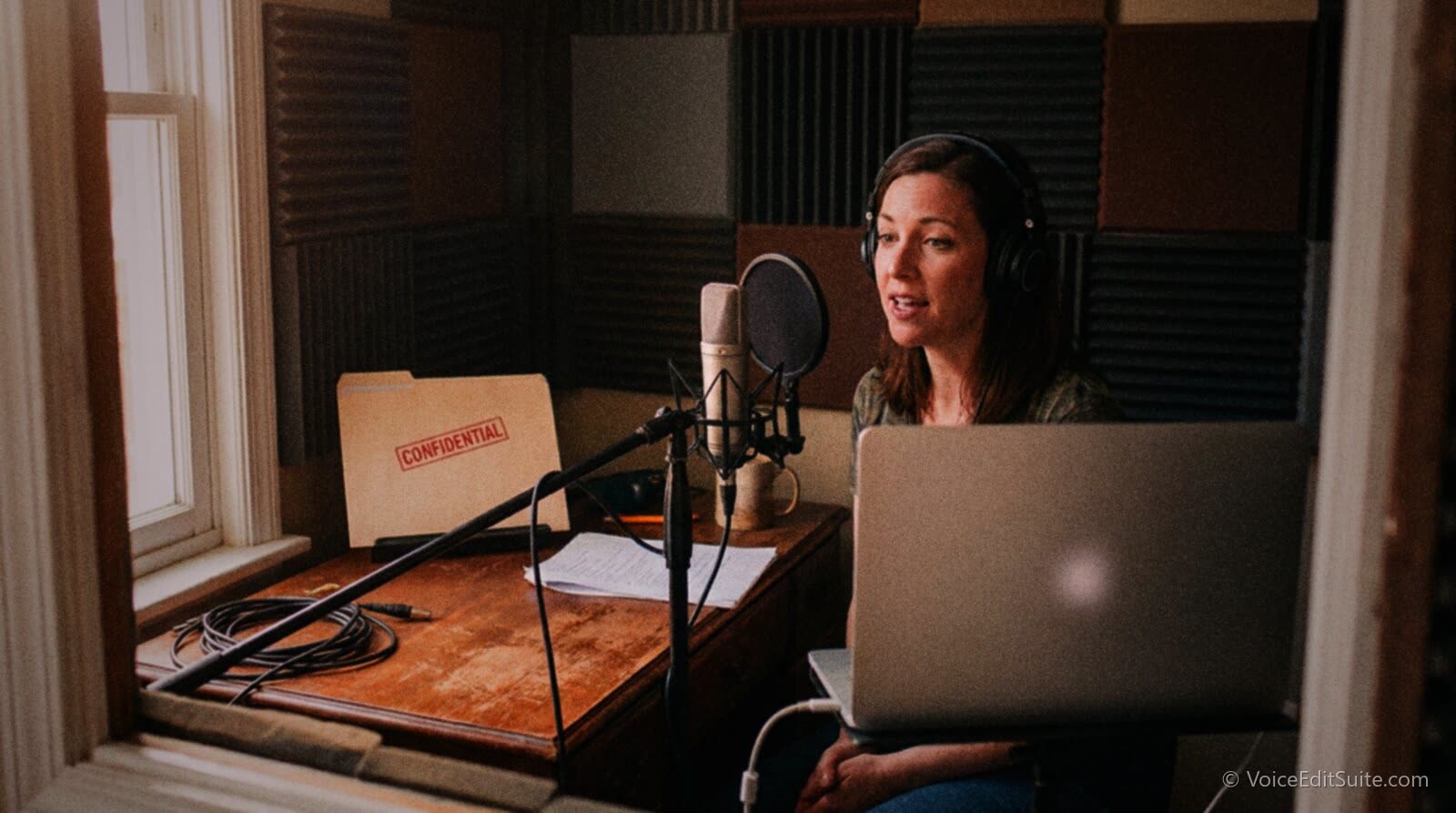
The short answer: once you take on a project that is still confidential, whether that is an unreleased video game, an unannounced product trailer, or a corporate client running a stealth launch, the default assumption should be that you cannot add it to your demo reel or resume, cannot post about it on social media, cannot name the client even in general terms, and in some contracts cannot confirm you worked on it at all, until the client lifts that restriction, usually at public announcement. Exactly where those lines sit comes from the specific agreement you signed, not from general industry custom, which is why reading the confidentiality language closely before a session matters more than guessing based on the last NDA you signed for a different client.
What an Active Voice Over NDA Actually Restricts
Confidentiality around unreleased work is not something studios bolt onto voice over sessions specifically. It is the same secrecy discipline a game studio, ad agency, or startup applies to every vendor who touches a project before launch, extended to the performer the same way it is extended to an editor, a motion capture technician, or a contractor building a demo unit. When Rockstar Games reportedly reminded its Grand Theft Auto 6 voice cast in 2025 that they remained bound by nondisclosure terms even after one actor, Stephen Root, told the Associated Press he voiced a character in the game, it illustrated how an active NDA outlives a leak: one public slip by one person does not release everyone else bound by the same agreement. The lead actor behind Kingdom Come: Deliverance 2's protagonist, Tom McKay, described a similar experience, saying his nondisclosure agreement kept him from even engaging with fans about the project during production.
What that secrecy actually covers varies by contract, but a few restrictions show up often enough to be treated as the default until your own paperwork says otherwise:
- Credit and demo reel use. You typically cannot add the project to a demo reel, resume, or portfolio page until the client has publicly announced it, and sometimes not even then if the contract restricts crediting altogether.
- Social media and public statements. Posting about the session, teasing details, or replying to fan speculation is usually barred outright. Even a vague hint, a release window or a genre, can be specific enough to count as a disclosure.
- Naming the client. Many agreements prohibit naming the studio, agency, or company at all, not just withholding plot details, which is stricter than performers sometimes expect going in.
- Confirming or denying involvement. Some contracts go further still and require you to decline to confirm or deny you worked on the project if asked directly, even by a casting professional, another actor, or a journalist.
None of this is uniform across every contract, which is the detail worth sitting with. Some agreements explicitly permit a vague resume line, something like an unannounced title, supporting role, once the project's existence is public knowledge even if its name is not, the way a performer cast in a project with an embargoed title might list the role only as an NDA project rather than leave the credit off entirely. Other agreements prohibit even that. The only way to know which rule you are under is to read your specific nondisclosure clause, or ask the production's legal or production management contact directly, rather than assume your last client's terms carry over to this one. Treat any unreleased or unannounced work as fully confidential by default until you have that answer in writing, a norm covered in more detail in voice over contracts and usage rights.
Handling the Gap in Your Portfolio and Resume
A year that includes a significant confidential project can look, from the outside, like a quiet year. That is an uncomfortable position for a freelancer whose portfolio website doubles as a sales tool, and it is a different problem from the anonymity that comes from ghost voice work, where a client may own the recording outright and never credit anyone at all. Ghost work is anonymous by design from the start. A confidential project is anonymous temporarily, by legal restriction, which makes the silence feel more like a hole in your history than a deliberate choice you made.
List the Shape of the Work, Not the Name
Where your contract allows any description at all, describe the shape of the project rather than its identity: the medium, the general role, and the general scale, without the title, the client, or specific plot and character detail. "Unannounced mobile game, lead character, client pending public announcement" or "national brand campaign, voice of an unreleased product line" convey real, recent, relevant experience to a prospective client without crossing into disclosure. If your contract is silent on whether even that level of description is permitted, ask before you publish it. Several creative fields outside voice over handle the identical problem. It's Nice That's reporting on design and illustration careers found that a password-protected portfolio section, shared only with vetted prospective clients and only with the original client's sign-off, is common enough to be a normal, expected practice rather than something that reads as evasive to a hiring client.
Lean on Range and Volume Instead of Titles
When even a vague description is off the table, numbers do some of the same work titles would. Total years active, an approximate project count for the period, genre or category breadth, and a separate client-list section many portfolio sites support apart from project samples, let you show real volume and variety without naming a single confidential title. None of this replaces an actual reel sample, but it keeps a resume from reading as a blank stretch during a period that was, in reality, some of your busiest and highest-paying work.
Contract Language Worth Reading Closely Before You Sign
Three pieces of language inside a nondisclosure clause do more to determine how a confidential project will actually feel to live under than anything about the project itself: how long the confidentiality lasts, whether a separate non-disparagement clause is layered on top of it, and what happens to the agreement if the project never gets made at all.
Perpetual, Indefinite, or Self-Releasing
Confidentiality duration clauses generally fall into two camps. A fixed-term or self-releasing clause ends on a stated date, after a set number of years, or automatically once the client publicly announces the project, the outcome most favorable to a performer, since it means the restriction lifts the moment you would actually want to use the credit. A perpetual or indefinite clause states no end date at all. According to terms.law's plain-English contract library, courts generally tend to accept indefinite protection for information that qualifies as a genuine trade secret, but are more skeptical of indefinite duration for everyday confidential information that never rises to that legal status, and common market practice for ordinary business confidentiality runs two to five years rather than forever. The detail worth watching for is which trigger releases you: a clause that only self-releases "upon public announcement" leaves you with no exit at all if that announcement never happens.
Non-Disparagement Clauses
A non-disparagement clause is a different instrument layered into some of the same contracts, and it is worth telling apart from the confidentiality clause itself. Cornell Law School's Legal Information Institute defines it as a contract provision that prohibits the parties from making negative statements, remarks, or representations about each other, a restriction on opinion rather than on information. That distinction matters because a non-disparagement clause can restrict you from saying something negative and true about how a client treated you, independent of whether any confidential information is involved at all, and it is a cousin of the broader restrictive-covenant language covered in the FTC's noncompete rule reversal and what it means for voice over contracts. Whether a specific non-disparagement clause is enforceable, and against what kind of statement, depends on the carve-outs it contains and the jurisdiction governing the contract, which is a question for a contract attorney rather than a general guide.
↗ Try the tool
Rate Calculator
A nondisclosure clause sometimes arrives bundled with an exclusivity hold, a restriction on taking similar work for competing clients while your project stays unannounced. That is a real cost on top of the usual session fee, not a courtesy you owe for free. The Voice Over Rate Calculator helps you work out what a fair rate looks like once an exclusivity hold or an unusually long confidentiality term is factored in, so the silence you are agreeing to is priced like the asset it actually is.
Open Rate Calculator →What Happens If the Project Is Cancelled and Never Announced
The scenario a lot of standard nondisclosure language does not anticipate well is cancellation. If the only trigger that lifts your confidentiality obligation is a public announcement, and the project is cancelled before that announcement ever happens, the restriction can simply continue indefinitely, because the event it was waiting for will never occur.
That is close to what happened to actor Eman Ayaz after Ubisoft cancelled its Prince of Persia: The Sands of Time remake in January 2026. She had reportedly spent three years working on the project and had been filming promotional material only two months before the cancellation, which she said she learned about from the internet rather than directly from the studio, according to Video Games Chronicle's reporting. Bound by an active nondisclosure agreement, she was able to describe the emotional impact publicly without confirming the project by name.
"The most devastating moment of my career. It brought out what I honestly believe is the best performance of my career, and now nobody is ever going to see that."
A kill fee, the subject of kill fees and cancellation clauses in voice over contracts, addresses whether you get paid when a project dies before completion or release. It does not automatically address whether you can talk about it. Those are two separate clauses doing two separate jobs, and a contract can pay a full kill fee while leaving the confidentiality clause fully intact with no new exit. The language worth asking for before you sign is a backup release date: confidentiality lifts at public announcement, or at a stated number of years after signing or after the project's last known activity, whichever comes first, so a cancelled, never-announced project has a defined endpoint instead of an open-ended one.

A General Background on Trade Secret and Confidentiality Law
A caveat before any of this: what follows is general background on how confidentiality and trade secret law typically work, not legal advice about your specific contract or the law of your specific state or country. Contract enforcement varies by jurisdiction, and the only reliable answer for your own situation comes from reading your actual agreement and, where the stakes are real, a licensed attorney.
Cornell Law School's Legal Information Institute explains that most U.S. states, the District of Columbia, the U.S. Virgin Islands, and Puerto Rico have adopted some version of the Uniform Trade Secrets Act, which generally protects information that derives independent economic value from not being generally known, provided the owner took efforts that are reasonable under the circumstances to keep it secret. That two-part structure, real economic value plus active secrecy effort, traces back to a much older source: the definition in the American Law Institute's 1939 Restatement of Torts, which became the model courts across the country built on for decades before the uniform statutes existed.
That legal status is also what separates a genuine trade secret from ordinary information a contract simply labels confidential. A trade secret carries its own independent legal protection, which is part of why courts are more comfortable enforcing an indefinite duty not to disclose it. Information a company calls confidential purely by contract, without meeting the trade secret test, generally only has whatever protection the contract itself provides, which is one reason fixed terms are more common for that category, and why the duration clause matters as much as it does.
One more detail worth asking about before you sign: what happens to your confidentiality duty if the company itself changes hands, folds, or the project is handed to a different studio mid-production. A contract going silent on that question is common, and in most standard drafting the obligation simply survives a change of ownership or a company's closure rather than dissolving with it, since the duty runs to the information, not to whichever entity currently holds it. If that matters to you, it is a specific question worth putting to whoever administers the contract rather than assuming either way.
Handling a Casting or Booking Conversation While You're Under NDA
The single most common moment this becomes awkward in practice is not a legal one. It is a new or prospective client, in a casting conversation or a general inquiry, asking what you have been working on lately, and your best, most relevant recent credit being the one you cannot discuss.
- Have a comparable sample ready, not an explanation. Offer an older, public credit in a similar genre or register instead of narrating why you can't share the recent one. "I have an unannounced project I can't speak to yet, but here's a similar read from a public credit" answers the question without dwelling on the gap.
- Do not soft-confirm details to build credibility. Hinting at genre, platform, character type, or release window to seem more impressive is itself a form of disclosure if your contract is strict, even without naming the client.
- State the category, not the name, only if your contract allows it. "A AAA studio" or "a national retail brand" is sometimes permitted language even when the name is not. Confirm this is actually allowed before you use it in a live conversation.
- Loop in your agent or representative if you have one. They may already have an approved way to describe pipeline work to prospective clients, and checking with them before a call avoids improvising language your contract does not cover.
- Decline directly rather than deflect vaguely. "That one's under NDA, I can't speak to it yet" reads as professional and is the plain truth. Casting professionals who regularly work with union and studio talent recognize that answer and rarely push on it.
The same etiquette applies to podcast producers handling confidential client work, not just performers. A producer building out a company's internal podcast ahead of a product launch, or mixing an embargoed sponsor campaign, is bound by the same kind of expectation: discretion about one client's unreleased work is itself part of what makes a producer trustworthy to the next client, and a producer who hints at embargoed work to look busy is advertising exactly the opposite of what a confidentiality-sensitive client wants to hear.
Frequently Asked Questions
Can I list an unannounced project on my resume at all?
Sometimes, in vague terms, but only if your specific contract allows it. Some agreements permit a non-identifying entry like "unannounced game, supporting role" once the project's existence is public in some form, even if the title is not. Others prohibit any mention until the full public announcement, and a smaller number prohibit crediting the role at all, even afterward. Check the actual clause, or ask the production's legal or production management contact, rather than assuming based on a past project's rules.
Does an NDA automatically expire once the project is publicly announced?
Only if the contract specifically says so. A self-releasing clause tied to public announcement is common and is the outcome most favorable to a performer, but it has to be written into the agreement. Absent that language, the confidentiality duty can continue on its own stated term, or indefinitely, even after the project you worked on is sitting on shelves or storefronts with your name nowhere near it.
What if I was only told verbally to keep a project quiet, with no signed NDA?
Treat it as binding regardless. A verbal confidentiality agreement can still carry legal weight depending on the jurisdiction and the specific facts, and separately from the legal question, breaking an informal request for discretion damages your reputation with that client and with anyone they talk to about hiring, which tends to matter more in a small industry than a technical gap in a signed document. Industry custom in voice over and game audio treats any unreleased or unannounced work as confidential by default, signed paperwork or not, until you are told otherwise.
Can I at least tell my agent or manager, even if I can't tell anyone else?
It depends entirely on how the specific clause is worded. Some nondisclosure agreements explicitly carve out your legal counsel or your direct representative from the restriction. Others define "disclose to no one" broadly enough to cover your own representation. Read the permitted-disclosure language in your contract, and if it is ambiguous, ask the client directly before assuming your agent is automatically covered.
Is it actually enforceable for an NDA to bind me forever on a project that got cancelled and never released?
In general background terms, yes, that kind of indefinite obligation is commonly enforceable, particularly for information that meets the legal test for a trade secret, and courts have historically been more willing to enforce indefinite confidentiality for that category than for everyday business information. Whether a specific clause in a specific contract, under a specific state or country's law, actually holds up is a question only an attorney reviewing that exact agreement can answer. This is general information, not legal advice for your situation.
Sources and Further Reading
- Cornell Law School Legal Information Institute, Trade Secret (Wex): the Uniform Trade Secrets Act's adoption across U.S. states and territories and the two-part definition of a trade secret used throughout this guide's legal background section.
- Cornell Law School Legal Information Institute, Nondisparagement Clause (Wex): the definition of a non-disparagement clause and how it differs from a confidentiality or nondisclosure clause.
- terms.law, NDA Clause Library: Term and Duration: general contract-drafting practice on fixed-term versus perpetual confidentiality obligations, cited for the courts-and-trade-secrets distinction and common market terms.
- terms.law, NDA Clause Library: Survival Clauses: how a survival clause determines which confidentiality duties continue after an agreement or project ends.
- PC Gamer, coverage of actor Eman Ayaz on Ubisoft's cancelled Prince of Persia: The Sands of Time remake: source for the verbatim quote used in this guide.
- Video Games Chronicle, "It was devastating": Prince of Persia remake actor found out the game was cancelled via the internet: reporting on the timeline of the cancellation and the actor's NDA.
- Dexerto, Rockstar reportedly tells GTA 6 cast to stay quiet until launch: reporting on a studio enforcing an active NDA on its voice cast after a partial public confirmation.
- GamingBolt, Kingdom Come: Deliverance 2 voice actor describes working on the game as an "amazing and unusual" acting challenge: the lead actor's account of his NDA restricting fan interaction during production.
- It's Nice That, "Lots of creatives have a password-protected part of their portfolio": reporting on how creative professionals commonly handle NDA-restricted work in a public portfolio.
- First Round Review, Stealth Mode glossary entry: a definition of stealth-mode startups and how confidentiality agreements function during a stealth launch.