
Most voice over work starts from a blank script and a director's guidance about tone and pacing. ADR (automated dialogue replacement, sometimes called looping) and dubbing start from something that already exists: a finished performance, on screen, with a specific rhythm, a specific emotional arc, and in dubbing's case a mouth moving in a language that is not the one you are recording. The job is not to interpret a script freely, it is to disappear into a performance someone else already gave, closely enough that an audience does not notice the seam.
ADR: Replacing Your Own Dialogue, or Someone Else's
ADR most commonly re-records dialogue that was captured poorly on set, wind noise, a plane overhead, a boom mic bump, using the original actor rereading their own lines against picture. Voice actors get pulled into ADR work in animation, games, and sometimes live-action looping where an on-camera actor is unavailable and a sound-alike is needed. Either way, the core skill is the same: matching the timing of an existing performance exactly, syllable for syllable, while still sounding like a real, present performance rather than a flat recitation timed to a stopwatch.
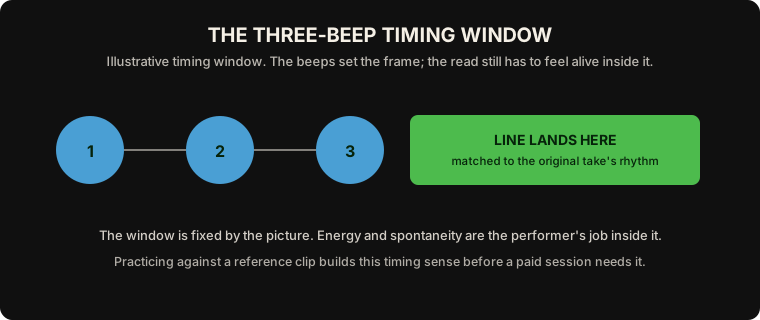
- Streamers and beeps set the timing, not you. Traditional ADR uses three audio beeps counting down to the exact frame where the line starts; the performance has to land inside that window every time, not close to it.
- Energy has to match the original take's context, not just its words. A line delivered while running needs to sound like it, even though you are standing still in a booth reading off a screen.
- Consistency across takes matters more than in a cold booking. ADR sessions frequently need several passes at the same line for picture-lock changes weeks or months apart, which makes a character bible or personal performance notes genuinely useful rather than optional.

Dubbing: The Same Discipline, Plus a Language Gap
Dubbing asks for everything ADR does, timing precision, energy matching, take-to-take consistency, with an added constraint: the translated line rarely has the same syllable count or mouth shapes as the original, so a dub script is adapted specifically to fit the visible lip movement as closely as a translation reasonably can. A voice actor working dubs is performing a script that was rewritten by a dialogue adaptor specifically to solve a timing problem you did not create and cannot fully control, which means flexibility with pacing and phrasing on the fly matters more here than in almost any other niche.
Not every market casts dubs the same way
Dubbing conventions and how closely lip sync is enforced vary significantly by target market and content type; animation generally allows more flexibility than live-action, and some markets favor a looser, more natural-sounding adaptation over frame-perfect lip match. Ask directly what standard a specific project is holding you to before the session.
Preparing for an ADR or Dubbing Session
- Watch the reference clip on a loop before recording, silently, focused only on the physical rhythm and energy of the original performance.
- Practice reading against picture with a stopwatch or the actual reference video if you have early access to it, not just the script in isolation.
- Warm up specifically for quick, repeated takes of the same short line; ADR sessions demand a different vocal stamina pattern than a long, continuous read.
- Keep a running note of any character-specific vocal choices you make, exactly as you would for a returning animation or game character, since ADR pickups can come back long after the original session.
↗ Try the tool
Performance Coach
Free to try: Performance Coach breaks down pacing and energy on every take, useful for checking that a matched ADR read still lands with real, felt energy rather than reading as timed and flat.
Open Performance Coach →How Voice Actors End Up Doing This Work
ADR and dubbing bookings tend to come through the same channels as animation and game work generally: studios, casting directors, and dialogue coordinators who already know your range from other projects, rather than a separate specialty market. Building the specific skill, timing precision without losing spontaneity, is worth doing deliberately with practice clips before the first real session, because it is genuinely different from open-script cold reading and does not transfer automatically just because the underlying acting skill is strong.
A Skill Worth Practicing Before You Need It
ADR and dubbing reward a specific, learnable discipline: hitting an exact window with a performance that still feels alive rather than mechanical. Practicing against any reference clip you can find, timing yourself, watching for where the energy slips when the pressure is on the clock rather than the performance, builds the exact muscle a real session will ask for.