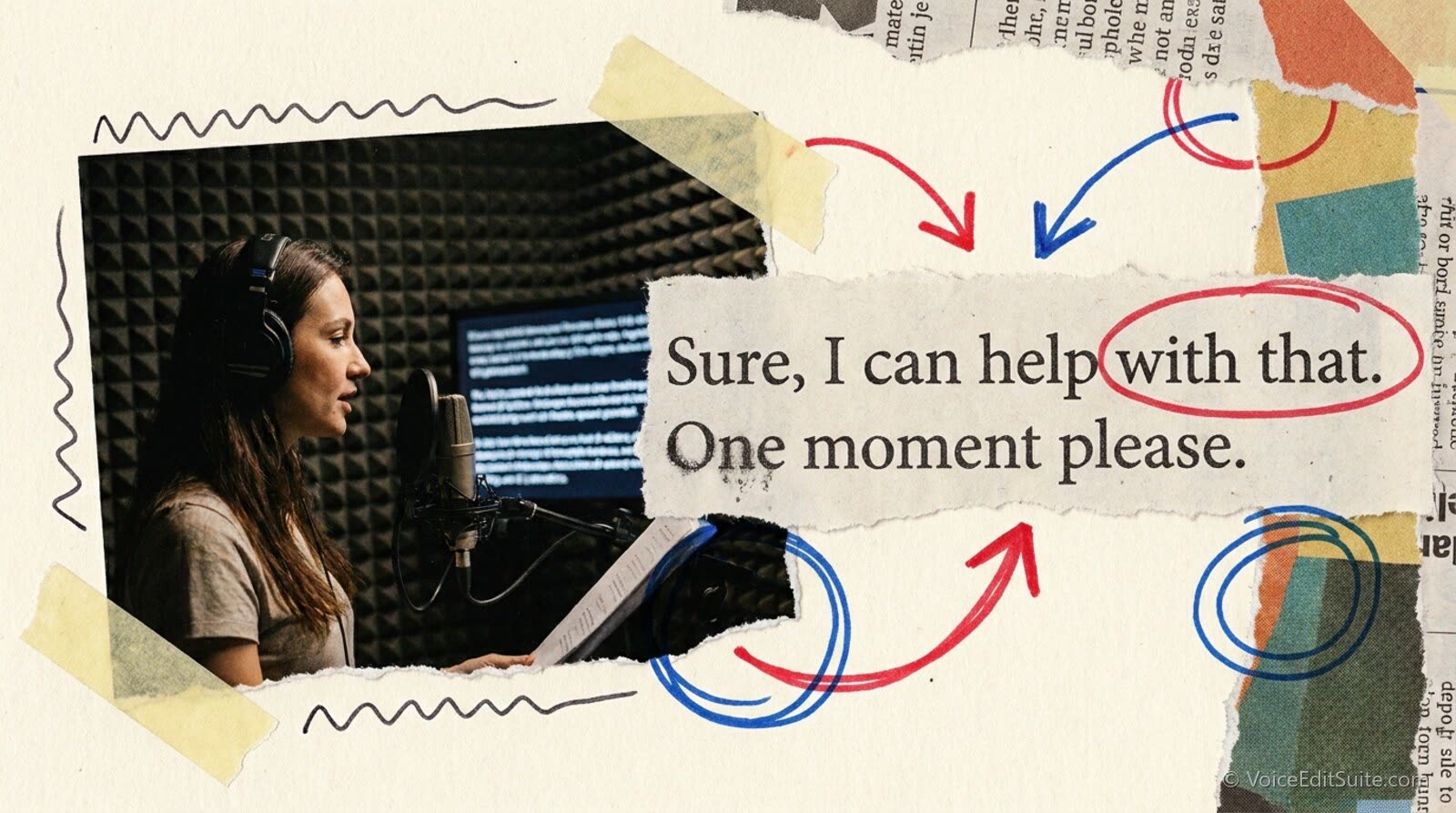
Voice over for AI chatbots and conversational agents means recording a prompt library: a spreadsheet of hundreds or thousands of short lines, read by one human voice in one consistent tone, delivered as individually named audio files rather than as a performance of a script with a beginning and an end. It is a different job from voice cloning, where a company builds a model that can generate new speech in your voice, and it is a different job from dubbing, where you are matching someone else's performance. Here, every word that plays back to a user was actually recorded by you, on that day, in that booth.
It overlaps with IVR and telephone-menu recording but is not the same niche, it prices differently from a buyout voice clone, and the contract risk sits in a specific clause: whether the files you record for the spoken lines can also be used to train a synthetic version of your voice. This Guide covers what a prompt library session actually involves, how it differs from phone-system work, how licensing for it is typically structured, who is actually hiring for it, and what to check before you agree to a session.
What a Prompt Library Session Actually Involves
The brief for this kind of job rarely looks like a script. It looks like a spreadsheet, or an export from a conversation-design tool, with one line per row: the text to read, an intent label such as "confirm_appointment" or "fallback_no_match", sometimes a character or duration limit, sometimes a note on which channel the line plays in. A single conversational agent can carry a few hundred of these for a narrow customer-service bot, and several thousand for a broad one that handles account lookups, troubleshooting, scheduling, and small talk fallbacks across multiple paths.
The script is a spreadsheet, not a page
Because the unit of work is the row, not the scene, a session is organized around batches rather than scenes or pages. A typical block runs somewhere from fifty to a couple of hundred lines, recorded with the microphone, distance, and room exactly fixed for the whole block, because even a small shift in proximity between lines that play back one after another is audible to a listener in a way it wouldn't be in a thirty-second ad. Many studios read a short tone-anchor line, the same one every time, at the start of each batch purely to check that the vocal energy and mic chain haven't drifted since the last block.
Tone has to hold across thousands of lines, not one
In a commercial or an audiobook chapter, a director is listening for a performance arc. In a prompt library, the goal is closer to the opposite: the same calm, friendly, mid-energy read has to be reproducible on line 40 and on line 4,000, on a Tuesday and then again eight months later when the client adds a hundred more lines. The brief for this work tends to name a specific, narrow emotional register rather than a performance note, because a conversational agent's voice needs to sound like one consistent character across every single interaction a user has with it, including the annoying ones, such as "I still didn't understand that" repeated three different ways.
Phoneme and prosody coverage
Some of these jobs ask for more than the functional lines themselves: a separate pass of phonetically balanced material, sentences and word lists chosen to cover the sounds and sound-combinations of the language, plus a range of question, statement, and list intonations. This is the legacy of how speech systems were built for decades. Karen Jacobsen, the Australian voice behind early Garmin GPS navigation units, has described spending roughly fifty hours in a studio for her original sessions and reportedly repeating the single word "approximately" 168 times so engineers could capture it cleanly enough to splice into other phrases; engineers also later synthesized her voice for street and place names that were never in her original script at all. Modern neural systems need less of that kind of brute-force phoneme drilling than the old concatenative systems did, but a coverage pass, reading sentences built to exercise specific sounds rather than to mean anything in particular, still shows up in briefs for voices meant to support a wide range of synthetic playback later, which is exactly the clause to read carefully, covered below.
Re-record cycles as the script expands
The defining feature of this niche, compared with almost any other voice-over category, is that the job doesn't end at delivery. A conversational agent is a live product: it gets new features, new failure messages, new regional phrasing, new compliance disclosures. Each of those additions is new lines that need the same voice, which means the client comes back, sometimes on a fixed schedule, sometimes whenever the product team ships something new. Actors who do this work well price and schedule around that pattern rather than treating each booking as a one-off.
How This Differs From IVR and Telephone-Menu Work
It's an easy niche to confuse with IVR and on-hold voice over work, and the two do share real DNA: both are built from short, individually filed lines rather than a continuous read, and both reward an actor who is reliable and consistent over years rather than flashy in any one session. But a phone-tree IVR is essentially a fixed decision tree: press 1 for sales, press 2 for support, and the menu rarely changes more than a few times a year. A conversational agent's script is closer to a living product backlog. It grows continuously as the underlying bot learns to handle new user requests, it often needs variants of the same line so the bot doesn't repeat itself verbatim in a long conversation, and it typically has far more branching fallback and error-recovery language, because a conversational system has to gracefully handle being misunderstood in ways a simple menu tree never has to.
The other practical difference is scale and cadence. An IVR client might record once and touch it again in eighteen months. A conversational-agent client, especially one still actively building the product, might be back within weeks with another batch. That makes the relationship closer to an ongoing contract than a single booking, which is exactly why the usage and training terms you agree to on the first session matter more here than in almost any other short-form voice-over category: you are very likely to be asked to extend the same terms again, not just once.
How Licensing and Usage Are Typically Structured
There is no single industry-standard contract for this work, which is part of the problem. What exists instead is a spread between two patterns, and most real contracts sit somewhere between them rather than cleanly at either end.
Per-line rates, flat session fees, and buyouts
Some clients pay per line or per batch, scoped explicitly to this product and this version of the script; when the script grows, that's a new batch at the same or a renegotiated rate. Others pay a flat session or day fee regardless of line count, which can be a fair deal if the batch is reasonably sized, or a bad one if "a day's recording" quietly expands to several thousand lines. A third pattern, more common the larger and better-funded the client, is an all-rights buyout: one payment, broad usage rights, and often language that is silent, vague, or explicitly permissive on whether the recordings can be used for anything beyond the stated product, including training a synthetic model of the voice.
Usage scope: what exactly did you license
A usage clause for this kind of work should name the product, the channel it plays on (app, phone line, in-car system, smart speaker skill), and a term, the way voice over contracts generally structure usage rights. A clause that just says "for use in Client's voice assistant" with no named product and no end date is effectively unlimited, and unlimited usage for a flat fee is a different, much larger transaction than a single license, whether or not either side has priced it that way.
The clause that matters most: can the client train a synthetic voice from these files
This is the one place where prompt library work connects directly to the AI voice cloning debate, even though the recording session itself involves no cloning at all. The files from a prompt library session are, technically, exactly the kind of clean, consistent, single-speaker audio a company would want if it later decided to train a text-to-speech model in that voice, so that the assistant could generate new lines on demand instead of booking another session. Whether a given contract allows that is a separate legal question from whether it pays you for the lines you actually read, and it's the question most likely to be glossed over in a template nobody wrote specifically for this use case.
- Does the contract name AI training, model-building, or synthetic voice creation at all? If a document never says those words, don't assume that means no; it may mean the client's lawyers drafted broad "all rights" language before anyone thought to carve the question out.
- Is consent for that use separate, signed, or initialed on its own, rather than bundled into the general rights grant? SAG-AFTRA's 2023 TV/theatrical agreement distinguishes consent for a performer's ordinary recorded performance from consent for building a digital or synthetic replica from it, and requires the latter to be clear, conspicuous, and separately signed, not implied by boilerplate.
- Is there a stated end date, or a right to revoke consent for future use? Replica Studios' 2024 agreement with SAG-AFTRA for video games lets covered performers opt out of further use of a digital voice replica in new productions, which is the kind of exit clause worth asking for even outside a union contract.
- Does the pay for a potential synthetic-voice use look like pay, or like an afterthought? When SAG-AFTRA negotiated a waiver covering AI-generated voice replicas in audio commercials, the agreed rate was $550 per commercial the replica is used in, separate from the session fee for the original recording. A number that small built into the base rate for the recording session itself is not the same deal.
- Is the clause reciprocal with what happened elsewhere in the industry when it went wrong? In early 2026, German voice actors represented by the VDS association publicly refused new Netflix dubbing contracts that added language permitting their recordings to be used for AI training without specifying extra compensation. That dispute was about dubbing, not chatbot prompts, but the clause pattern, broad AI-use rights folded quietly into an otherwise ordinary recording contract, is the same pattern to watch for here.
A buyout is not automatically a training-rights grant, but it's often read as one
The National Association of Voice Actors' free AI/Synthetic Voice contract rider states plainly that a client should not be able to use a performer's recordings to create a synthetic or cloned voice, or to train a machine-learning model, unless that use is separately named and agreed. If a client pushes back hard on adding language like that to an otherwise ordinary prompt-library contract, NAVA's own guidance is to treat the pushback itself as a signal: it often means voice cloning or AI training is exactly what they're planning to do with the files.
↗ Try the tool
Script Accuracy Checker
A prompt library script can run to thousands of rows, which is exactly the kind of batch where a single typo, an inconsistent character limit, or a line that doesn't match what the spreadsheet says gets missed by eye. Script Check compares your recorded take against the written line, row by row, so a mismatch gets caught before you deliver a file named for the wrong intent, not after the client's QA pass finds it.
Open Script Accuracy Checker →Demand Signals: Who Is Actually Building This
Market-research estimates for conversational AI vary a great deal depending on what's being measured, and the numbers below should be read as a range, not a precise figure. Fortune Business Insights puts the global conversational AI market at roughly $17.97 billion in 2026, up from about $14.79 billion in 2025, on its way to a projected $82.46 billion by 2034, a compound annual growth rate of around 21%. Within that, chatbots built on text still make up the larger share of deployments, but voice is reported as the faster-growing piece: Grand View Research separately sizes the voice AI agent segment at about $3.51 billion in 2026, projected to reach $35.24 billion by 2033 at close to a 39% compound annual growth rate. Different firms define "voice AI agent" differently, which is most of why the two sets of numbers don't match, but both point the same direction: voice-based conversational products are a smaller slice of a large and fast-growing category, and growing faster than the category as a whole.
Named, verifiable deployments are easier to point to than the market-size estimates. SoundHound, a publicly traded conversational AI company, has supplied voice ordering for White Castle's drive-thru lanes since a 2020 pilot, with the companies announcing in August 2023 a plan to expand voice ordering to more than 100 White Castle drive-thru lanes, later adding Samsung's digital signage hardware to the partnership. Cerence, another publicly traded voice AI company, builds in-car conversational assistants and describes supplying its technology to more than 80 automakers and parts suppliers. These are specific, named, sourced deployments of conversational voice products, distinct from the smart-speaker assistants (Alexa, Siri, Google Assistant) that a separate Guide on the smart speaker and voice assistant market covers in detail, including the documented history of who originally voiced them.
What those named deployments have in common for a voice actor is less glamorous than the market-size headline: a drive-thru ordering system or an in-car assistant still needs a defined, on-brand set of spoken responses, confirmations, and error-recovery lines, recorded by a human, maintained and expanded as the product changes. That's the actual job behind the stock-ticker story, and it is the same prompt-library work described above regardless of which industry is buying it.
Practical Advice if You're Approached for This Work
- Ask to see the actual line count, or a representative sample, before quoting. "A voice assistant project" could be 200 lines or 8,000. The difference changes both the fair price and how you should plan the session.
- Get the training-rights question answered in writing before you record, not after. Ask directly: can these recordings be used to build or train a synthetic or AI version of my voice, separate from using the recordings themselves in the product? A vague or deflected answer is itself useful information.
- Price with the re-record cycle in mind, not just the first session. If a client expects to come back for more lines as the product grows, say so in the contract, with a stated rate or a process for setting one later, rather than discovering informally that "a bit more" has become a standing arrangement at the original, now outdated, price.
- Keep a consistent recording setup documented for yourself. Mic, distance, interface gain, room: write it down after the first session so a re-record six months later genuinely matches, not just to your own ear but to a listener comparing old and new lines back to back.
- Read NAVA's free AI rider even if you never attach it. It's a short, specific checklist of exactly the protections, informed consent, the right to opt out, a bar on using recordings for machine training without separate agreement, that a one-off prompt-library contract is most likely to be missing.
- Treat a refusal to discuss AI/training terms as information, not an inconvenience. It doesn't automatically mean bad faith, but the clearest signal reported by voice actors who've run into this is that pushback on adding plain consent language tends to correlate with exactly the use they were trying to avoid naming.
None of this requires union membership to act on. SAG-AFTRA's AI protections apply to covered work under its own contracts, but the plain-language version of what to ask for, named product, stated term, separate written consent for anything beyond the recording itself, applies just as well to a freelance contract with a startup that has never heard of the union. The legal landscape around AI voice likeness is also moving, state by state, in ways that may eventually back some of these contract terms with statute rather than leaving them purely to negotiation, but that protection is uneven and recent, so a contract clause you can actually point to today is worth more than a law that might apply in your state next year.

It's also worth saying plainly what this work isn't. Recording a prompt library is not the same booking as licensing your voice for a one-time synthetic clone, and it shouldn't be priced or contracted as though it were. Confusing the two in either direction tends to cost the actor money: treating ordinary per-line work as if it carries clone-level stakes can price you out of a perfectly reasonable, recurring job, while treating a clause that actually grants training rights as if it were just another usage term can give away far more than the session fee reflects.
Frequently Asked Questions
What is a prompt library in voice over work?
A prompt library is the set of short, individually recorded lines a chatbot, voice assistant, or other conversational agent plays back to users: confirmations, menu options, error messages, small-talk fallbacks, and so on. It's delivered as named audio files that map to rows in a script spreadsheet, rather than as a continuous performance.
Is recording prompts for a chatbot the same as voice cloning?
No. In a prompt library session, every line a user hears was recorded by a human being, on that day, reading that exact text. Voice cloning means a company trains a model that can generate new speech in a voice without a human recording each line. The two can be connected by contract, since prompt-library recordings are exactly the kind of clean audio that could later be used to build a clone, which is why the training-rights clause matters so much, but the recording job itself involves no cloning.
How is this different from IVR or phone-menu voice over?
IVR work is built around a largely fixed decision tree that changes infrequently. Conversational-agent prompt libraries tend to grow continuously as the underlying product adds features and handles new kinds of user requests, include far more fallback and error-recovery language, and more often come with recurring re-record cycles rather than a single stable recording that lasts for years.
How should this kind of work be priced?
Per line or per batch, scoped to a named product and a stated term, is generally safer for the performer than a flat all-rights buyout, because it keeps the door open to being paid again when the script grows, which for this niche it usually does. If a flat fee is the only option offered, confirm the line count and usage scope in writing before agreeing to it, since the same flat number can be fair for 300 lines and poor for 3,000.
What if the contract just doesn't mention AI training at all?
Silence is not protection. Industry guidance from groups such as NAVA recommends adding explicit language barring the use of recordings for training or building a synthetic voice unless that use is separately named and agreed, precisely because a contract that says nothing about it can later be read as permitting it. Asking the client to add a sentence ruling it out, rather than assuming it's already ruled out, is the safer move.
Do SAG-AFTRA's AI protections apply to this kind of work?
They apply directly only to work covered by SAG-AFTRA contracts, and a large share of conversational-agent and chatbot voice work is freelance rather than union-covered. The principles the union negotiated, separate written consent for any synthetic-voice use, named compensation distinct from the base session fee, a right to opt out of further use, are nonetheless a reasonable template to ask a non-union client to match, even without the contract itself being a union agreement.
Sources and Further Reading
- SAG-AFTRA, Digital Replicas: the union's own explainer on consent requirements for employment-based and independently created digital replicas under the 2023 TV/Theatrical agreement.
- SAG-AFTRA, reporting via Variety and Decrypt on the Replica Studios interactive media agreement (January 2024): consent and opt-out terms for digital voice replicas in video games, and the $550-per-commercial AI voice replica rate agreed for audio commercials.
- National Association of Voice Actors, Synthetic/AI Voices and the published AI/Synthetic Voice Rider: a free contract addendum barring use of recordings for AI training or synthetic voice creation without separate consent.
- VDS (Verband Deutscher Synchronschauspieler) dispute with Netflix over AI-training clauses in German dubbing contracts, reported by DZRH News and Slator (early 2026): a documented real-world dispute over the same clause pattern, in a dubbing contract rather than a conversational-agent contract.
- Fortune Business Insights, Conversational AI Market size and growth estimates for 2025 to 2034.
- Grand View Research, voice AI agent market size estimates for 2026 to 2033, cited via industry market-tracking coverage; figures vary by firm depending on how "voice AI agent" is defined.
- SoundHound AI and White Castle, partnership expansion announcement (August 2023): voice-ordering drive-thru deployment across more than 100 lanes.
- Cerence Inc., company materials describing its automotive voice assistant technology and OEM/Tier-1 partner count.
- Claxton Speakers and multiple interviews with Karen Jacobsen on her original GPS navigation voice recording sessions for Garmin, including the reported 168 repetitions of "approximately" during phoneme capture.
- VoiceEditSuite Guides: On-Hold Messages and IVR Voice Over, Voice Over Contracts and Usage Rights, Smart Speaker and Voice Assistant Market 2026 and AI Voice Likeness Laws 2026.