
Voice actors have talked about AI cloning as a threat for several years now. What has changed more recently, and what gets discussed far less, is that actual, specific, named laws now exist addressing it, passed by real legislatures and signed by real governors, not just proposed. This article looks only at laws and bills that have actually passed at least one legislative stage, with direct sourcing for what each one says and quotes from the people who wrote, signed, or are actively championing them.
Tennessee's ELVIS Act: The First of Its Kind
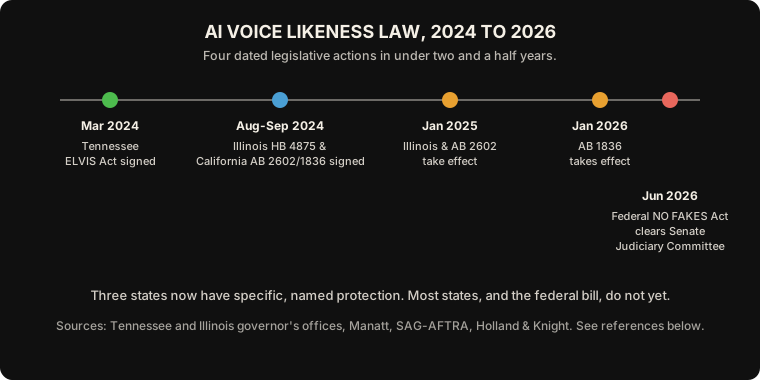
Tennessee's Ensuring Likeness Voice and Image Security Act, known as the ELVIS Act, was signed into law by Governor Bill Lee on March 21, 2024, and took effect July 1, 2024. It amended the state's existing right-of-publicity statute to explicitly add a person's voice as a protected property right, specifically naming unauthorized AI-generated vocal likeness as a violation, the first state law in the country to do so in those specific terms. At the signing, Governor Lee said: "From Beale Street to Broadway, to Bristol and beyond, Tennessee is known for our rich artistic heritage... As the technology landscape evolves with artificial intelligence, I thank the General Assembly for its partnership in creating legal protection for our best-in-class artists and songwriters."
Illinois: The Second State
Illinois followed a few months later. Governor J.B. Pritzker signed HB 4875 on August 9, 2024, effective January 1, 2025, amending the Illinois Right of Publicity Act to explicitly cover unauthorized AI-generated "digital replicas" of a person's voice and likeness. Illinois is widely described as the second state in the country, after Tennessee, to enact this kind of protection specifically. Recording Academy National Trustee Dani Deahl said of the law: "Nothing is more fundamental to each of us than our identities, and everyone should have the right to decide what words come out of their mouths and how their likeness is used."
California: Two Separate Laws, Signed at SAG-AFTRA's Own Headquarters
California passed two related but distinct laws, both signed by Governor Gavin Newsom on September 17, 2024, notably at a signing event held at SAG-AFTRA's Los Angeles headquarters. AB 2602 requires that any contract clause allowing a company to create and use an AI-generated digital replica of a performer's voice or likeness must be specific and the performer must have professional representation or legal counsel when agreeing to it; it took effect January 1, 2025. AB 1836 requires consent from a deceased performer's estate before a studio or company can create a digital replica of their voice or likeness for a new performance; it took effect January 1, 2026. SAG-AFTRA's National Executive Director and Chief Negotiator, Duncan Crabtree-Ireland, said of the broader effort behind these laws: "No one should live in fear of becoming someone else's unpaid digital puppet."
Distinguishing voice-specific laws from broader deepfake laws
A neutral state-legislative tracker, MultiState, reports that roughly 45 states have enacted some form of deepfake-related law as of mid-2026. Most of that broader category addresses political deepfakes or non-consensual explicit imagery, not specifically a performer's voice as a commercial right-of-publicity asset. The Tennessee, Illinois, and California laws described above are narrower and more specific to exactly this issue; do not assume every state has an equivalent to the ELVIS Act just because a deepfake law of some kind exists there.
SAG-AFTRA's Public Position
SAG-AFTRA has been vocal and specific in its public advocacy on this issue, publishing an open letter that gathered more than 16,000 signatures urging Congress to pass federal protection. SAG-AFTRA President Fran Drescher said: "A performer's voice and their appearance are all part of their unique essence, and it's not ok when those are used without their permission... I'm grateful that Sens. Coons, Blackburn, Klobuchar and Tillis are working to give performers recourse." Crabtree-Ireland put the underlying concern in blunter terms: "The explosion in popularity and capability of generative artificial intelligence has flooded the internet with AI-created songs, videos, and voice recordings which exploit the voices and likenesses of our members without consent or compensation... It is outrageous to think someone can undermine that value with a few prompts and clicks on a keyboard."
The Federal NO FAKES Act: Out of Committee, Not Yet Law
At the federal level, the NO FAKES Act would create a nationwide civil right of action against unauthorized AI-generated "digital replicas" of a person's voice or visual likeness, layered on top of whatever state law already applies. Led in the Senate by Senator Marsha Blackburn (R-TN) and Senator Chris Coons (D-DE), the bill passed the Senate Judiciary Committee by a unanimous voice vote on June 18, 2026, advancing it to the full Senate floor, where it had not yet received a final vote as of this article's publication. Senator Blackburn said: "AI should empower innovation, not give scammers and online predators a free pass to exploit someone's voice and visual likeness without permission."
Status changes fast; check before you rely on this
Legislative status moves quickly and this article reflects committee action current as of its publication date. Before relying on any of this for a real legal decision, verify current status directly at congress.gov and consult an attorney; this article is journalism about the state of the law, not legal advice.
What This Actually Means for a Working Voice Actor Today
- Your protection currently depends heavily on which state you are in. Tennessee, Illinois, and California now have specific, named legal footing against unauthorized AI voice cloning; most other states do not yet, which is exactly the gap the federal NO FAKES Act is designed to close if it eventually passes.
- Contract language matters more than ever, regardless of which state you are in. Understanding exactly what a contract grants for AI or digital-replica use is worth explicit attention in any new agreement, state law or not, especially following California's AB 2602 requiring clearer, represented consent specifically for this kind of clause.
- This legal landscape is a genuinely different conversation than the technical one. The technology behind AI voice cloning itself keeps advancing regardless of the law; these statutes are about what recourse exists after an unauthorized clone is made, not about preventing the technology from existing.
↗ Try the tool
Performance Coach
Free to try: the legal landscape protects the use of your voice, but the reason a client hires a real performer in the first place is the directed, felt performance a clone cannot yet replicate on its own. Performance Coach breaks down what a genuinely well-directed take actually sounds like, take by take.
Open Performance Coach →Real Law, Moving Fast, Still Incomplete
Three states have passed specific, named protections for a performer's voice against unauthorized AI cloning since 2024, and a federal bill with bipartisan Senate sponsorship has cleared committee by unanimous vote. None of that means the issue is settled: most states have no equivalent law yet, and the federal bill has not passed the full Senate as of this writing. The law is moving in a specific, documented direction; it has simply not arrived everywhere yet.

Sources and Further Reading
- State of Tennessee, Governor Lee Signs ELVIS Act Into Law: the signing date and governor's quote.
- Billboard, Tennessee's ELVIS Act: Protecting Artists' Voices From AI Impersonation: background on what the law covers.
- Recording Academy, Illinois Governor Pritzker Signs HB 4875 Into Law: the Illinois signing and Dani Deahl quote.
- Entertainment Partners, Illinois Is the Second State in the Nation to Ban Unauthorized AI-Generated Digital Replicas: confirms Illinois's position as the second state.
- Manatt, California Enacts a Host of New AI and Digital Replica Laws: AB 2602 and AB 1836 details and effective dates.
- SAG-AFTRA, Gov. Newsom Signs Union-Championed AI Bills at SAG-AFTRA Plaza: the California signing and Crabtree-Ireland quote.
- SAG-AFTRA, SAG-AFTRA Applauds Announcement of the NO FAKES Act: the Drescher and Crabtree-Ireland quotes on federal legislation.
- Holland & Knight, Senate Judiciary Committee Advances Legislation to Protect Name, Image, and Likeness: the June 2026 committee vote on the NO FAKES Act.
- MultiState, How AI-Generated Content Laws Are Changing Across the Country: the broader state deepfake-law count, used here only for context and clearly distinguished from voice-specific right-of-publicity law.
- VoiceEditSuite, AI Voice Cloning and Voice Acting in 2026: the companion piece on the underlying technology.
Corrections
This article reflects the legislative status of each law and bill as of its publication date; legislative status can change quickly, and readers relying on this for a real decision should verify current status directly and consult an attorney. This is journalism, not legal advice. If you spot an error or a status change worth noting, tell us through the contact page and we will correct it.