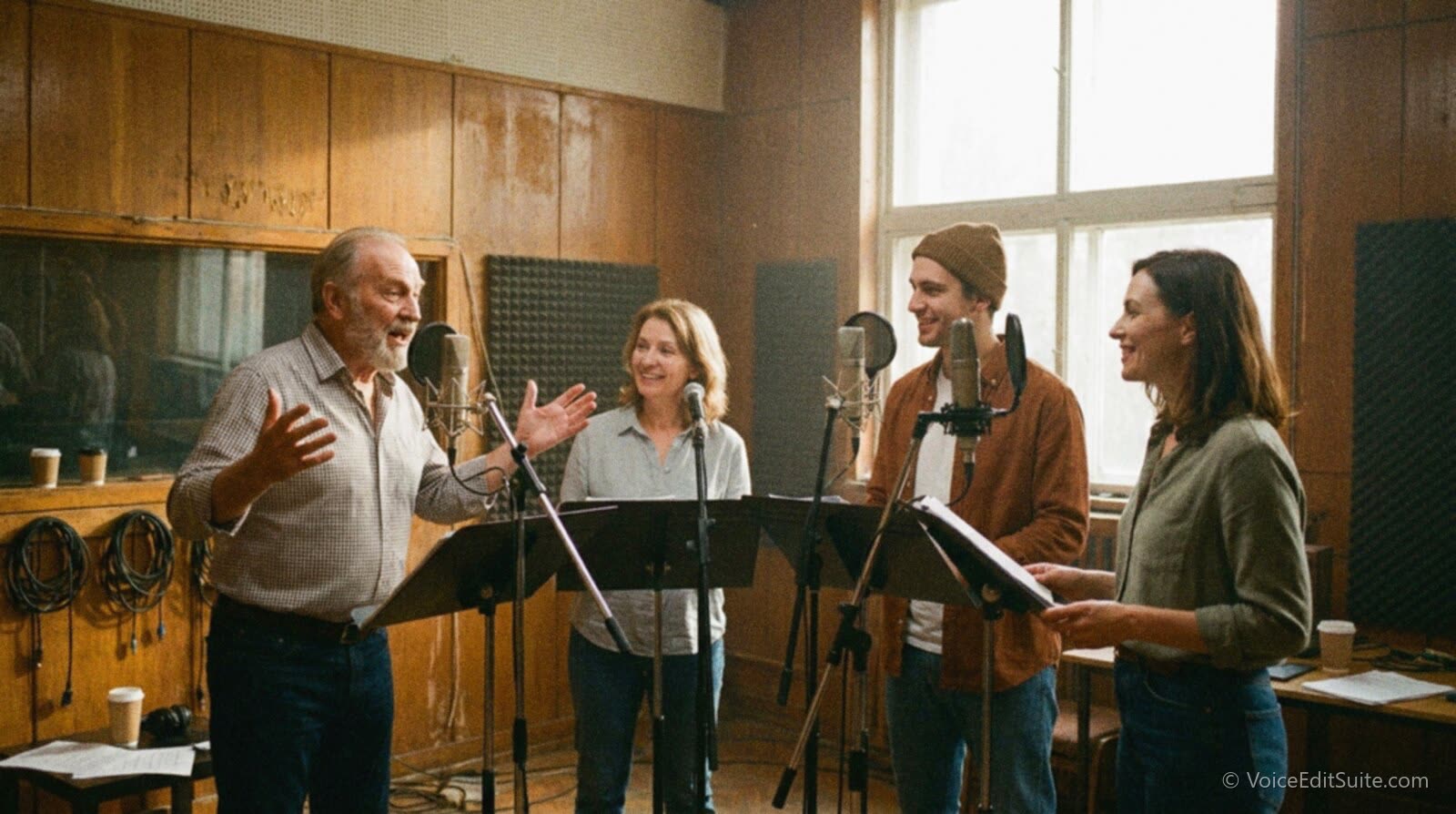
For most of the audiobook industry's history, a single narrator reading an entire book, sometimes voicing dozens of characters alone, was the default production model, and dual or full-cast narration was the exception reserved for a handful of prestige literary fiction titles or children's books. That default has been shifting for a few years, and in 2026 the shift got a kind of institutional confirmation that's hard to argue with: the Audio Publishers Association, the industry's own trade body, added four brand-new categories to the Audie Awards, its annual honors for audiobook production, and one of them exists specifically to recognize ensemble narration.
Four New Categories, One Clear Signal
The four categories added for the 2026 Audies were Adaptation/Original Work, Ensemble Performance, New Voice Award, and Production & Sound Design. Two of those four are directly relevant to the full-cast trend: Ensemble Performance exists to recognize audiobooks narrated by multiple voice actors working together as a cast rather than one person carrying the whole book, and Production & Sound Design recognizes the layered sound work, music, effects, mixing, that increasingly accompanies these bigger, more theatrical productions. An awards body doesn't add a permanent new category lightly; it does so when enough of the industry's actual output has shifted to justify one.
The inaugural Ensemble Performance winner made the case for the category on its own. The 2026 Audie for Ensemble Performance went to The Correspondent, written by Virginia Evans, narrated by a cast of fifteen: Maggi-Meg Reed, Jane Oppenheimer, Carly Robins, Jeff Ebner, David Pittu, Chris Andrew Ciulla, Mark Bramhall, Petrea Burchard, Robert Petkoff, Kimberly Farr, Jim Seybert, Cerris Morgan-Moyer, Jade Wheeler, Peter Ganim, and Steve West. A novel told through correspondence between multiple characters lends itself naturally to a full cast, with each letter-writer voiced by a different, distinct performer rather than one narrator shifting registers alone.
"Thanks to outstanding narrations, responses to [Sybil Van Antwerp's] letters allow each correspondent to emerge as a fully realized individual."
That kind of recognition, from a respected book-review outlet rather than an industry trade publication alone, matters for the trend's credibility. It signals that ensemble narration is being judged by ordinary literary standards and succeeding on them, not treated as a novelty format reviewed on its own separate curve.
What's Actually Driving the Shift
The underlying audiobook market itself has kept growing enough to fund this kind of production investment. Mordor Intelligence puts the global audiobook market at roughly $8.68 billion in 2026, projecting growth at a compound annual rate of about 10.6% through 2031, while Grand View Research's own estimate puts 2026 at roughly $13.9 billion with a steeper projected growth curve. The two firms use different methodologies and arrive at meaningfully different absolute numbers, which is worth being upfront about rather than treating either figure as the single settled truth, but both point the same direction: a market large enough, and growing fast enough, that publishers have real incentive to differentiate a title with a more ambitious, more expensive production rather than a standard single-narrator read.
Sound design and immersive atmospheric elements, music beds, ambient effects, spatial mixing, have become a more consistent feature of premium audiobook productions alongside the cast expansion itself, which is exactly what the new Production & Sound Design category was built to recognize. Together, the two new categories describe the same underlying shift from two different angles: audiobooks increasingly produced less like a single person reading a book aloud and more like a scripted audio drama built from a full creative team.
What This Actually Means for a Working Narrator
A full-cast or ensemble production changes the job in some specific, practical ways compared to solo narration. You're recording your portion against a script built around timing and handoffs with other performers you may never be in the same room with, which puts a premium on disciplined pacing and a director's guide track to match against. Audiobook pacing and character voice work still matters enormously, but the skill shifts slightly: holding a single, consistent character convincingly across your assigned portions matters more than the solo narrator's broader skill of differentiating a dozen characters alone within one voice.
↗ Try the tool
ACX Audiobook Prep
Whether you're narrating solo or recording your portion of an ensemble cast, the final files still need to meet the same technical bar. ACX Audiobook Prep checks your delivery against the spec before you submit.
Open ACX Audiobook Prep →For narrators pursuing this kind of work, the practical path in isn't dramatically different from building any other audiobook relationship: how long it actually takes to edit an audiobook and the realities of audiobook production schedules still apply, scaled up for coordinating multiple performers and a more complex post-production process. Publishers and audiobook producers who already commission ensemble work are the ones worth building a relationship with specifically, since not every audiobook producer has the budget or workflow set up for multi-narrator projects even as the trend grows.
Frequently Asked Questions
Is full-cast narration going to replace solo narration as the industry standard?
There's no indication of that in the available data. Solo narration remains by far the dominant production model industry-wide; full-cast and ensemble work is growing as a distinct, premium category alongside it, not displacing it, in much the same way that a bigger film budget doesn't eliminate smaller, single-actor productions.
Does ensemble audiobook work pay differently than solo narration?
Pay structures vary by publisher and by project, and the available public reporting doesn't give a reliable industry-wide comparison between the two. Understanding ACX royalty share versus per-finished-hour pay is a useful starting framework regardless of whether a project is solo or ensemble, since the underlying pay-structure questions are the same either way.
How does a narrator actually get cast in an ensemble audiobook project?
Mechanics vary by producer, but existing relationships with audiobook publishers and production companies who already commission this kind of work tend to matter more than a general open casting process, since coordinating a full cast is a bigger production lift that publishers often plan around narrators they already trust.
Sources and Further Reading
- New York Public Library, These Audiobooks Just Won a 2026 Audie Award: confirmation of the four new 2026 Audie categories and winners.
- Audio Publishers Association, 2026 Winners: the official Audie Awards results, including the Ensemble Performance category and The Correspondent's narrator cast.
- Audio Publishers Association, 2026 Audies Finalists Press Release: the APA's own announcement of the finalists across the new categories.
- Mordor Intelligence, Audiobook Market Size, Trends & Industry Overview, 2031: the $8.68 billion 2026 market estimate and growth projection.
- Grand View Research, Audiobooks Market Size, Share & Trends Report, 2026-2033: the alternative $13.9 billion 2026 market estimate.
Corrections
Market size figures above are reproduced from the cited Mordor Intelligence and Grand View Research reports with their original attribution; the two firms use different methodologies and their dollar figures should not be treated as directly comparable. The Kirkus Reviews quote is reproduced as published in that outlet's review coverage. Spot an error? Tell us through the contact page and we will correct it with a note.