Audiobook work is quoted per finished hour (PFH): one hour of final, listenable audio. The economics of narration live in the gap between that finished hour and the real hours it takes to produce, because a $250 PFH rate that consumes seven working hours is really $35 an hour, while the same rate at three working hours is $80.
So how long does it actually take? For most narrators doing their own post: five to seven real hours per finished hour, and editing is the biggest single piece. Here is the honest breakdown, and the levers that move it.
The Honest Math Per Finished Hour
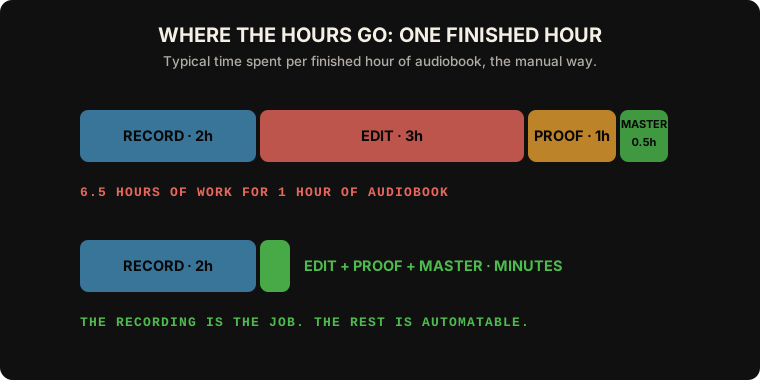
- Recording: about 2 hours. Even a clean narrator re-takes lines, drinks water, and rests the voice. A 2:1 record ratio is solid professional pace.
- Editing: 2 to 3 hours. Cutting false starts and retakes, tightening gaps, removing breaths and mouth noise, chasing the page-turn thumps. The classic estimate narrators trade is 2 to 3 hours of editing per finished hour, and it matches reality.
- Proof listen: about 1 hour. Someone has to hear every finished minute against the manuscript to catch misreads and skipped lines. If it's you, that is another real-time pass.
- Mastering and QC: about 30 minutes. Levels into the ACX window, peaks limited, noise floor checked, room tone at head and tail, exports per chapter.
Total: roughly 5.5 to 6.5 real hours per finished hour. A 10-hour book is a 55 to 65 hour project. That number is why experienced narrators either pay an editor (commonly $60 to $100 per finished hour, straight off the margin) or get serious about collapsing the post-production time.
Where the Editing Time Actually Goes
Track an editing session and the time is not going where you would guess. The artistic decisions are quick. The clock disappears into mechanical work:
- Finding the keeper take. You read the sentence three times mid-chapter. Which one stays? Scrubbing back and forth to compare takes is the single biggest time sink.
- Breath and gap management. Hundreds of breaths per chapter, each one a decision: keep, soften, or cut. Then the pause after every sentence needs to feel consistent.
- The hunt for flubs you half-remember. You know there was a stumble somewhere in chapter 7. Finding it means listening, not editing.
- Repetitive cleanup. Mouth clicks, chair creaks, the same mechanical fix applied five hundred times.

The Three Ways Narrators Cut It Down
- Punch and roll while recording. When you flub, stop, roll back a sentence, and re-record over the mistake in place. The edit happens at record time, and the session file comes out nearly clean. This is the single best manual habit in audiobook work.
- Proof while editing, not after. One combined pass where you listen against the manuscript AND make cuts saves a full real-time listen, at the cost of more focus per hour.
- Automate the mechanical layer. Take selection, false-start removal, breath handling, and gap tightening are pattern work, and pattern work is what software is for. This is where the 90 percent lives.
↗ Try the tool
Auto Clean Up
Auto Clean Up does the mechanical layer in one pass: it keeps your best take of every line, drops the false starts and off-script talk, and tightens the silences with your natural breaths kept. A chapter that took 90 minutes to edit comes back in about a minute, and you review the result on a waveform where the recording has become editable text.
Open Auto Clean Up →Don't Skip the Accuracy Pass
The most expensive error in audiobook production is the one found last. A misread caught by the publisher's QC after delivery means a pickup session, a remaster, and a redelivery for one sentence, days after you left that headspace. Word-level accuracy against the manuscript is not optional, the only question is whether checking it costs you an hour per finished hour or a few minutes.
↗ Try the tool
Script Accuracy Checker
The Script Accuracy Checker compares your finished audio against the manuscript word by word and flags every drop, swap, and stumble with its timestamp. A chapter's accuracy pass goes from a real-time listen to a scan of the flagged lines.
Open Script Accuracy Checker →The Last Half Hour: Mastering to Spec
Audiobook delivery has hard numbers: RMS between -23 and -18 dB, peaks at -3 dB or lower, noise floor at -60 dB or lower, and real room tone at the head and tail of every file. Getting these right the first time matters because the failure loop is slow: ACX QC takes days to bounce a file, and a bounced book is re-work across every chapter. Master to the numbers, verify the numbers on the finished files, and the QC email is an approval, not a to-do list.
The Per-Chapter Checklist
- Recorded punch-and-roll, so the session file is nearly clean already.
- Mechanical edit done (best takes, gaps, breaths), by machine or by grind.
- Accuracy verified against the manuscript, every chapter, before mastering.
- Mastered to the ACX numbers and verified on the delivered file.
- Raw session archived untouched, in case the publisher wants a different treatment later.
The recording is the job: the performance, the characters, the stamina. Everything after the record light goes off is process, and process is exactly the part you are allowed to make fast.