
The short answer: ACX estimates that most narrators average about 9,300 words per finished hour, which is roughly 155 words a minute once every pause, scene break and chapter header is counted in. That is an average across a whole book, not a speed to hold: good audiobook pacing moves with the story, slower through description and faster through action and quick dialogue. Character voices work best as two or three small, repeatable shifts in pitch, pace, placement and attitude, written down and recorded the first time each character speaks, so you can match them in every later session.
Most voice training is built for short reads: a thirty-second spot, a two-minute explainer, an audition. Audiobook narration asks for different muscles, because nobody listens to a ten-hour book the way they listen to an ad. They listen in the car, on a walk, while cooking, often for an hour at a stretch, and the performance has to hold them across that whole span without ever announcing itself. Two skills do most of that work: pacing that breathes with the story instead of running at one flat speed, and character voices distinct enough to follow with your eyes closed but light enough to sustain for a whole book. This guide covers both in detail, for audiobook narrators and for podcasters who narrate fiction, history or story-driven episodes.
How Fast Should You Read an Audiobook?
The most useful number in audiobook pacing comes from ACX, Audible's production marketplace. Its help centre says most performers narrate about 9,300 words per hour, and tells authors to divide a book's word count by 9,300 to estimate the finished length. ACX uses the same figure to calculate running time when a title profile is created, so it quietly shapes how books are budgeted, scheduled and paid for on a per-finished-hour basis.
Divide 9,300 by 60 and you get 155 words a minute. The detail that matters is what that minute contains. A finished hour is not an hour of continuous speech: it includes the pause after every full stop, the longer beat at a paragraph turn, the silence around a scene break, the chapter header, and the room tone at the head and tail of every file. So your speaking rate inside a sentence is usually faster than 155, and the pauses bring the average back down. A narrator who reads every sentence at exactly 155 words a minute and trims the pauses tight will finish short of the estimate and sound rushed.
The chart is simple arithmetic, but it answers the planning questions that matter. An 80,000-word novel lands at about 8.6 finished hours. ACX's own estimate of production time is about 6.2 hours of work per finished hour, made up of roughly two hours of recording, three of editing and about 1.2 of quality review, and it notes that new narrators generally take five to seven hours just to record one finished hour. That puts the same novel at around 53 hours of work. If you are quoting a per-finished-hour rate or blocking out a recording calendar, start there, and see how long it takes to edit an audiobook for where the editing hours go.
Measure your own rate instead of copying the average
9,300 is a population average. Your natural rate, your genre and the book's prose will move you off it, and that is fine. To find your own figure, record one finished chapter at the pace that feels right for the book, edit it as you normally would, then divide the chapter's word count by its running time in minutes. Do this for two or three chapters. If you come in well above 155, listen back for clipped full stops and rushed paragraph turns before you assume you are simply a quick reader. If you are well below, check for over-long pauses and a habit of leaning on every adjective. Either way, the number tells you where to listen, not what to change.
Listeners can change your speed, but not your pauses
Audible's player lets listeners set narration speed anywhere from 0.5x to 3.5x, and many listen faster than 1x. Speeding up playback compresses everything evenly, so a narrator who leaves clear, well-judged pauses still sounds organised at 1.5x, while one who rushes the pauses becomes a blur. Pace for the 1x listener and let the shape of your pauses do the work at any speed.
If you find yourself running fast because you are nervous or tired rather than because the text calls for it, that is hurry, not pace. Hurry shortens the pauses first and the words second, so the fix is usually to restore the full stops rather than to slow every word. When a passage genuinely needs speed, keep the consonants crisp and the pauses proportionate, and it will sound urgent rather than rushed.
Pacing by Genre
There is no published table of words per minute by genre, and you should be wary of anyone who quotes one. What does hold across genres is that pace follows what the prose is doing. According to the Audio Publishers Association's 2026 sales survey, general fiction was the largest share of audiobook revenue in 2025 at 27 percent, with science fiction and fantasy, romance, and mysteries, thrillers and suspense among the other top genres. Those cover most of what a working fiction narrator records, and each pulls pace in a recognisable direction:
- Thrillers and suspense: short chapters, short sentences, cliffhanger endings. Let the pace tighten through action, but protect the pause before a reveal. Tension lives in the beat you hold, not in the speed you hit.
- Romance: the inner monologue carries the story, so the narrator voice should sound like the point-of-view character's own thoughts. Banter can run quick; the emotional turns need room. Dual point-of-view romances are often cast with two narrators for this reason.
- Science fiction and fantasy: invented names, places and systems. Slow slightly the first time a new term appears so the listener can file it, then say it at normal speed afterwards. A pronunciation glossary is not optional in this genre.
- Literary and general fiction: long sentences with nested clauses. The job is to make the grammar audible, so the listener always knows where the main verb is. That usually means more variety in pace, not less speed.
- Nonfiction and business: steadier and clearer, with deliberate emphasis on the key term in each paragraph and a fuller pause before a numbered point or a section summary.
- Memoir: the author's personality should come through, which usually means a more conversational, slightly less polished pace than fiction narration.
- Children's and middle grade: clearer and usually slower, with more room around jokes, sound words and page turns.
Inside any genre, the bigger pacing mistake is treating speed as one dial set once at the top of a session. A skilled narrator lets pace track the content: a touch more measured through scene-setting, tightening as tension builds, quickening through a fast exchange, settling back through the resolution. None of this is about reading faster or slower in an absolute sense. It is relative variation that mirrors what a reader's own inner voice would do with the same text.
Read each chapter silently for its shape before you record it, and mark, even just with a pencil line, where tension rises and where it releases. Cold-reading a chapter on mic means you discover its shape at the same moment you are meant to be performing it. Then vary pace across paragraphs, not just across chapters: a whole chapter delivered at one well-chosen pace still reads as monotone over forty minutes, even if no single sentence sounds wrong.
Pauses, Scene Breaks and Chapter Files
Pauses are where most of an audiobook's structure lives, because the listener cannot see a paragraph indent, a section break or a chapter heading. Your pauses are their punctuation. A useful way to think about it is as a ladder, where each rung is clearly longer than the one below:
- Comma: a lift or a tiny hold, often no real silence at all.
- Full stop: a definite stop. This is the one most often rushed, and honouring it consistently changes how easily a listener follows a long passage.
- Paragraph: a fuller breath. The listener should feel the thought has turned.
- Scene break: the blank line or ornament in the print book. Hold clearly longer than a paragraph pause, and let the first line of the new scene start fresh, often a little lower in energy, so the listener hears the shift in time or place.
- Chapter: handled by the file itself. ACX requires each chapter or section in its own file, each opening with its section header, such as "Chapter 1" or "Prologue".
ACX's submission requirements set the rest of the chapter-level structure. Each file needs between one and five seconds of room tone at its beginning and end, and spacing must not exceed five seconds. No file may run longer than 120 minutes; a longer chapter has to be split, with a secondary header for continuity. Opening and closing credits are separate files, and the closing credits must tell the listener the book has ended. ACX warns that missing headers mean revisions and can delay release. If you clean up your audio with an editing tool that tightens dead air, such as Auto Clean Up, check afterwards that your scene-break pauses are still clearly longer than your paragraph pauses.
Punch and roll makes pacing experiments cheap
If you are unsure whether a pacing choice is landing, punch-and-roll recording lets you redo just the phrase in question without re-recording the whole page, which makes it far cheaper to actually try a different pace on a tricky passage instead of settling for the first take.
The Narrator Voice and the Character Voices
Every fiction audiobook has at least two kinds of voice in it: the narrator voice that carries the prose, and the voices of the characters who speak. The narrator voice is the home base the listener spends most of the book with, and it should be close to your own natural, relaxed voice so you can sustain it for hours. Julia Whelan, whom NPR introduced as one of the most prolific narrators in the business, told the network in 2022 that she has developed "a narrator voice that I feel is the least intrusive for the listener", and that her aim is to represent the voice of the book first, not her own.
Character voices then move away from that home base, and the real skill is judging how far. Audiobook character work has a constraint animation and games do not: you may hold a character across ten hours of recording, spread across weeks of sessions, without straining your voice or losing track of who they are by chapter twelve. The pitch-and-pace framework for building character voices still applies, but audiobooks usually want a lighter touch. A useful scale:
- Narration: home base. Your own voice, tuned to the book's tone and point of view.
- Minor and one-scene characters: a small shift, one marker such as a slightly different pace or attitude. The dialogue tag does most of the identifying.
- Recurring characters: two or three clear, repeatable markers, written down. A listener with their eyes closed should know who is speaking within a few words.
- Big, comic or non-human characters: a fuller transformation, used sparingly and only where the book invites it, and only in a voice you can hold safely for every scene they appear in.
In a first-person book the line moves. The narrator is a character, so your narration voice is that character's voice, and the other characters are heard through them. In a first-person book with two alternating narrators, each needs a distinct narration voice of their own, which is one reason publishers often hire two performers.
Building a Character List and Voice Notes
Character work starts before you open the microphone. Whelan told NPR that she does a thorough prep read first, tracking every character who speaks and every vocal trait the author gives them: accents, descriptions and biographical details. By the time she steps into the booth, she has a plan. That prep read also catches the traps a cold read falls into, such as a character's accent revealed in chapter nine, after you have already voiced them in chapter two, or a late twist in which a speaker turns out to be someone else.
Jim Dale, who narrated the US editions of the Harry Potter books, built one of the best-known systems for keeping track of a huge cast. He told Publishers Weekly in 2003 that Order of the Phoenix had 134 characters, more than 60 of them new, and that he remembered the voices by recording them as he reached them, capturing each character's first line of dialogue to keep a catalogue for himself. In a 2020 interview on AudioFile's Behind the Mic podcast, published by Lit Hub, he described reading each character's line into a small tape recorder with its page and line number, then playing it back whenever that character returned. A phone and a folder of labelled clips do the same job today.
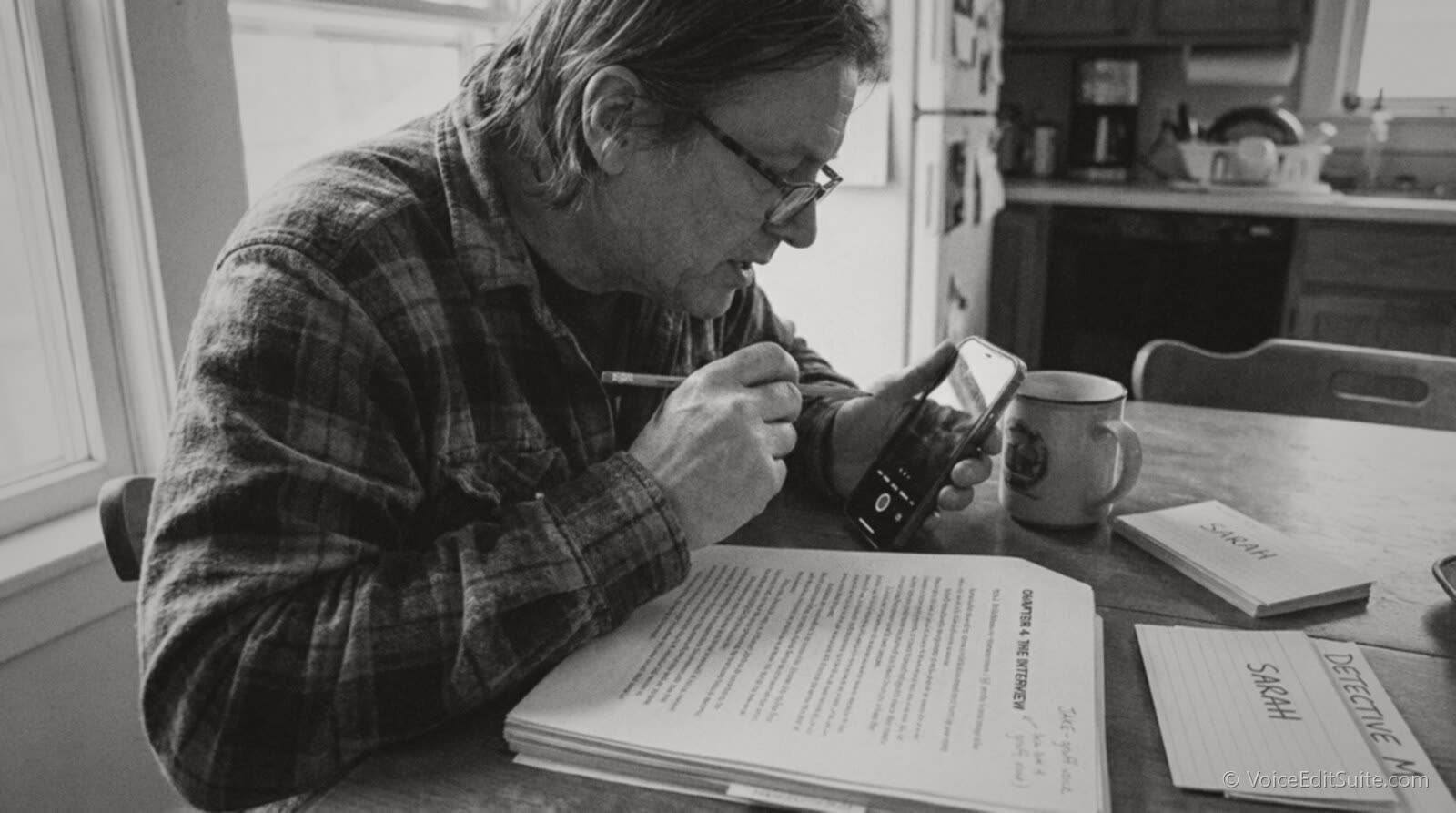
A practical character list has one entry per speaking character, built during the prep read and finished the first time they speak on mic. Record what the author gives you first, because those details are not yours to change: age, origin, accent, any description of the voice, and the page where it appears. Then record your own choices. The classic levers are pitch centre (where the voice sits relative to your narration), pace and rhythm, placement or resonance (forward and bright, or back and dark), accent or dialect, and attitude, meaning what the character wants and how that colours every line. Most characters need only two or three of these moved. Write them in words you will understand three weeks later, not in technical shorthand you invented at midnight.
Then make the reference clip. Record the character's first line, or a short line that captures them, name the file with the character, chapter and page, and keep it with the project. The character bible guide covers this in more depth for series work, where the same cast returns book after book and a listener will notice if a voice has moved between volumes. Put pronunciations in the same document: ACX's requirements list pronunciation alongside levels and tone as something that must stay consistent across the whole audiobook.
Notice that the example moves the pitch only a little and does most of the work with rhythm and attitude. That is deliberate. Pitch is the most tiring lever to push and the easiest to drift on; pace, attitude and a single signature habit are far easier to repeat precisely across a long book.
Dialogue Tags: Reading "He Said" Well
Dialogue tags are the phrases that tell the reader who spoke: he said, she asked, Mara muttered. On the page the eye skims them. In audio they take real time, and how you read them decides whether a conversation flows or stumbles. The usual expectation in commercial audiobooks is that you read the text as written, tags included, so the craft is in the delivery rather than in cutting them.
- Read the tag in the narrator voice, not the character's. Drop out of the character cleanly on the tag, then back in if the line continues. Carrying the character's voice into "she said" blurs who is talking.
- Keep tags light and close. A tag after a line usually wants little or no pause before it and a slightly lower, quicker delivery, so it lands as information rather than a performance.
- Watch for the late tag. In "Get out," she whispered, the instruction arrives after the line. If you have not prepped the page, you will shout a whispered line and have to re-record it. This is one of the most practical reasons for a full prep read.
- Do not double the description. If the tag says "he snapped", the reading of the line should already have snapped. Do not then read "snapped" with extra bite as well.
- Mid-line tags need a seamless return. In "I told you," he said, "I'm not going", the second half must come back in exactly the same voice and energy as the first, as though the tag never interrupted.
- Untagged runs rely on your voices. Long back-and-forth exchanges without tags are where character differentiation earns its keep. Mark the speaker in the margin during prep so you never lose track mid-scene.
Action beats, the lines that attribute speech through movement ("Mara set down her cup. 'You're late.'"), work the same way. Read the action in the narrator voice, then let the character speak. The beat does the job of a tag, and listeners follow it easily as long as you switch voices cleanly.
Keeping Voices Consistent Across Sessions
A cast of six or seven characters recorded over three weeks is exactly the situation where memory quietly drifts, and listeners notice drift faster than narrators do. The listener hears chapter twelve an hour after chapter two; you recorded them sixteen days apart. Consistency is not only a performance issue, either. ACX's submission requirements say audio levels, tone, noise level, spacing and pronunciation must be consistent across the audiobook, so a voice that drifts and a room that changes are both problems a reviewer can flag.
The routine is mostly minutes. Listening to the reference clips for the characters in today's chapters takes less time than re-recording one scene in which a voice slid. Keep your physical setup fixed as well: the same mic distance, the same gain and the same chair height all affect tone, and many narrators mark the mic position with tape. A consistent warm-up brings your voice to the same place each day, and the end-of-session comparison, one line from today played against the same character on day one, takes thirty seconds and catches drift while it is still small.
The room matters as much as the voice. Heating that switches on in winter, a new fridge, or a change in traffic can shift the noise floor between sessions, which ACX treats as an inconsistency. Run Home Studio Analysis, which is free and measures your room, when you start a project and again if anything in the room changes. If a session does pick up hiss, hum, fan or room noise, Studio Rescue removes it, though it cannot fix echo, so room treatment still matters. The guide to removing background noise from podcast audio walks through the same problem for spoken-word recording generally, and the ACX loudness requirements guide covers the measurements a chapter has to pass.
Gender and Age Without Caricature
Every narrator voices characters of a different gender and age from their own, and this is where restraint matters most. The listener does not need you to sound like a person of another gender or age. They need to know instantly who is speaking and to believe the character. Both are achievable without pushing your voice anywhere unhealthy or leaning on stereotypes.
Voicing the other gender
Keep the pitch shift modest and stay in a part of your range you can use all day. Then do the rest of the work with placement, rhythm and attitude. Narrators voicing men often shift resonance slightly back and down, slow the rhythm a touch and land phrase endings more firmly; narrators voicing women often bring placement slightly forward and let the melody move more. These are tendencies, not rules, and the best guide is always the character as written: a quiet, careful man and a blunt, fast-talking woman are both more convincing played from who they are than from a generic idea of gender.
What reads as caricature is almost always exaggeration in one stereotyped direction: a breathy, simpering register for every woman, a growl for every man. It also tends to get worse as a narrator tires. If a voice only works when you push, it will not survive a long session, and it will not survive a listener's judgement either. The same principle applies to accents; the guide to accent and dialect work without stereotyping covers how to suggest an accent respectfully and how much is enough.
Children and older characters
Children are not simply higher. They speak in shorter bursts, with more energy, more curiosity and fewer adult hedges, and they react before they think. A modest lift in pitch plus that change in rhythm and intent sounds younger than a strained squeak. Older characters are not simply shaky either. Age often shows in a slower decision before speaking, a lower energy level and a more settled melody, while the mind can be as sharp as anyone's. Play the person, then add just enough age to place them.
Gravel is expensive
Jim Dale has told the story of recording Hagrid as a gravelly giant and losing his voice within ten minutes, which cancelled the session. Rough, gravelly, shouted and whispered voices put the most strain on your instrument. Find a way to suggest them through placement and attitude, keep them short, and schedule their heaviest scenes at the end of a session rather than the start of a long day.
Put your gender and age choices on the voice sheet like any other marker. A note such as "pitch barely moved, rhythm slower, ends phrases down" is easier to repeat in week three than a vague note that says "deeper".
For Podcasters: The Same Skills on a Smaller Scale
Podcasters use these skills more often than they might think. A history show quotes letters and speeches from real people. A true-crime episode reads court transcripts with several speakers. A fiction podcast or audio drama narrated by one host is a short audiobook with a release schedule. The same rules apply: a stable narrator voice as home base, small and repeatable shifts for quoted speakers, a clear pause ladder so listeners hear where a quote starts and ends, and a voice sheet if any speaker returns across episodes.
Quoting real people adds one rule of its own. Do not perform an impression of a real person's accent or manner unless you can do it accurately and respectfully; a neutral, clearly signalled quote in your own voice is almost always the better choice. Fiction podcasters running a series should keep reference clips exactly as audiobook narrators do, because episode twelve may be recorded months after episode one.
Practice Drills
Pacing and character work are both skills you can practise away from a paid project. These drills each take ten to twenty minutes, and work best recorded and played back the next day with fresh ears:
- Measure your rate. Record a 1,000-word passage at book pace, edit it normally, and divide 1,000 by the running time in minutes. Repeat with a thriller passage and a literary one, and compare.
- The pause ladder. Take a page with a scene break. Record it once with all pauses equal, then again with comma, full stop, paragraph and scene break each clearly longer than the last. Listen to both back to back.
- One line, five levers. Say a neutral line ("I didn't expect to see you here") as five different characters, moving only one lever each time: pitch, pace, placement, accent, attitude. Notice which shifts you can repeat exactly the next day.
- The two-hander. Find a page of quick untagged dialogue between two characters and record it without stopping. Then play it to someone who has not read it and ask them to say who is speaking at each line.
- The drift test. Record a character's line today. In a week, record it again without listening first, then compare the two. Repeat after listening to the clip. The difference is the reason reference clips exist.
- Stamina run. Once a month, record a full chapter in one sitting at book pace and listen to the last five minutes against the first five. Pace variety and character precision usually fade before the voice sounds tired.
That last drill points at the skill nobody names directly: stamina. A forty-minute chapter recorded in one sitting is a different physical task from a thirty-second spot, and pacing and character precision both slip before the voice obviously sounds tired. Build sessions with real breaks between chapters, not just between hours, and schedule a book across sensible daily sessions rather than marathon days. Good breath support and hydration help too, but the schedule protects the performance most.
↗ Try the tool
ACX Audiobook Prep
Free to try: once a chapter is recorded, run it through the ACX Audiobook tool to confirm it clears Audible's loudness, peak and noise floor requirements before you submit, so a strong performance is not held up by a technical rejection.
Open ACX Audiobook Prep →The best long-form narrators make both skills disappear into the listening. You notice a character without noticing the technique that built them, and you feel a chapter's momentum without tracking the pacing decisions behind it. That invisibility comes from practising each skill on its own, writing down what works, and then trusting both once the red light comes on.
Frequently asked questions
How many words per minute is an audiobook?
ACX estimates most narrators average about 9,300 words per finished hour, which is about 155 words per minute with all pauses and breaks included. Speaking rate within sentences is usually somewhat faster, and individual narrators and genres vary around the average.
How long will my audiobook be?
Divide the word count by 9,300 for ACX's estimate. An 80,000-word novel comes out at about 8.6 finished hours and a 100,000-word novel at about 10.8. Production takes much longer than the running time: ACX estimates about 6.2 hours of recording, editing and review per finished hour.
Do audiobook narrators have to do character voices?
Fiction listeners expect characters to be distinguishable, but that does not mean a full theatrical voice for everyone. Many narrators use small shifts in pitch, pace, placement and attitude, and keep big transformations for a few characters. Nonfiction usually needs little or no character work beyond quoted speech.
How do you narrate a character of the opposite gender?
Keep any pitch change modest and comfortable, and do most of the work with resonance, rhythm and attitude drawn from the character as written. Avoid falsetto, breathiness or growling as a shortcut; they read as caricature and are hard to sustain across a book.
How do narrators keep character voices consistent?
Most keep a written character list with notes for each voice and a short reference recording of each character's first line, then play the relevant clips before each session. Jim Dale described doing exactly this with a tape recorder for the Harry Potter books. A fixed mic position and room setup keep the tone consistent too.
How long should a pause be at a scene break?
There is no fixed rule. A scene break should be clearly longer than a paragraph pause so the listener hears the shift, without dragging. Chapter boundaries are handled by separate files: ACX asks for one to five seconds of room tone at the start and end of each file, never more than five.
Sources and Further Reading
- ACX Help Center, How long will my narrated audiobook be?: the 9,300 words per hour estimate.
- ACX Help Center, Producing and recording your audiobook: the 6.2 hours of work per finished hour estimate and its breakdown.
- ACX Help Center, ACX Audio Submission Requirements: room tone, file length, section headers, credits and consistency rules.
- Audio Publishers Association, Sales and consumer surveys, June 2026, as reported by infoDOCKET: 2025 revenue and genre share.
- NPR, Julia Whelan on narrating her romance novel about a narrator who hates romance novels, August 2, 2022: the narrator voice and the prep read.
- Shannon Maughan, The Voice of Harry Potter's World: PW speaks with Jim Dale, Publishers Weekly, July 14, 2003: 134 characters and the catalogue of first lines.
- Behind the Mic with AudioFile Magazine, In Conversation with Legendary Harry Potter Audiobook Narrator Jim Dale, Lit Hub, January 22, 2020: the tape recorder method and the Hagrid story.
- Audible, Narration speed: the 0.5x to 3.5x playback range.