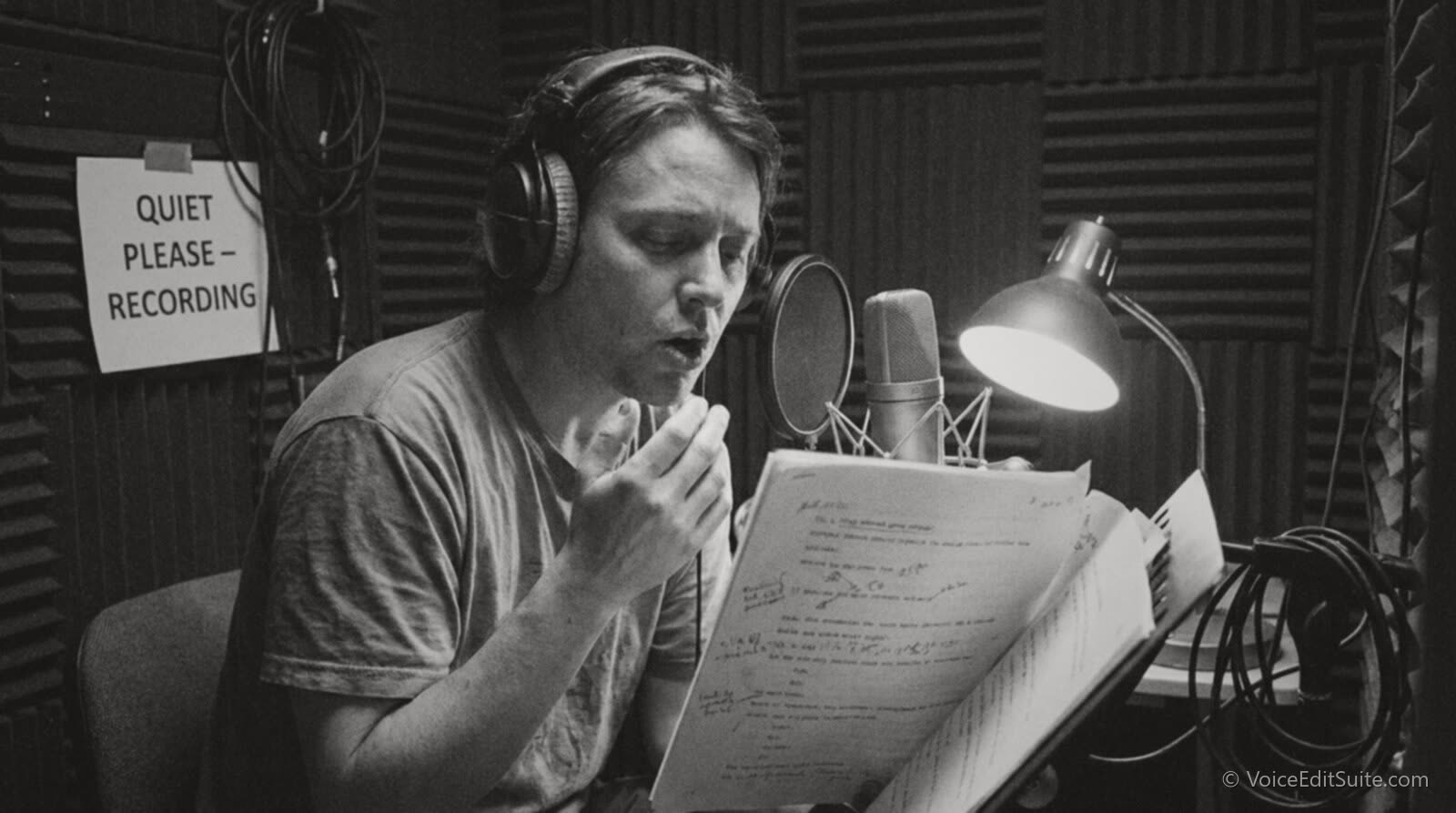
The short answer: a commercial script is judged on two things a director will almost never spell out in those exact words, how close your read sits to an actual conversation rather than a performance aimed at a room, and whether you land the specific word or phrase the script is actually selling. Nail the first and a director will usually leave you alone. Get the second wrong, bury the word that carries the sentence's whole point, rush the last line so it doesn't land, and no amount of warmth in your voice will fix it. Everything below, the vocabulary directors use, the length limits a :15 or a :30 forces on you, and a handful of techniques for finding what a line actually means before you record it, exists to help you do those two things on purpose instead of by accident.
Commercial copy is short, usually somewhere between twenty and two hundred words, written to be read inside a fixed slot of fifteen, thirty, or sixty seconds, and built to move a specific feeling, trust, urgency, relief, desire, in that time. That combination, tight time pressure plus a persuasive goal, is what makes reading a commercial its own skill rather than a smaller version of narration or audiobook work. A :30 spot gives you roughly seventy words and about as much room to establish tone, deliver the idea, and land the close as a narrator gets in a single paragraph. Every choice you make, where you breathe, which word you lean on, how fast you let the pace run, has to earn its place inside that small a space.
What follows covers the vocabulary directors actually use in session, so "more conversational" or "take it down" stop being a mystery, the real timing math behind :15, :30, and :60 scripts, and how to work out what a line is actually asking for before you touch the mic, whether you are a voice actor booked for the read or a podcast host recording your own sponsor spot.
The Shift From the 'Announcer Voice' to the Conversational Read
For most of the twentieth century, the default commercial voice was what the industry now calls the announcer voice: big, bright, pitched up, delivered from a kind of elevated position above the listener, the sound of someone selling you something from a stage. Industry commentary on the format, including a widely discussed piece by the ad production company Killerspots, traces that sound back to town criers, newspaper sellers, and circus barkers, voices built to cut through noise and command the attention of a crowd, carried into early twentieth century radio and then television, and reinforced for decades by the clipped, placeless Mid-Atlantic accent that dominated American broadcasting. It worked because, for most of that period, it was close to the only voice on the air.
That style has not disappeared. Plenty of car lots, mattress sales, and furniture clearances still want it, often deliberately, for the urgency or the nostalgia it signals. But it has stopped being the default. Killerspots' own account of the shift makes the case directly: the announcer voice places the speaker above the listener, and what once read as authoritative now more often reads as a parent lecturing a child, in a media environment where audiences expect to be spoken with rather than spoken at. The replacement, usually just called the conversational read or the natural read, asks for the opposite posture: the same information, delivered at the volume and pace you would actually use telling a friend about something you liked, without the lift, the projection, or the sales-pitch cadence.
What 'Conversational' Actually Asks You to Change
"Conversational" is the single most common note a commercial director gives, and it is also the vaguest, because it names an effect rather than a technique. Voice-over coaching material is fairly consistent on what it means in practice. One frequently repeated exercise, from the training company Such A Voice, is to read copy as though you are talking to a friend rather than delivering a script, and to go a step further and picture an even more specific, familiar listener, a friend, or even a child, rather than an anonymous audience, because that mental shift tends to loosen pitch, slow down word-for-word enunciation, and add warmth without any separate instruction about "warmth" ever being given. The same material points to concrete, checkable habits underneath that mental picture: contractions read the way you would actually say them, don't, it's, you'll, instead of carefully opened out, sentences that trail into each other the way talk does rather than landing as separate, equally weighted units, and enough restraint on emphasis that nothing in the read sounds performed.
The practical test is simple. Record a line, then ask whether you would actually say it that way to the person sitting across from you at a coffee shop. If the honest answer is no, the fix is almost never to try harder to sound natural. It is to slow down fractionally, drop the pitch lift at the start of the sentence, and let the thought finish before you decide how the next word should land.
Directors shorthand all of this into a small, fairly stable vocabulary, because there is rarely time in a session to explain the acting note behind a note. Learning what the shorthand actually means ahead of time saves the two or three confused takes it otherwise costs.
Director Shorthand and What It Actually Means
None of these terms are standardized the way union contract language is. Different directors, studios, and regions use variants of each, and a director who says one of these phrases will almost always be happy to clarify if you ask. But the following cluster of phrases shows up often enough, across voice-over training material and working voice actors' own accounts of session notes, that it is worth knowing before you hear it live rather than guessing in the moment.
- More conversational / less announcer. Drop the lift and the projection. Read it the way you would actually say it, not the way you would present it.
- Take it down. Lower the energy, the volume, or both, usually paired with pulling the imagined distance between you and the listener in closer, so the read feels more private than performed.
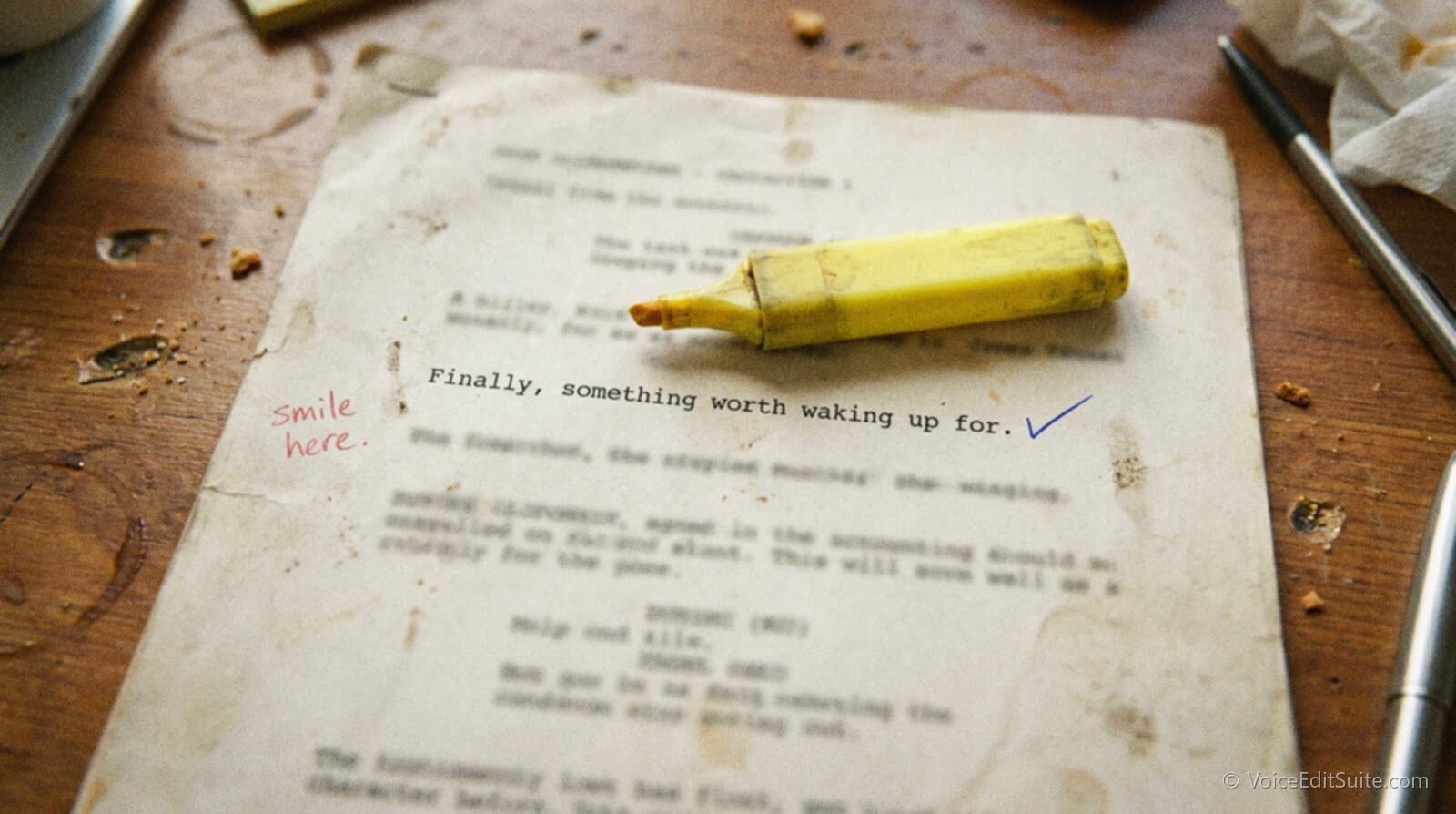
- Find the smile. A physical cue, not just a vocal one: an actual small smile while you read lifts pitch and warmth automatically, without you having to manufacture either on purpose. One voice-over artist's own description of studio direction puts the opposite cue the same way: making a read darker starts with lowering the eyebrows and the resonance, which is the same mechanism working in reverse.
- Button it. Land the final word or line cleanly. Don't trail off, rush past it, or add an extra flourish on the way out. A button is a full stop, said with the same commitment as the rest of the line.
- Give me an eyebrow. A small lift of curiosity, playfulness, or mild skepticism, usually asked for on one specific word rather than the whole line. Like "find the smile," it is a physical instruction because physical instructions change the voice more reliably than abstract ones like "be more playful."
- Billboard that word. Slightly highlight one specific word so the ear catches it, without turning the whole line into a shout. This is the emphasis technique behind most subtext choices, covered in more detail below.
- More intimate. Close, quiet, as if speaking near someone's ear rather than across a room. Often paired with an instruction to imagine standing physically closer to the person you're talking to, not just closer to the mic.
- A level. A plain, at-volume read the engineer uses to set input gain before the first real take. Not a performance choice. If you're asked for a level, read at the volume you intend to actually use, not quieter, so the levels don't clip on take one.
Timing a :15, a :30, and a :60: The Real Word-Count Math
Commercial slots are sold in fixed lengths, almost always :15, :30, or :60 seconds, and the length is not a suggestion. Broadcast traffic systems, ad servers, and simple multi-spot pods all assume the delivered file is exactly that long, give or take a second of tolerance. That means timing isn't something you adjust after the read. It has to be built into the script and the pace before you ever press record.
The ad production company Killerspots, which builds radio and video spots for a living, publishes a working rule of thumb: a natural, conversational commercial read runs at roughly two and a half words per second. On that basis, its own script-timing guide puts about 38 words comfortably inside a :15, about 75 words inside a :30, and about 150 words inside a :60. Its separate, free script-timer tool assumes a slightly faster 3 words per second and gives a wider planning range of about 70 to 85 words for a :30 and 150 to 170 words for a :60, with a recommendation to aim for roughly 28 seconds of actual read time rather than the full 30, so there's a clean half-second of breathing room at the front and back of the file. The gap between the two figures is the rate assumption, not a contradiction: energetic reads genuinely run faster than warm ones, and both are correct for the delivery style they describe.
A useful planning range, pulling those together with other published script-timing guidance, is roughly 35 to 40 words for a :15, 70 to 85 words for a :30, and 140 to 155 words for a :60, at a natural pace with normal breathing. That range narrows fast once the copy itself gets heavier. A script-timing tool built specifically to correct for this, Diktorov's Chronometer, makes the point explicitly: a flat words-per-second rule is too crude on its own, because a phone number, a street address, or a long brand name takes noticeably longer to say clearly than its word count implies. Any script that leans on numerals or an unfamiliar name deserves extra time budgeted in, not a faster read.
Two practical consequences follow from these numbers. First, a script that runs long on the page almost never gets fixed by reading faster. Production guidance behind these same benchmarks puts the realistic ceiling on speeding up a read at somewhere around 10 to 15 percent before the words start blurring into each other and the read stops sounding like speech, so a :30 script written at 95 words needs a trim, not a faster take. Reading faster without sounding rushed covers the technique side of that ceiling in more depth, the difference between genuinely tightening a read and just talking faster. Second, the last few words of the spot usually carry the entire commercial's job, the brand name, the offer, the call to action, so pacing that protects a clean landing on those words matters more than pacing that hits the stopwatch exactly on the second. A take that finishes at :29 with an unhurried, clean button beats a take that finishes at exactly :30.0 by rushing the close.
Subtext and Motivation: Reading the Words Versus Reading the Intent
Every line of commercial copy is doing two jobs at once: saying something, and wanting something from the person listening. The words are the first job. The want, what an acting teacher would call the objective or the subtext, is the second, and it is the part a flat, word-for-word read skips entirely. Voice-over coaching built on standard acting technique, such as the acting-for-voice-over course offered by the training studio VoiceOne, describes the work the same way stage and screen acting does: break the copy into beats, and find the subtext, the emotion, and the intention underneath each one, rather than simply decoding the sentence and saying it out loud.
In practice this means asking a short, specific set of questions before you record, not after a take already falls flat. Who is this line actually for: a tired parent, a stressed small business owner, someone who has already tried three other products and been disappointed? What does the speaker want that person to feel in the next ten seconds: relief, curiosity, reassurance, a small laugh? And what is the one word in the line the whole sentence is actually built around, the word that would change the meaning completely if the emphasis landed on a different one instead?
Reading the words
"Our new formula works twice as fast. Try it today." Read flat, word for word, with even emphasis across the whole line, this says exactly what it says and nothing more: a claim followed by an instruction. It is technically accurate and completely forgettable.
Reading the intent
The same line, worked through subtext: if the real audience already feels let down by a slower product, the word that matters is twice, not formula or today. Landing the emphasis there, with a small lift of relief rather than a sales push, turns a generic claim into a specific promise aimed at a specific frustration. Nothing in the script changed. The choice about what it means did.
That choice is exactly what reading a casting brief is trying to set you up to make before you ever open the script: a brief that tells you the target audience and the brand's tone is handing you the raw material for this exact subtext decision, and skipping it is why a technically clean read can still get passed over for one that clearly understood who it was talking to.
Marking the Page So the Choice Survives the First Take
A subtext decision made in your head during a quiet read-through rarely survives contact with a live mic, a director listening on headphones, and the small adrenaline spike of actually recording. The fix is the same one editors and actors have used on paper scripts for decades: mark it. A breath mark at the natural pause points, an underline or circle on the one or two words carrying the emphasis, and a short margin note for any direction already given, turn a decision you made once into a decision you can execute the same way on take eleven as on take one. How to mark up a voice over script walks through a fuller marking system for longer scripts; a :30 commercial usually needs only a handful of marks, because there is only room in the copy for a handful of real choices in the first place.
Notice what the markup above is not doing: it is not adding performance on top of the read, underlining every important-sounding word, or writing a direction next to half the lines. A script marked up like that is harder to read live than a clean page, because you are now tracking a dozen instructions instead of acting on two or three real choices. The best markup looks almost sparse: one breath mark where you actually need the air, one emphasis mark on the single word the line depends on, and a note only where a direction from the brief or the director genuinely changes how a specific line should land.
This Applies to a Podcast Host-Read Just as Much as a Commercial Booking
Everything above was written with a hired voice actor reading an agency's commercial copy in mind, but the same mechanics govern a podcast host reading their own sponsor's ad inside an episode. A host-read ad is, functionally, a short commercial script with a looser format: it still has a length to hit, most run :30 to :90, it still has one or two words the sponsor actually cares about, the brand name, the promo code, the specific claim, and it still fails for the same reason a bad commercial VO take fails: when it gets read in the host's "ad voice" instead of their actual conversational voice, the exact announcer-versus-conversational gap this guide opened with. Host-read podcast ads: rates and delivery covers the business side of that format in detail. On the performance side, the fix is identical to the fix for a flat commercial take: find the one sentence that matters, decide what you actually want the listener to feel about it, and read the rest of the copy the way you would tell a friend about the thing, not the way you would read a script about the thing.
Rehearsing a Commercial Read Before You Hit Record
A commercial script is short enough to fully rehearse in under five minutes, and almost every avoidable mistake on a submitted take, a rushed button, a buried emphasis, a pace that runs long, gets caught in those five minutes rather than on the client's first listen-back. A workable rehearsal pass looks like this: read the whole script once silently for meaning, read it once aloud at whatever pace feels natural while timing it against the slot length, mark the one or two emphasis words and the breath points based on what that first aloud read revealed, then record two full takes back to back, one leaning slightly more conversational and one leaning slightly more energetic, since a casting brief's idea of "upbeat" and your own read of it do not always match exactly.
Commercial auditions add a wrinkle that rehearsal time does not always allow for. Many casting calls hand over the copy with very little lead time, sometimes minutes, and expect a submitted read with no live direction at all. The subtext work above still has to happen, just compressed into a faster first pass: scan for the sentence the whole spot is built around, decide in one read what the speaker wants from the listener, and commit to that choice rather than burning your limited takes trying out five different interpretations of the same line.
Listening back honestly is its own skill, worth treating separately from the performance itself. The habits that make a read sound natural while you are speaking it, the pace, the emphasis, the breath, are hard to judge accurately in the moment, because you are inside the performance rather than hearing it the way a listener will. Self-directing a voice over session goes into the specific habits that make this kind of self-review reliable instead of just a second round of guessing.
↗ Try the tool
Performance Coach
Performance Coach listens to a recorded take the way a director would: it flags a stretch where the energy never actually shifts, a button line that trails off instead of landing, or a pace that has crept past the natural range for the slot length you're recording against, and points to the specific moment rather than leaving you to guess from a vague feeling that a take "isn't quite right." Useful for checking a commercial read against itself before you submit it, not just once at the very end.
Open Performance Coach →None of this replaces an actual director's ear when one is available, and plenty of commercial bookings, especially union jobs and higher-budget campaigns, still happen live with someone giving real-time adjustments. But a growing share of commercial work, especially for small and mid-sized direct clients, arrives as a self-directed home-studio booking with no one on the other end of the call until the finished file lands in their inbox. That makes the rehearsal habit above, read, time, mark, record two versions, listen back critically, the actual substitute for the director who isn't there.
Frequently Asked Questions
What does a director actually mean by 'more conversational'?
They want you to drop the announcer posture, the pitch lift, the projection, the sense of presenting to a room, and speak the line the way you would actually say it to one specific person. The reliable technique for getting there is to picture a real, familiar listener rather than an anonymous audience, read contractions the way you'd actually say them, and let sentences run into each other the way natural talk does instead of landing as separate, equally weighted beats.
How many words actually fit into a :30 commercial?
Published ad-production guidance puts a natural, conversational :30 at roughly 70 to 85 words, based on a pace of about 2.5 words per second. An energetic read can push closer to 90 words in the same slot; a warm, unhurried read may sit closer to 60 to 65. A script with a phone number, an address, or a long brand name needs extra room beyond its raw word count, since those elements take longer to say clearly than they take to read silently.
How do I know which word in a line to emphasize?
Work out the subtext first: who the line is actually for, and what the speaker wants that specific listener to feel. The word that carries that want, not necessarily the most dramatic-sounding word in the sentence, is usually the one to lean on. A quick test is swapping the emphasis to a different word in the same sentence and noticing how much the meaning changes; the word that changes the meaning the most when you stress it is almost always the right one to stress on purpose.
Does any of this apply to a podcast host reading their own sponsor ad?
Yes, directly. A host-read ad is a short commercial script with a looser format: it still has a length to hit, still has specific words a sponsor cares about, and still fails in the same way a flat commercial VO take fails, when the host switches into a separate "ad voice" instead of staying in their normal, conversational hosting voice. The fix is the same subtext work: find the sentence that matters, decide what you want the listener to feel, and read the rest like you're talking to them, not presenting to them.
What if I only get the script a few minutes before I have to record it?
Compress the same process rather than skipping it. On a fast first read, look for the one sentence the whole spot is built around and the single word that sentence depends on, decide quickly what the speaker wants the listener to feel, and commit to that choice. It is better to commit fully to one clear interpretation under time pressure than to spend your limited takes hedging between several half-formed ones.
Is the old 'announcer voice' completely obsolete now?
No. It has stopped being the default for most commercial categories, but it is still used deliberately in a handful of them, car dealership sales events, mattress and furniture clearances, some local retail, where the bigness and the urgency of the old style is exactly the feeling the ad is going for, sometimes leaning into the nostalgia of it on purpose. The shift is toward conversational as the baseline, not the disappearance of the announcer read as an option.
Sources and Further Reading
- Killerspots, Radio Script Timer: How Long Is a 30 Second Script?: the 2.5-words-per-second benchmark and the 38/75/150-word figures for :15, :30, and :60 scripts used throughout the timing section.
- Killerspots, Free Radio & Video Script Timer: the production company's own script-timing tool, its 3-words-per-second assumption, its 70 to 85 and 150 to 170-word ranges, and its recommendation to target about 28 seconds of read time for a :30 slot.
- Killerspots, E-VO-lution: Why Brands Have Moved Away From 'Announcer Voice': the history and critique of the announcer read, and the case for why conversational delivery became the commercial default.
- Such A Voice, Top Ten Voice-Over Technique Tips For Aspiring Voice Actors: the friend-and-child visualization technique and the contraction and pacing habits behind a conversational read.
- VoiceOne, Acting for VO: the beats, subtext, and intention framework for approaching commercial copy as an acting problem rather than a reading one.
- Diktorov, Chronometer online: the caveat that a flat words-per-second rule understates timing for scripts with phone numbers, addresses, or unfamiliar brand names.
- At A Glance, 30 Second Radio Script Word Count: additional published word-count guidance for radio-style commercial scripts at a range of reading paces.
- VoiceEditSuite, How to Mark Up a Voice Over Script, How to Read a Casting Brief, Reading Faster Without Sounding Rushed, Self-Directing Voice Over Sessions, and Host-Read Podcast Ads: Rates and Delivery: companion guides on the related marking, briefing, pacing, self-review, and podcast-ad sides of this subject.