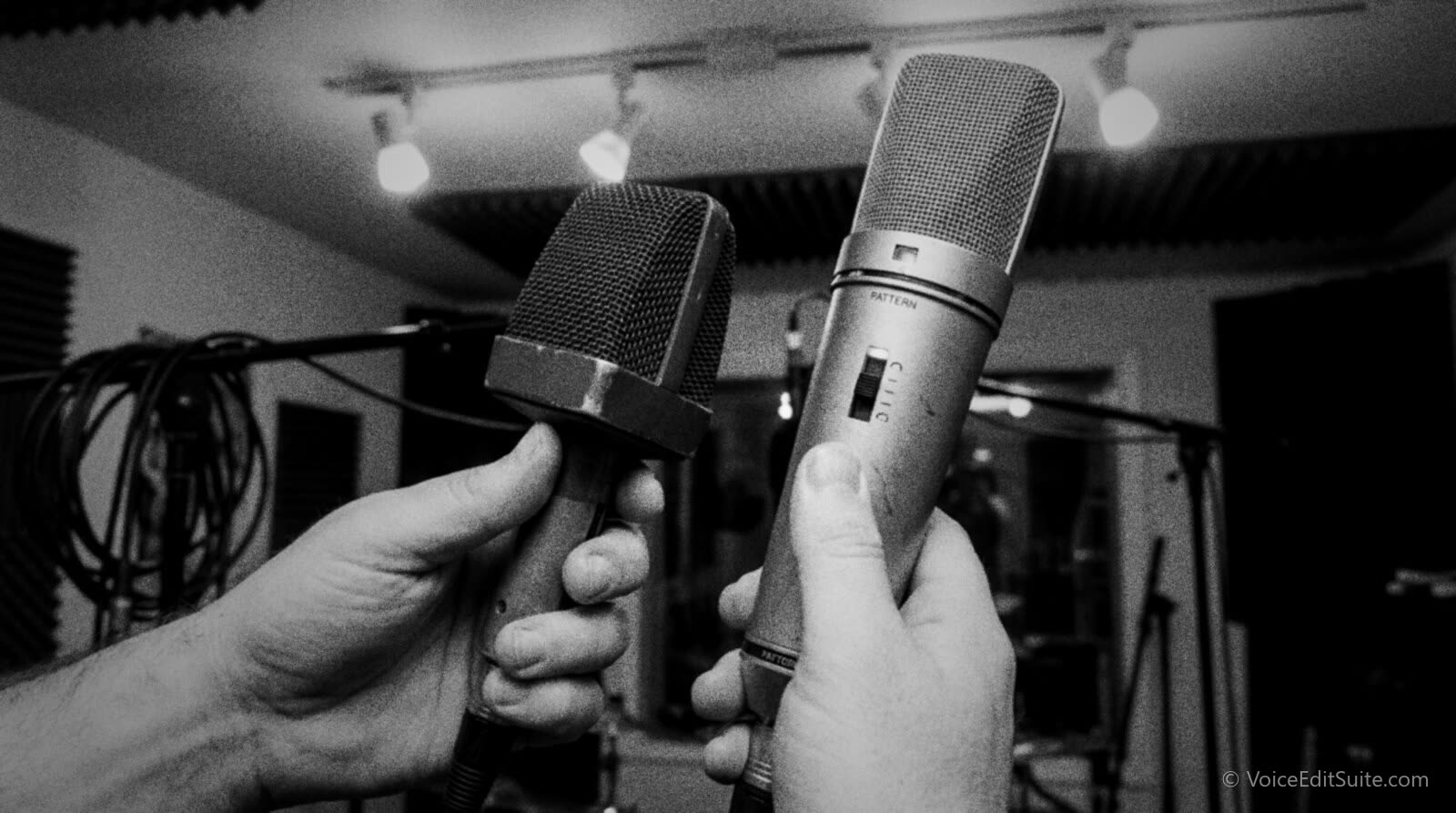
A microphone's polar pattern is a map of how sensitive it is to sound arriving from different directions around the capsule, drawn as a shape when you plot that sensitivity on a circle. The short version: cardioid picks up a wide cone from the front and rejects most of what happens behind it, which is why it is the default choice for a solo voice in a treated booth. Omnidirectional picks up everything around it equally, which sounds like a downside until you need an honest recording of a whole room rather than one mouth in it. Figure-8, also called bidirectional, picks up front and back equally while rejecting the sides almost completely, which makes it the right tool for exactly two specific jobs: a real duet take with two people facing the same mic from opposite sides, and the side channel in an M/S stereo rig.
Supercardioid and hypercardioid sit between cardioid and figure-8, trading a narrower front pickup for better rejection of everything else, which is why they show up on boom poles and in loud shared rooms rather than on a desktop stand in a quiet booth. None of these four shapes is objectively better than the others. Each one trades off-axis rejection against coverage in a specific way, and the pattern that makes one recording sound clean makes the next one sound hollow or thin. The rest of this guide walks through what each pattern physically is, which real microphones use it, and how the choice interacts with proximity effect, the bass boost that shows up whenever you work close to almost any directional capsule.
The Four Polar Patterns, and What Each Lobe Shape Actually Means
The physical reason these shapes exist at all comes down to what a capsule's diaphragm is actually responding to. DPA Microphones' own technical reference, Microphone Technology: The Essentials, explains the two basic designs plainly. In a pressure microphone, one side of the diaphragm faces the outside air and the other faces a sealed chamber, so the capsule reacts only to absolute sound pressure, which is a scalar with no direction attached. That design is what gives you an omnidirectional pattern: a perfect sphere of equal sensitivity, because there is no directional information for the diaphragm to respond to. In a pressure-gradient microphone, both sides of the diaphragm are open to the outside air, so the output depends on the difference in pressure between the front and the back. Sound arriving from directly behind a capsule designed this way hits both sides at the same time with equal pressure, cancels out, and produces a pure figure-8 pattern. Every other directional pattern, cardioid, supercardioid, and hypercardioid, is some blend of those two principles, built either mechanically, by controlling how much sound reaches the back of the diaphragm through internal ports, or electrically, by mixing the output of an omni element with a figure-8 element in different proportions.
Cardioid: The Default for a Reason
A cardioid pattern, named for its heart-shaped lobe, is the most common unidirectional pattern on the market and the one most voice over and podcast microphones ship with by default. Shure's own published figures put a cardioid's useful pickup angle at 131 degrees, with the point of least sensitivity sitting directly behind the capsule at 180 degrees off-axis. In plain terms, that means a cardioid mic hears almost everything within a fairly generous cone in front of it at full strength, tapers off to the sides, and rejects the most sound at the very back, where a monitor, a computer fan, or a second person in the room usually sits. Real examples include the Shure SM7B and the Electro-Voice RE20, both cardioid dynamic mics built specifically for broadcast and voice over use, and condensers like the Rode NT1, a cardioid large-diaphragm mic marketed directly at podcasting and voice-over work.
Supercardioid and Hypercardioid: Tighter, With a Trade-Off
Supercardioid and hypercardioid patterns narrow the front pickup further and push the rejection harder, but they do it differently than most people assume: rather than simply shrinking the cardioid lobe, they add a small rear lobe back in. Shure's own reference puts a supercardioid's typical pickup angle at around 115 degrees with its point of least sensitivity at 125 degrees off-axis, not directly behind the mic, and a hypercardioid tighter still, with a pickup angle as narrow as 105 degrees and a null around 110 degrees. The rear lobe is where the two patterns actually differ in practice: a supercardioid rejects sound from directly behind it by close to 12 dB, while a hypercardioid, more sensitive to the rear, rejects by only about 6 dB. A supercardioid is the better choice when you specifically need to reject one source directly behind the mic, a loud fan or a second host; a hypercardioid trades a bit of that rear rejection for a slightly tighter front lobe. These patterns are what boom operators and shotgun mics rely on. The Sennheiser MKH 416, long a standard for film and location sound, is officially specified as supercardioid or lobar, behaving as hypercardioid at low and mid frequencies and narrowing toward a true lobar pattern above 2 kHz, the mechanism that lets a boom reach past the frame and still isolate one voice from a crowded set.
Omnidirectional: Equal in Every Direction, On Purpose
An omnidirectional, or omni, microphone picks up sound equally from every direction around the capsule in what amounts to a perfect sphere. That sounds like the opposite of what you want for isolating one voice, and for a solo booth it usually is, but the same property makes omni mics genuinely useful elsewhere. A lavalier like the DPA 4060, a miniature omnidirectional condenser built for broadcast and theater, is deliberately omni so that a performer's voice stays consistent no matter which way their head turns relative to a mic clipped to their chest; a directional lav would thin out and change tone every time they looked away from the capsule. Because an omni capsule is a pressure design rather than a pressure-gradient one, it also does not produce proximity effect at all, and it tends to handle wind and handling noise more gracefully than a tightly directional mic, which is one reason field recordists and documentary crews reach for omni capsules on location.
Figure-8: Front and Back, Nothing From the Sides
A figure-8, or bidirectional, pattern is the purest pressure-gradient shape there is: equally sensitive to the front and the rear, with the deepest possible rejection directly from the sides. It is the narrowest practical pickup angle of the four patterns in terms of what it accepts, but it accepts it from two opposite directions at once rather than one. The classic example is a ribbon microphone like the Royer R-121, built as a bidirectional velocity transducer with equal sensitivity from either face, addressed from the front where the manufacturer's logo sits for the correct, in-phase sound. Multi-pattern studio condensers like the Neumann U87 Ai also include figure-8 as a switchable option alongside cardioid and omni, selected with a switch below the headgrille and shown through a small window above it.
Why Cardioid Dominates a Solo Voice Over Booth
Cardioid wins the default slot for solo voice work for a simple, mechanical reason: a 131-degree front cone is wide enough to forgive normal head movement and small positioning mistakes, while the 180-degree rear null is pointed, by convention, at whatever is making the most noise behind you, a computer, an air vent, a doorway to the rest of the house. In an untreated or lightly treated room, that rejection does more real work than any amount of extra clarity a more exotic pattern could add. A cardioid mic also tends to be the most forgiving to position: a few centimeters off-axis barely changes the tone, where a tighter supercardioid or hypercardioid pattern starts to color the sound noticeably once you drift outside its narrower cone.
That forgiveness matters more than gear specs once you add in the room itself. A cardioid capsule aimed away from a hard wall or a window still picks up some of that reflection through its side lobes, which is exactly why acoustic treatment on a budget and a genuinely isolated recording space do more for a cardioid's real-world sound than switching to a pricier mic with the same pattern. If you are still deciding whether your current mic is holding you back at all, or whether the room is, this guide to knowing when to upgrade your microphone and a look at solid budget cardioid options are both worth reading before you spend money chasing a pattern problem that is actually a room problem. For voice actors weighing a dedicated isolation booth against simply treating the corner they already record in, the pattern math is the same either way: cardioid's rear rejection is doing less work in a bad-sounding room, because the reflections it is supposed to reject are now arriving from every direction at once, not just from directly behind the capsule.
Pattern choice does not fix a bad room
A tighter pattern narrows what the mic hears from the front and sides, but it cannot remove a reflection that is already bouncing straight back at the capsule from the one direction cardioid is built to reject. If your recordings sound boxy or hollow regardless of which pattern you switch to, that is a room-treatment problem, not a microphone one. Building or buying an isolation space is the actual fix, covered in detail in our guide to a vocal isolation booth, buy or build.
When Omni Actually Makes Sense
Omni is the right call whenever the thing you actually want to capture is the room, not a single voice isolated from it. Field recordists reaching for ambient texture, a bustling street, a forest, a crowd before a live show, want a microphone that represents the whole soundstage honestly rather than one that aggressively points at and amplifies whatever happens to be directly in front of it. Because an omni capsule is a pressure design with no front-to-back pressure difference to speak of, it also avoids the handling and vibration noise that plagues pressure-gradient mics on a handheld rig, which is a real consideration for anyone recording voice over or ambience away from a fixed desk stand; our guide to building a mobile voice over rig for travel recording covers the practical side of working untethered from a booth.
Omni's lack of proximity effect is a genuine advantage in one more specific case worth calling out: a lavalier mic. Because a lav rides on a performer's chest or lapel and the angle to their mouth changes constantly as they turn their head, a directional lav would swing wildly in tone and bass response from moment to moment. An omni lav stays tonally consistent precisely because it has no directional sensitivity to lose. The trade-off is unavoidable: an omni mic cannot reject a noisy room the way a cardioid can, so it is the wrong choice the moment isolation, rather than honesty, is the actual goal.
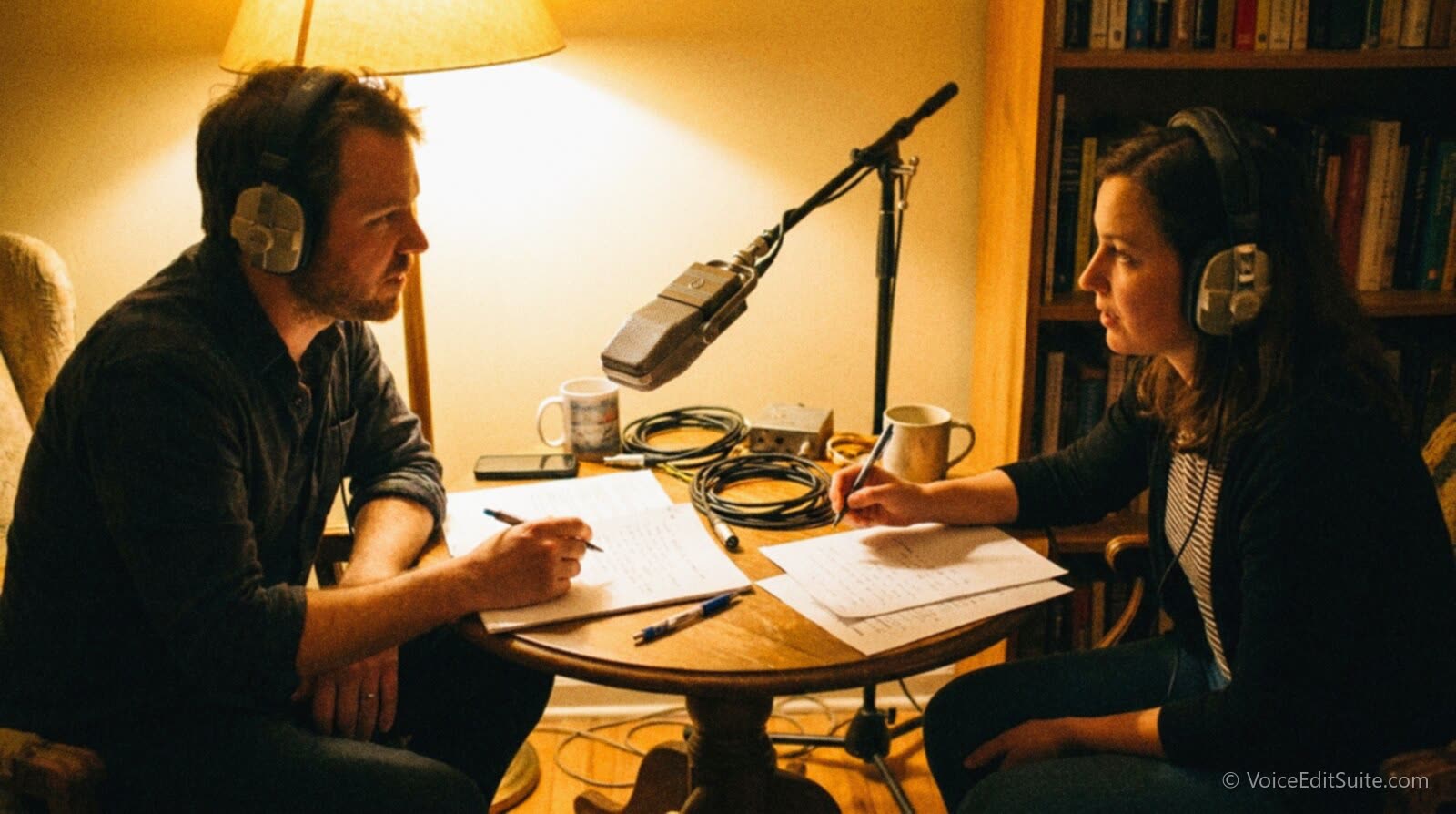
When Figure-8 Actually Makes Sense
Figure-8 earns its place in exactly two situations that come up constantly in podcasting and far less often in solo voice over. The first is a genuine duet or two-host take recorded on one microphone in one room: two people seated on opposite sides of a figure-8 capsule, each addressed by one of its two equally sensitive lobes, while sound from the sides, where a third source or a hard wall reflection would otherwise intrude, gets rejected almost entirely. This only works cleanly when both speakers sit close to directly opposite the capsule rather than off to one side, since a figure-8's rejection zone is narrow and centered exactly at 90 degrees off-axis; drift too far off that line and you start picking up less of your own voice rather than more.
The second case is M/S, or mid-side, stereo recording, a technique patented by Alan Blumlein in 1933 and still the standard way broadcasters capture a mono-compatible stereo image. An M/S rig pairs a forward-facing mid microphone, typically cardioid or hypercardioid, with a second microphone turned 90 degrees to the side, whose output supplies the stereo width. That side mic has to be figure-8, because its job is to capture everything to the left and right while its null faces straight ahead at the source the mid mic is already covering. The two signals are combined in a simple matrix, mid plus side for the left channel and mid minus side for the right, and because the technique is fundamentally mono-compatible, it has stayed a broadcast standard for nearly a century. A multi-pattern condenser that includes a true figure-8 setting, rather than a fixed-pattern mic, is what makes building an M/S pair practical without buying two separate specialized microphones.
Figure-8 has one real weakness worth naming plainly: its rear lobe means it picks up just as much of whatever is directly behind the capsule as whatever is in front of it, including ceiling reflections if the rig is not angled carefully in an untreated room, since the pattern has no rear rejection at all. It is also the pattern most prone to a strong proximity effect at close range, because it is the purest pressure-gradient design of the four. A Neumann U87 Ai's own documentation notes that its cardioid setting stays smooth down to about 30 to 40 centimeters of working distance, while its figure-8 setting only holds that same smoothness down to roughly 15 to 20 centimeters, meaning the same close-talking distance that sounds fine on cardioid will push a figure-8 capsule noticeably further into bass buildup.
How Proximity Effect Interacts With Pattern Choice
Proximity effect, the disproportionate boost in low frequencies that happens as a sound source moves closer to a directional capsule, is not a flaw in any one microphone. It is a direct consequence of the pressure-gradient design that makes a pattern directional in the first place, which means it shows up on every pattern on this list except true omni. Our dedicated guide to mic technique and proximity effect covers the habit side of managing it in detail; the pattern side of the same question is simpler to state but easy to miss: the tighter and more pressure-gradient-dependent the pattern, the stronger the proximity effect tends to be at a given distance. Figure-8, being the purest gradient design, shows the strongest effect at close range. Supercardioid and hypercardioid, built from a blend that leans more heavily gradient than a standard cardioid, generally show more proximity effect than a plain cardioid at the same distance, a trade-off Shure's own material on specialist patterns flags directly alongside the narrower pickup angle. True omni, being a pure pressure design with no front-to-back difference to amplify, shows essentially none.
This is exactly why a dynamic cardioid broadcast mic like the Electro-Voice RE20 bothers with a Variable-D internal design at all: it specifically works to limit the bass buildup that would otherwise come from close-talking at the distance broadcast and voice over work typically uses, so a speaker can stay tight to the capsule for intimacy and gain without the low end turning muddy. Multi-pattern condensers often add a rear low-cut switch for the same reason, intended specifically to compensate for the unavoidable bass boost pressure-gradient designs produce at short working distances rather than to shape tone generally. None of this means you should avoid a tighter pattern close up; a controlled, intentional proximity boost on a hypercardioid or figure-8 capsule is exactly how plenty of movie-trailer and ASMR work gets its signature warmth. It means knowing which pattern you are on before you lean in, since the same six centimeters of distance change will read very differently on a cardioid than on a figure-8.
↗ Try the tool
Home Studio Analysis
Not sure whether a pattern problem or a room problem is behind a boxy or inconsistent recording? Home Studio Analysis listens to a sample take from your actual space and flags reflections, background noise, and tonal imbalance separately, so you know whether the fix is repositioning your current mic, switching patterns, or treating the room itself before you spend money guessing.
Open Home Studio Analysis →Which Pattern for Which Situation
Laid out as a single decision, the four scenarios above cover most of what a working voice actor or podcaster actually runs into. A solo voice actor recording in a treated booth or a well-controlled room wants cardioid almost every time, for the reasons already covered: a wide enough front cone to forgive small movement and a rear null pointed at the room's main noise source. Two hosts seated across a table from each other, in a room with decent acoustics, are the clearest case for figure-8 on a single capsule, or alternatively two separate cardioid mics each aimed at one host and away from the other, which trades the elegance of one mic for independent control over each voice's level in post. Outdoor ambience, field recording, and any lavalier work where the capsule's angle to the mouth will keep changing call for omnidirectional, trading isolation for honesty and tonal consistency. A loud, shared room, a convention floor, a busy newsroom, a crowded live event, is where supercardioid or hypercardioid earns its narrower front lobe and stronger rear rejection, accepting a bit more proximity effect and a bit less forgiveness for off-axis positioning in exchange for genuinely isolating one voice from genuine chaos.
Frequently Asked Questions
What is the best polar pattern for voice over work?
Cardioid, for the overwhelming majority of solo voice over and podcast recording done in a booth or a treated room. Its roughly 131-degree front pickup angle is wide enough to forgive normal head movement, and its rear null, pointed at the loudest source in a typical room, does most of the practical noise rejection you need without the narrower, less forgiving cone of a supercardioid or hypercardioid mic.
What is the real difference between supercardioid and hypercardioid?
Both narrow the front pickup angle compared with cardioid and add a small rear lobe, but they differ in how much of that rear lobe they let through. Supercardioid rejects sound directly behind the mic by close to 12 dB with a null around 125 degrees off-axis; hypercardioid is more sensitive to the rear, rejecting by only about 6 dB with its null closer to 110 degrees, trading some rear rejection for a slightly tighter front cone. Supercardioid generally gives better isolation from one specific noise source directly behind the mic.
Why doesn't an omnidirectional mic have proximity effect?
Proximity effect comes from a pressure-gradient design, where the output depends on the difference in pressure between the front and back of the diaphragm, and that difference grows disproportionately at close range for low frequencies. An omnidirectional capsule is a pure pressure design instead: one side of the diaphragm faces a sealed chamber rather than open air, so there is no front-to-back difference to amplify as the source gets closer, and essentially no proximity effect results.
Can I really record two people on one figure-8 microphone?
Yes, and it is one of the pattern's two main real-world uses. Seat each person directly opposite the other, facing the capsule from its two equally sensitive sides, and keep both close to the mic's actual front-back axis rather than off to one side, since the side-rejection zone is centered precisely at 90 degrees off-axis. It works best in a room with reasonably controlled acoustics, since figure-8 has no rear rejection at all and will pick up ceiling and wall reflections just as readily as a voice.
Which polar pattern do I need for M/S stereo recording?
Two different patterns, paired together. The mid microphone, aimed straight at the source, is typically cardioid or hypercardioid. The side microphone, turned 90 degrees so its two lobes point left and right with its null facing the source, has to be figure-8, since the technique depends on that pattern's pure front-back symmetry to generate a mono-compatible stereo width when the two signals are matrixed together.
Does polar pattern matter as much on a budget microphone as an expensive one?
The underlying physics behaves identically regardless of price: a cardioid capsule on a budget USB mic rejects its rear in roughly the same proportional way a cardioid capsule on a studio condenser does, and proximity effect follows the same pressure-gradient rule on both. What a higher price usually buys is a cleaner, lower-noise capsule and tighter manufacturing tolerance on the pattern itself, not a fundamentally different directional behavior. Choosing the right pattern for your situation matters at every price point.
Sources and Further Reading
- Shure, Multi-Pattern Microphones: What, Where and How?: Shure's own published pickup angle and null-point figures for omnidirectional, cardioid, and bidirectional patterns, including the 131-degree cardioid pickup angle used throughout this guide.
- Shure, Specialist Polar Patterns: Hypercardioid and Subcardioid: Shure's figures for supercardioid and hypercardioid pickup angles, null points, and comparative rear rejection.
- DPA Microphones, Microphone Technology: The Essentials: the pressure-versus-pressure-gradient physics behind every polar pattern, and how cardioid is built from a blend of the two.
- Neumann, U 87 Ai product documentation: the three-position pattern switch, the rear low-cut switch for proximity compensation, and the published close-miking distances for cardioid versus figure-8 settings.
- Sennheiser, MKH 416 product specification: the supercardioid and lobar pattern behavior by frequency, and the mic's pressure-gradient interference-tube design.
- Royer Labs, R-121 application notes: the figure-8 ribbon's equal front-and-rear sensitivity, correct front-facing orientation, and proximity bass buildup at close range.
- Rode, What Are A Microphone's Polar Patterns?: omnidirectional's spherical pickup and figure-8's role in Blumlein and mid-side stereo recording.
- ProSoundWeb, In the Studio: Mid-Side Microphone Recording Basics: the mid-cardioid-plus-side-figure-8 M/S setup, the matrixing of mid and side signals, and Alan Blumlein's 1933 patent.