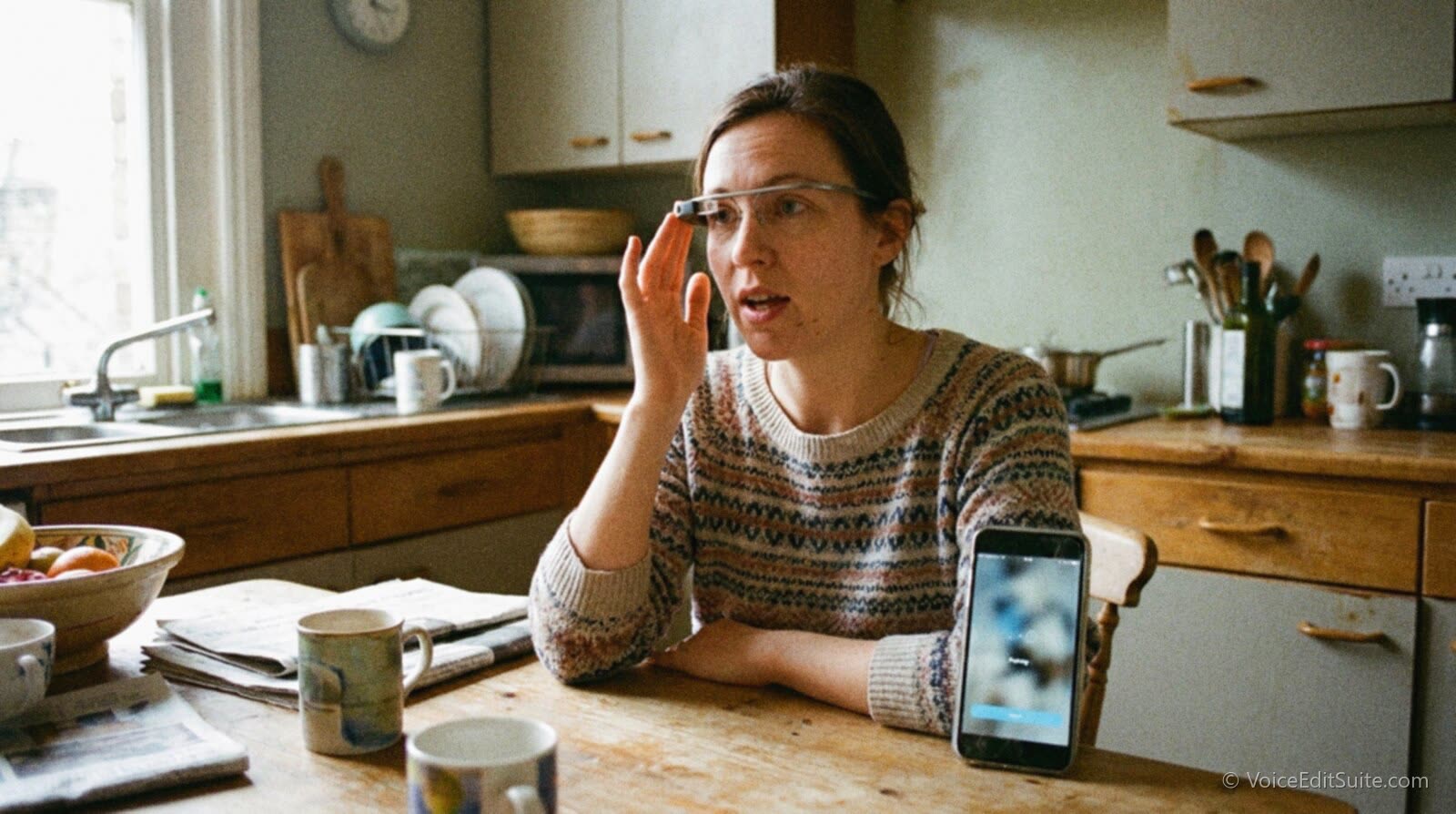
The short answer: AR and smart glasses, along with wearable AI devices like Meta's Ray-Ban line, Samsung's new Android XR glasses, and clip-on pendants such as Bee, do not run on a single voice. They run on two. A short library of human-recorded lines, the wake chime's spoken confirmation, the onboarding greeting, the privacy disclosure read aloud during setup, handles the fixed moments a hardware maker needs to control exactly. A separate, live synthetic text-to-speech layer handles everything open-ended: the AI's actual answers, translations, and read-back of a dictated message. Voice-over work in this niche means recording the first layer, not the second.
This is a genuinely new corner of the voice-over business, built on a hardware category that barely existed three years ago and is now shipping in the millions. It sits next to smart speaker and voice assistant work and voice-over for AI chatbots and conversational agents, but a device worn on a person's face or wrist carries its own legal, technical, and creative demands that neither of those niches fully covers. Knowing what the market actually looks like, what a real recording brief asks for, and which companies are the real buyers is the difference between chasing a casting notice that will never post and quietly landing a client who needs exactly this.
What This Market Actually Looks Like Right Now
Smart glasses stopped being a novelty item sometime in 2025. EssilorLuxottica, the eyewear giant that manufactures Meta's Ray-Ban glasses, reported selling more than 7 million units in 2025 alone, more than triple the roughly 2 million units sold across 2023 and 2024 combined. Meta followed that with the Ray-Ban Display, a $799 pair with a built-in screen and an EMG wristband called the Neural Band, launched in the US on September 30, 2025 and rolling out to Canada, France, Italy, and the UK in early 2026, with Deutsche Telekom bringing it to Germany on October 13, 2026. Samsung showed its own entry at Galaxy Unpacked in July 2026: Android XR smart glasses built with Gentle Monster and Warby Parker and running Google's Gemini assistant. A smaller player, Even Realities, sells a camera-free display model called the G2 for $599, woken with the phrase "Hey, Even."
The shipment numbers back up the headlines. IDC's Worldwide Quarterly Wearable Device Tracker put global shipments of display-less smart glasses at 9.6 million units in 2025, with Meta holding roughly 76 percent of that volume, and forecasts 2026 shipments near 13.6 million units, growing to 27.3 million by 2030, an 18.9 percent compound annual growth rate. Counterpoint Research measured an even sharper swing at the top of the market: global AI glasses shipments rose 263 percent year over year in the first half of 2026 alone. Different research firms use different definitions of what counts as a smart glasses or AI glasses device, so the exact totals move depending on who is counting, but every firm agrees the category is now shipping in the millions rather than the thousands, and still growing fast.
Not Just Glasses: The Wider Wearable Assistant Category
Glasses are not the only wearable asking for a recorded voice personality. Clip-on and pendant devices sit in the same category: Amazon acquired the wearable AI company Bee and launched the $74.99 Bee Frontier bracelet and the $99.99 Bee Eclipse phone attachment in October 2026, both built around an always-listening assistant that summarizes conversations and speaks reminders aloud. This corner of the market is also genuinely volatile. Humane's AI Pin, a wearable with its own spoken assistant, shut down entirely in February 2025, less than a year after launch, when HP bought the company's software and patents for $116 million and left the hardware itself to go dark within days. A voice actor's recorded lines for a device like that can outlive the device by exactly zero days, which is a real risk worth pricing into any contract in this niche.
Two Different Voices Live Inside One Device
Every one of these products actually needs two separate voice jobs filled, and conflating them is the single most common mistake a voice actor makes when first approaching this niche. The first is a small, fixed library of human-recorded lines: the acknowledgment when the wake word lands, the short greeting on first setup, the spoken consent and privacy disclosure a lawyer insisted go in word for word, the low battery warning, a handful of personality flourishes the brand wants said in exactly one approved way, forever. The second is a live synthetic text-to-speech layer that reads back whatever the AI model generates on the fly: an open-ended answer, a translated sentence, a read-aloud text message. The recorded layer is what a voice actor is actually hired to perform. The synthetic layer is usually built later, sometimes from that same actor's recordings, sometimes from an entirely separate licensed voice.
- Recorded voice bank. Wake and pairing confirmations, onboarding and setup greetings, privacy and consent disclosures, battery and connectivity alerts, and a short set of approved brand personality lines. Fixed forever once the product ships.
- Live synthetic TTS. Open-ended AI answers, real-time translation, read-back of dictated messages, and any reply the product's script could never fully predict in advance. Generated at the moment someone actually asks.
The split matters because it is exactly the same split this site has already documented in other corners of the voice assistant world. Smart speaker assistants like Alexa and the rebuilt Siri went through the identical shift: a human voice actor recorded hours of raw speech once, and a synthetic engine now generates everything the assistant actually says in open conversation. Voice-over for AI chatbots works the same way: a prompt library of fixed, human-recorded lines sits alongside a generative layer nobody voices directly. A wearable device just squeezes that same structure onto something worn on a person's face or wrist, which adds pressures neither a kitchen speaker nor a phone app ever had to deal with.
What the Actual Voice-Over Work Looks Like
A recording brief for a pair of smart glasses or a wearable pendant reads closer to the line-by-line scripts covered in our guide to voice-over for smart toys and interactive children's products than to any kind of commercial read. A typical first-generation device needs somewhere between 40 and 150 short, independent lines: a two or three-second confirmation chime read, a ten-second onboarding greeting that plays the first time the device is worn, a short series of pairing and setup confirmations, three or four variations on "battery low" and "reconnecting," a handful of error states for when the camera or microphone fails, and a small library of brand personality lines a product manager wants said in a specific, rehearsed tone. None of it connects to anything else in sequence. A line gets triggered by a button press, a gesture on the temple, or a firmware event, not by a story.
- Wake and confirmation chimes. The spoken or tonal acknowledgment that the device heard the wake word or a gesture, usually the single most-repeated line in the whole product.
- Onboarding and setup lines. The guided walkthrough spoken the first time someone wears the device or pairs it to a phone, often the longest continuous piece of scripted speech in the entire project.
- Privacy and consent disclosures. Legally reviewed wording, read exactly as written, confirming that recording, a camera light, or a listening indicator is active.
- Battery, connectivity, and error alerts. Short, calm, functional lines that have to stay recognizable at low volume through open-ear speakers or bone conduction audio.
- Brand personality moments. A small set of lines where the hardware maker wants the device to sound like a specific, consistent character rather than a plain utility.
The privacy disclosure line is not yours to improvise
On a wearable with a camera or a live microphone, the consent and privacy lines in the script are usually written and cleared by the manufacturer's legal team before the session, word for word, and a director will reject a take that paraphrases even slightly. Treat that script page the way you would treat a pronunciation guide for a client's product name: read it exactly, every time, because the finished device will say it that way for years.
The closest fully documented example of this kind of work is Audiobrain's voice branding project for Jaybird's wireless headphone line, a wearable audio product rather than a pair of glasses, but built on an identical brief: script translation and proofing, voice casting and recording, editing and mastering, and implementation of branded voice prompts across eight markets in seven languages. That is the shape of work a glasses maker or wearable pendant company commissions too, usually through an outside sound design or sonic branding studio rather than an open casting call, and it is worth studying as a template for what a pitch to this kind of client should actually include.
How This Overlaps With and Differs From Smart Speaker and Chatbot Work
The overlap with smart speaker and chatbot voice work is real: both ask for short, consistent, independently triggered lines rather than continuous narration, and both increasingly pair a small human-recorded set with a much larger synthetic layer built around it. The differences are what make this a distinct niche rather than a rebrand of either one. A wearable sits directly on a person's body, so its microphone and camera disclosures carry a sharper legal weight than a kitchen speaker's ever did, closer in spirit to the state-level protections covered in our guide to AI voice likeness laws than to a typical commercial buyout. A wearable also ships on a much faster hardware cycle than a car dashboard, more like GPS and automotive voice work in its demand for total consistency across many recombinable fragments, but with a product lifespan closer to eighteen months than the decade a car's navigation voice can stay on the road.
How a Voice Actor Actually Gets Into This Niche
This work does not move through a general casting marketplace, for the same reason smart toy and automotive voice work does not: the buyers are a short, identifiable list of hardware companies and the specialist studios they hire, not an open pool of anonymous clients posting notices. The realistic path in runs through three kinds of buyer. First, the hardware makers themselves, Meta, Samsung, Amazon's Bee team, and smaller glasses and pendant startups like Even Realities, most of which have a small internal audio or UX team that commissions voice work directly or through a vendor. Second, the sonic branding and audio UX agencies, firms built on exactly the kind of work Audiobrain did for Jaybird, that hardware companies hire to handle the whole voice package, script, casting, recording, and delivery, as a single line item. Third, the game audio and interactive-media studios that have branched into wearables because the workflow, short triggered lines mapped to firmware events, is close to what they already build.
- Build a dedicated short demo. A dozen lines covering a wake confirmation, an onboarding greeting, a privacy disclosure read cold and clean, and two or three personality flourishes shows a buyer the exact range this work asks for, faster than a general commercial reel.
- Study how the category talks about itself. Read a hardware maker's own developer and support documentation for its voice features before pitching; it tells you the tone and vocabulary a real brief will use.
- Approach audio UX and sonic branding studios directly, not general voice casting sites, since they are the vendors hardware companies already trust with this exact kind of multi-language, multi-line delivery.
- Price it by line count and language, not by the hour, since a 100-line English script that becomes 600 lines across six languages is a materially bigger job than a single day rate implies.
That last point is where a lot of wearable voice work gets quietly underpriced. A client asking for "50 short lines" sounds like a quick afternoon, but once wake confirmations, onboarding, disclosures, error states, and brand lines are all counted, plus whatever language versions a global launch needs, the real scope looks much closer to the toy and automotive projects covered elsewhere on this site than to a 30-second commercial.
↗ Try the tool
Rate Calculator
A banked-personality script for a wearable device prices by line count and language coverage, not by session length, and guessing at a flat day rate is how this work gets underpaid. The Voice-Over Rate Calculator lets you model a quote around actual line counts, retake allowances, and usage terms, so a 90-line English script that becomes 450 lines across five languages gets priced for what it really is.
Open Rate Calculator →Frequently Asked Questions
Is voicing a pair of smart glasses the same as voicing its AI assistant?
No, and that distinction is the whole niche. A device's open-ended AI conversation almost always runs on a separate, synthetic text-to-speech voice generated at the moment someone asks a question. What a voice actor actually records is the fixed library around it: wake confirmations, onboarding, privacy disclosures, and error and battery alerts, lines the manufacturer wants said in exactly one approved way for the life of the product.
How many lines does a typical wearable voice-over project need?
It varies by product complexity, but a first-generation pair of smart glasses or a simple wearable pendant commonly needs somewhere between 40 and 150 final English lines once wake confirmations, onboarding, setup, battery and error alerts, and a small set of brand personality lines are all counted. A more ambitious device with a display, like Meta's Ray-Ban Display, or a companion app with its own voice feedback can run well past that.
Who actually buys this kind of voice-over work?
Mostly three kinds of client: the hardware makers' own internal audio and UX teams, outside sonic branding and audio UX agencies that hardware companies hire to handle the entire voice package, and game or interactive-media audio studios branching into wearables. It almost never moves through a general, open casting marketplace, because the list of companies actually shipping these devices is still short.
Will synthetic voice cloning eventually replace the recorded parts of this work?
Not the fixed, legally reviewed lines, at least not soon. Privacy disclosures, consent statements, and setup instructions on a device with a camera or an always-on microphone tend to get more legal scrutiny over time, not less, and a manufacturer's lawyers generally want a documented, approved human recording for exactly those lines. What is more exposed to automation is everything downstream of that recording, the live synthetic layer that reads open-ended answers, which was never recorded by a human performer in the first place.
How is pricing different from a standard commercial voice-over job?
A standard commercial quote is usually built around session length and the usage rights for one finished spot. A wearable voice-bank project is usually quoted by line count, language coverage, and how long the lines stay in active use on a shipping product, since a 100-line script recorded for a device sold worldwide represents a very different scope than the same line count for a single market launch, even if both fit into a similar length studio booking.
What should a voice actor check before signing a contract for this kind of work?
The same five questions that apply to any synthetic-voice-adjacent booking: who owns the final recordings, whether the device maker can also use them to train a generative voice model beyond the specific lines approved, how long the license runs, whether it is exclusive, and whether pay is a one-time session fee or includes any ongoing usage or renewal fee. Wearable hardware contracts move fast and are often drafted by a legal team focused on the camera and privacy side of the product, not the voice talent side, so a performer should not assume standard voice-over contract language applies by default.
Sources and Further Reading
- IDC, Smart glasses surge: the XR market is rewriting its own rules: IDC's reporting on 2025 smart glasses shipment volume, Meta's unit share, and the 2026 to 2030 shipment forecast.
- Mixed News, AI glasses shipments rose 263% in H1 2026, but 96% had no display, says Counterpoint: Counterpoint Research's measurement of first-half 2026 AI glasses shipment growth and the display-less segment's share.
- EssilorLuxottica reports more than 7 million Meta smart glasses sold in 2025: the 2025 unit sales figure for Meta's Ray-Ban glasses used throughout this guide.
- UploadVR, Meta Ray-Ban Display glasses officially announced: launch details, pricing, and the rollout timeline for Meta's Ray-Ban Display and Neural Band.
- Deutsche Telekom, Launch: Telekom offers Meta Ray-Ban Display: the October 2026 German market rollout of Meta's Ray-Ban Display.
- ProPakistani, Samsung unveils AI smart glasses with Android XR and Gemini: Samsung's July 2026 Galaxy Unpacked announcement of its Android XR glasses built with Gentle Monster and Warby Parker.
- Dezeen, Even G2 smart glasses by Even Realities: product details, pricing, and voice features of the camera-free Even Realities G2.
- Wikipedia, Humane Inc.: the AI Pin's launch, its shutdown in February 2025, and HP's $116 million acquisition of the company's software and patents.
- TechCrunch, Amazon's Bee launches two new personal AI devices starting at $75: the October 2026 launch of the Bee Frontier and Bee Eclipse wearable AI devices.
- Audiobrain, Voice Branding: Audiobrain's documented voice branding work for Jaybird's wireless headphones across eight markets and seven languages, a real template for how hardware companies commission this kind of work.