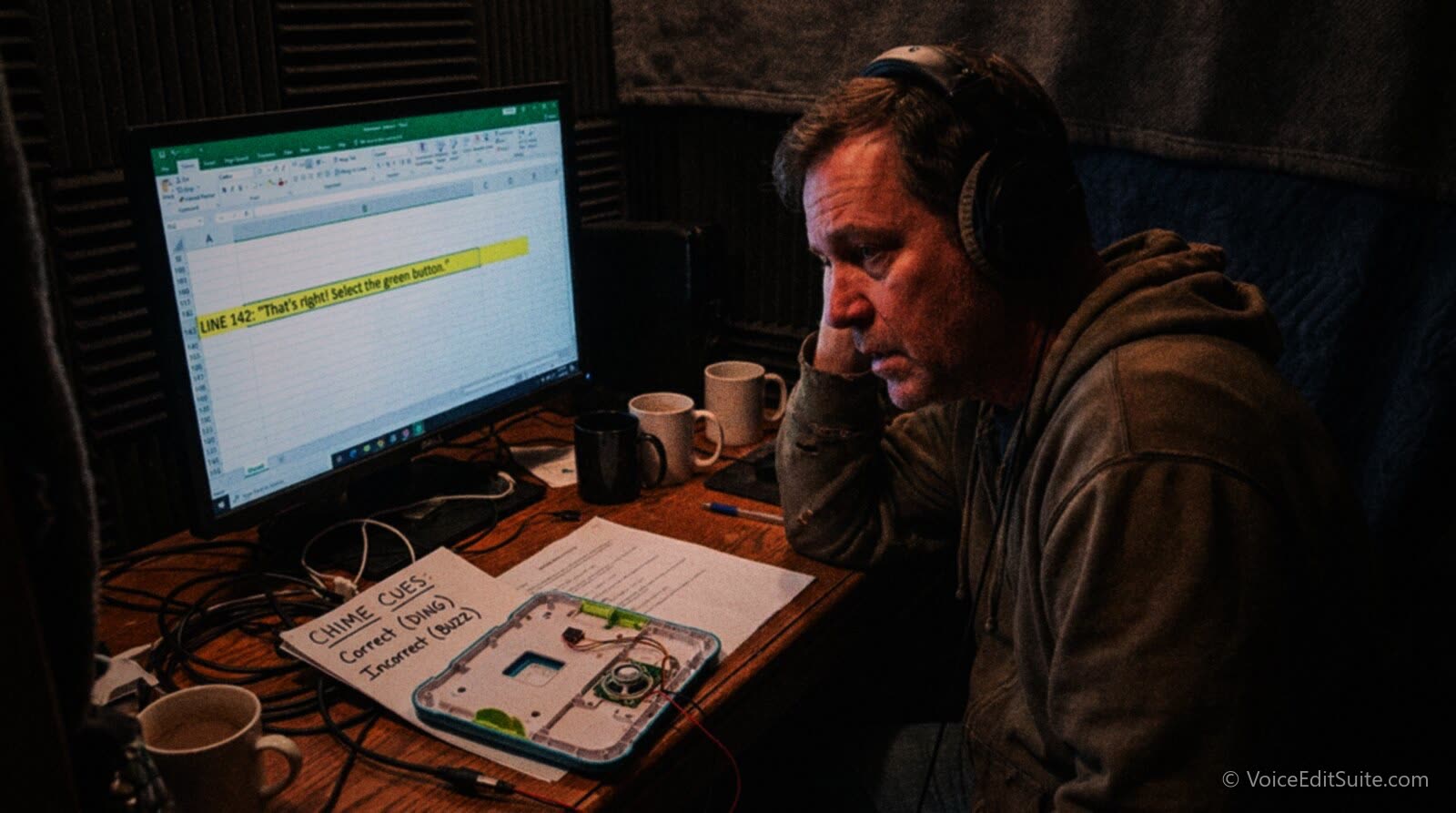
The short answer: voice-over for smart toys and interactive children's electronics is not children's audiobook narration with a smaller budget. It is short-form, high-repetition line reading, dozens to hundreds of individual phrases, usually two to twelve words each, recorded as standalone takes rather than a continuous performance. A single product's script covers greetings, correct-answer praise, incorrect-answer encouragement, idle chatter the toy plays when nobody has touched it in a while, and system lines like low battery or a lost connection. The market behind that work is real and growing fast. Grand View Research values the global smart toys market at roughly $14.39 billion in 2025 and projects it will reach about $44.0 billion by 2033, a 15.8 percent compound annual growth rate, with the educational-toy segment growing fastest of all at a projected 18.8 percent CAGR.
This is a distinct niche from narrating a children's picture book, which asks for sustained, page-turn-paced storytelling, and from the smart speakers and general voice assistants that live in the kitchen and the car. A smart toy's voice is usually a real human being recorded specifically for that product: a plush animal, a learning tablet, a robot pet, or an interactive flashcard set that needs its own cheerful, specific, endlessly repeatable voice. Child-directed products also carry a layer of US privacy regulation that a general commercial voice-over job never touches, and any voice actor working in this niche should understand it before booking the session.
What Makes This Work Different From Narration
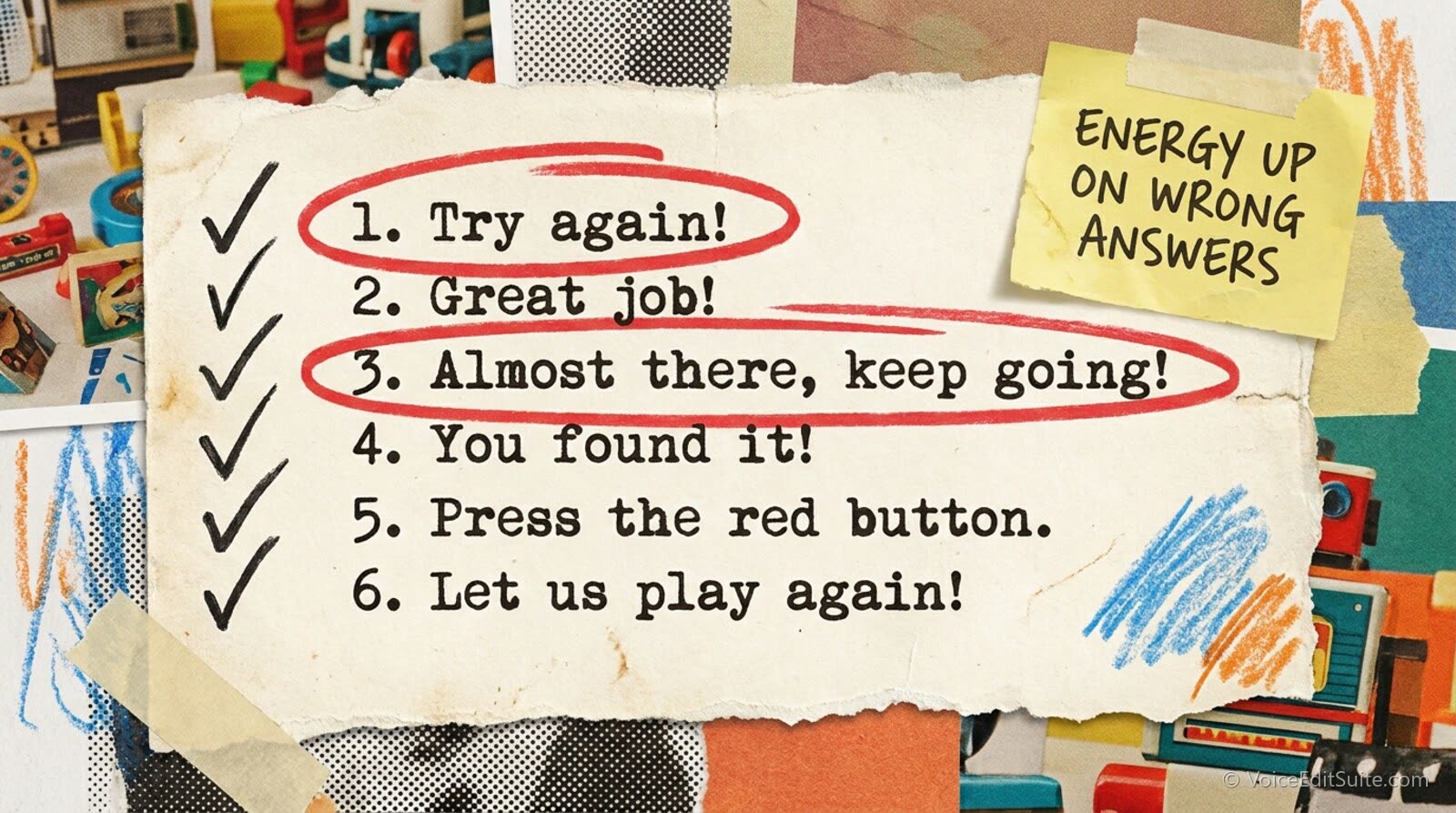
A continuous audiobook chapter or a 30-second commercial script asks for one performance that holds together from start to finish. A smart toy script asks for the opposite: a long flat list of discrete lines, each one only a few words, each one needing to sound exactly as fresh and committed on the fortieth take as it did on the first. A single interactive learning tablet or plush toy can carry dozens to several hundred separate audio lines covering every button press, every correct tap, every wrong tap, and every stretch of silence long enough that the toy has to say something to remind a child it is still there. None of those lines connects to the one before or after it in a script sense. A voice actor reading line 118, a chirpy "Try again!", has no idea, and does not need to know, what line 117 or 119 said, because the toy's firmware will play whichever line a child's actual button presses trigger, not the order they happen to sit in on the script document.
That structure changes what a session actually feels like. A narrator working on a children's picture book settles into a character and a pace and stays there for pages at a time. A smart toy session is closer to the stop-start rhythm of barks and callouts recorded for a video game: record a line, stop, listen back, record the next one, often five or six alternate takes of the exact same three words because the director wants to bank options for a tired version, an extra-excited version, and a slightly confused version of the same correct-answer chime. A single four-hour session can easily produce 150 to 300 final lines once every alternate take and every retake for a flubbed consonant is factored in. Voice actors used to long-form narration sometimes find this pace tiring in a different way than narration is tiring, not from sustaining a performance, but from the sheer number of discrete decisions and the discipline of staying consistently warm on the two hundredth repetition of basically the same sentence.
The Line Categories Almost Every Script Uses
Scripts for this category of product break down into a small number of recurring line types, and knowing them before an audition helps a voice actor understand what the brief is actually asking for, and why the tone note attached to each category can be so specific.
- Greeting and wake lines. The first thing the toy says when it is turned on, picked up, or squeezed: short, high-energy, and usually the only line a parent hears before deciding whether the toy's voice is tolerable for the next six months.
- Correct-answer feedback. Praise lines triggered when a child gets a quiz question, a shape match, or a button sequence right. Projects commonly need ten or more variations so the same praise does not repeat identically every time, ranging from a plain "That's right!" to a bigger "You got it, great job!"
- Incorrect-answer feedback. Gentle, encouraging redirection rather than anything that could read as correction or disappointment: "Nice try, let's try again" rather than a buzzer tone in the voice. This is the category where tone direction is strictest, because a wrong-answer line that sounds even slightly flat, sarcastic, or discouraging gets flagged in review almost every time.
- Idle or ambient chatter. Lines the toy plays on its own after a period of no interaction, meant to feel like the toy noticing the child again rather than nagging them, often the largest single category by line count in a toy with a rich personality.
- Error and system lines. Low battery, a lost Bluetooth connection, a firmware update needed: short, functional, and usually recorded last in a session, after a voice actor's warmth and energy level from the fun lines has become the reference a director checks even the mundane lines against.
Add those categories up across a toy with a real personality, built-in games, and a companion app, and the resulting script document can run longer than the dialogue script for a short animated special, just cut into pieces a few words long instead of full scenes.
How Big This Market Actually Is
The category behind that work has grown from a toy-aisle curiosity into a genuine consumer electronics segment. Grand View Research's smart toys market report values the global market at roughly $14.39 billion in 2025 and projects it will reach about $44.0 billion by 2033, a 15.8 percent compound annual growth rate across that period. Within that total, the firm expects educational toys specifically, the interactive learning tablets, talking flashcard sets, and STEM kits that depend most heavily on short, structured feedback lines, to grow fastest of any segment, at a projected 18.8 percent CAGR, as parents keep steering toy budgets toward products that double as early learning tools. Interactive games, the broad category covering most voice-driven play patterns, already accounted for 75.9 percent of the market's 2025 revenue, and North America held the largest regional share at 38.9 percent. Other research firms publish higher totals under broader definitions of "smart toy," which is a reminder that this category still lacks one settled industry standard for what counts, but every published estimate agrees on the direction: fast, sustained growth through the rest of the decade.
The product side of this growth is visible in recent headlines, not just in a market research spreadsheet. In June 2025, Mattel announced a partnership with OpenAI to build AI-powered products across brands including Barbie, Hot Wheels, and Fisher-Price, with voice-enabled toys and companion apps named explicitly as part of the plan, as The Register reported at the time. Smaller companies have moved faster: the plush-toy maker Curio already sells AI companion toys that hold open-ended conversations with children, built on a cloned, celebrity-style voice. Whatever a given product's underlying AI model turns out to be, somebody still has to record the base voice, the brand's approved tone, and the library of fixed lines that the product falls back on when its live conversation engine is offline, or deliberately kept simple for younger ages, which is exactly the work this niche is built around. The overlap with voice-over for AI chatbots and conversational agents is real: a toy with a generative AI backend still needs a recorded voice personality to build its text-to-speech output on, and still needs a set of hand-recorded fallback lines for the moments a live model should not be trusted unsupervised with a child's question.
What the Recording Session Itself Is Actually Like
Walk into an actual session and the difference from a narration booth is obvious before a single line is recorded. The script is usually a spreadsheet or a numbered list rather than a manuscript, sorted by trigger event rather than by any story order. Directors for this category often ask for a specific small set of named "flavors" per line, energetic, calm, extra silly, so the product's firmware can rotate between them and avoid repeating the identical recording every single time a child presses the same button. A toy that uses three recorded variants of "Good job!" instead of one lasts noticeably longer before a parent starts hearing the same clip on a loop and quietly retires the toy to a closet shelf.
Pronunciation and brand-term accuracy matter more here than in almost any other commercial category, because a mispronounced character name or product term gets locked into a mass-produced device that will say it exactly the same way for the life of the product, with no post-release fix short of a firmware update most toys never receive. Directors typically supply a short pronunciation guide for any invented character or product name up front, and a voice actor who treats that guide as optional, the way an audiobook narrator might treat a minor background name, is making exactly the kind of mistake that gets a take rejected after the session rather than caught during it.
Energy is the hardest thing to fake on line 200
The first ten takes of a session are easy. The challenge in this niche shows up around line 150 or 200, when a voice actor's natural instinct is to let correct-answer praise flatten into the same tired cadence out of simple fatigue. Directors budget real break time into long toy sessions for exactly this reason, and a voice actor who paces their own energy across a session, rather than front-loading it, delivers a more usable, more consistent set of files.
Keeping the Voice Consistent Across a Product Line
Smart toy lines rarely ship once and disappear. A successful line, a plush animal, a learning robot, a flashcard system, typically spawns sequels and companion products recorded months or years apart, the same consistency challenge that long-running children's book series face, but with an added wrinkle: a toy line's voice also has to survive a manufacturer swapping sound hardware, re-encoding audio at a lower bitrate for a cheaper speaker, or adding a companion app that reuses the same voice bank for new content types nobody had scripted when the original sessions were recorded. Keeping a clean, labelled archive of every approved take, not just the ones used in the first product, is one of the few genuinely toy-specific pieces of session discipline worth building early in this niche.
Localization: One Script, Many Languages
Toy manufacturers selling into more than one country rarely localize a smart toy's voice through a single generalist studio the way a corporate training video might be. Because the script is already broken into short, independent, numbered lines, it localizes cleanly into a per-line translation and recording workflow, close to the line-by-line pattern used for multi-language YouTube audio tracks rather than to dubbing a continuous narration against a locked video. A single toy with 200 English lines commonly becomes 200 lines times however many languages the manufacturer sells into for a holiday launch, five or six languages being a common range for a mid-sized toy company targeting North America and Western Europe, each one needing its own native voice actor who can match the English version's energy and comedic timing on an equally short, equally repeatable line.
That multiplication is exactly where this niche quietly turns into a bigger job than it looks on paper. A 200-line script is a manageable single-language session. The same script, localized into six languages with three alternate takes per line for variety, is well over 3,500 individual recorded files once every language and every take is counted, each one needing to clear the same pronunciation, tone, and timing bar as the original. Manufacturers on a holiday release schedule often need that entire pipeline, script, casting, recording, review, and delivery across every language, to close inside a few weeks, which rewards voice actors and small studios who can turn around clean, correctly labelled files fast rather than ones who need a long back-and-forth on each batch.
↗ Try the tool
Rate Calculator
A 200-line English script that becomes 1,000 or more lines once it is recorded in five or six languages does not price the way a single 30-second commercial does, and quoting it by the hour instead of by the line is how a lot of this work gets badly underpaid. The Voice-Over Rate Calculator lets you model a project by line count, session length, and usage rather than guessing, so a quote for 300 short feedback lines across three toy variants actually reflects the real scope instead of a flat day rate meant for a normal commercial session.
Open Rate Calculator →Child Safety and Regulation: What COPPA Actually Requires
Products aimed at children under 13 in the United States are regulated in a way few other voice-over clients are, and the regulation reaches further into a toy's voice work than most actors expect. The Children's Online Privacy Protection Act and its implementing COPPA Rule, enforced by the Federal Trade Commission, define "personal information" to include any photograph, video, or audio file that contains a child's image or voice, a definition added in a 2013 rule amendment specifically because toys and apps had started recording children rather than just displaying content to them, as the Congressional Research Service laid out in its own report on smart toys and COPPA. A toy that listens to a child's spoken answer and records it, rather than simply reacting to a button press, is handling exactly the kind of data COPPA was expanded to cover, which is why manufacturers building voice-recognition toys need verifiable parental consent before collecting that audio, with a narrow exception the FTC carved out in an October 2017 enforcement policy statement, summarized at the time by the law firm Fenwick, for services that use a child's voice only as a stand-in for typed text, such as running a search, and delete the recording immediately after.
That framework was tightened again recently. The FTC finalized a fresh round of COPPA Rule amendments on April 22, 2025, taking effect June 23, 2025, with most of the substantive new obligations due by April 22, 2026, according to law firm coverage summarized by Jones Day. The headline change requires separate, specific opt-in consent before a child's data can be used for targeted advertising, and the amendments also tightened data retention and security requirements and expanded what counts as regulated personal information, including biometric identifiers, a category voice data already sits close to. None of this falls on the voice actor directly. The manufacturer, not the performer reading the script, is the one who has to secure consent and manage the data a finished toy collects. But it changes what a voice actor should expect from a serious client: a toymaker that has actually thought through COPPA compliance will usually also run tighter script review, clearer pronunciation guides, and more conservative tone notes than a smaller operation moving fast, because the same legal team reviewing data practices tends to review the script too.
A parallel, non-governmental layer of scrutiny sits on top of COPPA. CARU, the Children's Advertising Review Unit run by BBB National Programs and the longest-running COPPA safe harbor program in the US, published a risk matrix for generative AI aimed at children that names AI toys, smart devices, and voice assistants directly, flagging voice cloning techniques inside child-directed advertising as a specific risk and recommending that products remind children regularly that they are talking to AI rather than a person. For a voice actor, the practical takeaway sits close to the questions worth asking before voicing an AI chatbot or conversational agent: know, in the contract, exactly what the recording can be used to train. A library of short, generic lines for a specific toy's fixed vocabulary is a normal, bounded licensing question. A request to record enough material that a generative model could later extend your voice into lines you never actually read and never got to approve is the point where a performer should ask for the same kind of explicit, scoped usage language any synthetic-voice-adjacent booking deserves, spelled out in the contract before, not after, signing.
Breaking Into This Niche
Breaking into this corner of voice-over rewards a different demo than general commercial or audiobook work. A toy manufacturer, or the sound studio handling its audio package, is listening for exactly the two things casting for a picture book narrator or a general commercial read will not show: whether a performer can hold a genuinely warm, un-sarcastic tone through ten near-identical takes of the same three words, and whether their "excited" and "extra excited" read for a correct answer sound like two real options rather than the same take played at different volumes. A short demo built specifically for this category, a dozen or so sample lines covering a greeting, two or three correct-answer variants, an incorrect-answer line, and one idle chatter line, demonstrates range that a general demo reel tends to bury under longer, more conventional reads.
Most of this work does not move through a general casting marketplace at all. It tends to run through toy manufacturers' own audio or product teams, through the handful of sound design and localization studios that specialize in consumer electronics and toys, and through game audio studios that have expanded into interactive toys because the workflow, short triggered lines mapped to firmware events, is close to what they already build for games. Finding direct clients without going through a marketplace is the more useful skill to build here than optimizing a generic casting-site profile, since the toy companies and studios actually buying this work are a short, identifiable list rather than an open marketplace of anonymous buyers.
None of this requires abandoning other kinds of children's or character voice-over work. The skills overlap heavily with voicing consistent characters across animation and games, and a voice actor already comfortable holding a character's energy across dozens of game lines is usually most of the way to being comfortable in a toy booth already. What is different, and worth practicing deliberately before an audition, is the discipline of staying warm, specific, and un-tired-sounding on the two hundredth line of a session that will never ask a performer to carry a story, only to be the same reliable, cheerful voice a child presses the same button to hear again and again.
Frequently Asked Questions
How many lines does a typical smart toy voice-over project include?
It varies enormously by product complexity, but a mid-range interactive learning toy or plush companion commonly runs from 80 to 300 final English lines once greetings, multiple correct and incorrect feedback variants, idle chatter, and system lines are all counted, with flagship products carrying substantially more. A simple single-function toy that only confirms a button press might need as few as 20 to 40 lines.
Is this the same work as voicing a children's audiobook?
No. Audiobook and picture book narration is sustained, continuous storytelling paced for a listening child, covered in our guide to narrating children's books and educational audio. Smart toy work is short, independent, triggered lines with no narrative order, recorded in rapid-fire takes rather than a single flowing read, and judged on consistency across dozens of near-identical lines rather than on sustaining one character through a story.
Does COPPA affect the voice actor directly, or only the toy manufacturer?
The legal consent and data-handling obligations under COPPA fall on the manufacturer, since it is the manufacturer collecting any audio or data from the child using the finished product, not the performer who recorded the toy's scripted voice lines. What does reach the voice actor is the downstream effect: a manufacturer that takes COPPA and CARU's guidance seriously tends to run tighter script review and clearer usage terms, which is worth asking about directly in any contract, especially around whether your recorded lines could later be used to train a generative voice model beyond the specific lines you approved.
How is pricing different for a high-line-count toy project compared to a normal commercial voice-over job?
A normal commercial quote is usually built around session length and usage rights for one finished spot. A toy project is usually quoted by line count and complexity instead, since a 300-line script with multiple feedback variants and several language versions represents dramatically more recording and editing time than a single 30-second read, even if both fit inside a similarly long studio booking. Quoting a large line-count project at a flat day rate meant for a normal commercial session is one of the most common ways this work gets underpriced.
Do smart toy manufacturers need voices in multiple languages?
Often, yes, particularly manufacturers selling into North America, Western Europe, and Latin America from one product line. Because the script is already broken into short, independent, numbered lines, it localizes in essentially the same per-line pattern used for multi-language audio tracks on platforms like YouTube: the same line list, translated and recorded separately by a native voice actor in each target language, matched for energy and timing rather than translated word for word.
Is AI-generated voice likely to replace human voice actors in this category soon?
Not entirely, and not evenly. The base voice, brand tone, and fixed fallback library for a toy still get recorded by a real performer in almost every product on the market today, including ones like Mattel's AI-toy partnership with OpenAI that lean heavily on generative technology elsewhere in the product. Where automation is encroaching is in extending that recorded voice into open-ended conversation through a generative model, which is exactly the use CARU's guidance and a careful usage-fee clause in a performer's contract are meant to put a boundary around, rather than in replacing the original recording session itself.
Sources and Further Reading
- Grand View Research, Smart Toys Market Report: the $14.39 billion 2025 valuation, the $44.0 billion 2033 projection, the 15.8 percent CAGR, the 18.8 percent CAGR for educational toys, and the interactive games and North America revenue shares used throughout this guide.
- FTC, Children's Privacy business guidance: the Federal Trade Commission's own hub for the Children's Online Privacy Protection Rule, including its definition of personal information and consent requirements.
- Congressional Research Service, Smart Toys and the Children's Online Privacy Protection Act of 1998: a non-partisan legislative research summary of the 2013 COPPA Rule amendment covering audio of a child's voice, and the COPPA Rule's coverage of connected toys as an online service.
- Fenwick, FTC's New COPPA Guidance on Recording Children's Voices: a law firm's summary of the FTC's October 2017 enforcement policy statement and its narrow exception for voice recordings used only as a stand-in for typed text.
- Jones Day, FTC Finalizes Amendments to COPPA Rule: the 2025 COPPA Rule amendments, their April 22, 2025 finalization, June 23, 2025 effective date, and April 22, 2026 compliance deadline.
- CARU (Children's Advertising Review Unit, BBB National Programs), Generative AI and Kids: A Risk Matrix for Brands and Policymakers, as summarized in trade legal coverage: CARU's naming of AI toys, smart devices, and voice assistants as a privacy risk category and its guidance on voice cloning and AI disclosure to children.
- The Register, I'm just a Barbie Girl in a ChatGPT world, June 13, 2025: the Mattel and OpenAI partnership covering voice-enabled toys and companion apps across Barbie, Hot Wheels, and Fisher-Price.