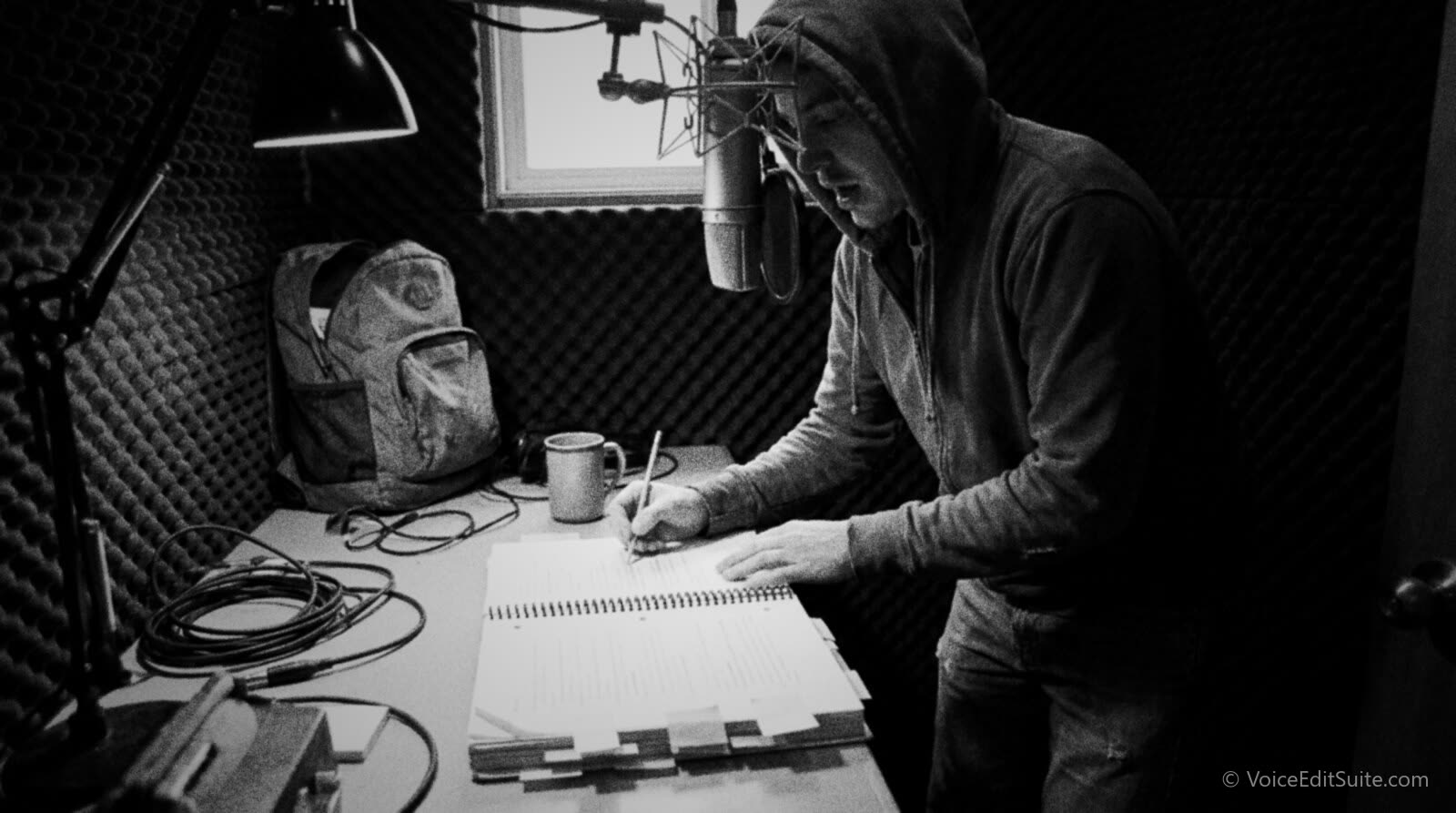
The short answer: narrating nonfiction audiobooks is not a quieter version of narrating fiction. A novel asks you to disappear into characters and let tension set the pace. A memoir, a history, a self-help book or a work of popular science asks for something closer to the opposite: one steady, recognizable voice a listener can trust for eight or ten hours straight, carrying them through an argument, a timeline or a set of instructions without the performance itself ever becoming the most noticeable thing in the room. The craft differences are specific and learnable, not a vague feeling about "tone": how fast you move through dense information compared with a dramatic scene, what you do with a footnote or a citation that was never written to be heard, how you read a pull quote or a chapter subheading out loud, and how much personality you let show before it starts competing with the author's.
This guide works through the four kinds of nonfiction narrators actually record most often: memoir and personal narrative, history and narrative nonfiction, self-help and business, and popular science or other academic-adjacent nonfiction. Each pulls pace and tone in a slightly different direction, but all four share the same underlying job, earning and keeping a listener's trust, which is a different muscle than the one fiction pacing and character work trains. If you already narrate fiction, the single biggest adjustment is giving up range for consistency. If you are new to audiobooks altogether, nonfiction is often the more forgiving place to start, provided you understand what it is actually asking of you.
Narrating Nonfiction Is a Different Job, Not an Easier One
The chart above simplifies a real distinction, not a strict rulebook. Fiction narration is built around variation: a narrator earns their fee by making a dozen characters sound like a dozen different people, by letting pace swing with a chase scene or a quiet confession, and by using silence the way a composer uses rests. Nonfiction strips most of that toolkit away. A memoirist writes in one voice, a historian writes in one voice, a business author writes in one voice, and the narrator is asked to represent that single, sustained voice for the length of an entire book without the dialogue, scene breaks and character entrances that give a novel its natural rhythm changes.
"Non-fiction is difficult to voice; possibly more difficult than fiction. As the style is generally 1st or 3rd person, there is rarely opportunity for the narrator to mix things up or vary their delivery."
That is a confession from a university press that runs its own in-house nonfiction audiobook program, not a complaint from an amateur, and it explains why the two formats need different training. A narrator who has spent years building sharp fiction character voices sometimes struggles the first time they sit down with a business book or a memoir, because the instinct to color every line fights against a text that wants to be heard as a single, trustworthy line of thought from start to finish. The opposite problem shows up too: a narrator trained mostly on nonfiction can sound flat and undifferentiated the moment they try their first novel, because staying out of monotone across a long, information-dense read and building vivid, separate character voices draw on genuinely different instincts, even though both start from the same microphone technique.
The Four Subgenres Working Narrators Actually Record
Audiobook catalogs lump an enormous amount of writing under one label, nonfiction, that covers very different listening experiences. Four subgenres account for most of the nonfiction work a working narrator actually books: memoir and personal narrative, history and narrative nonfiction, self-help and business, and popular science or other academic-adjacent nonfiction. None of them behave like a novel, but they do not behave like each other either, and treating all nonfiction as one undifferentiated reading style is where a lot of otherwise competent narration goes flat.
Memoir and Personal Narrative
Memoir sits closest to fiction of the four, because it is still a story with scenes, remembered dialogue and an emotional arc, just one the author insists really happened. The tone narrators reach for here is intimate rather than theatrical: a slightly slower, more conversational pace than a thriller, more room around a difficult sentence, and a willingness to let a pause sit instead of filling it. Where memoir differs sharply from fiction is in how much performance a listener will tolerate. A novelist's narrator can voice a villain with relish; a memoirist's narrator voicing a parent, an ex-partner or the author's younger self too broadly risks turning someone's real grief or real regret into a caricature. The safer default is understatement: let the writing carry the emotional weight, and keep your own delivery just slightly behind it rather than ahead of it.
History and Narrative Nonfiction
Narrative history and biography borrow fiction's storytelling shape, scenes, characters, rising stakes, but carry an additional cargo that fiction rarely has to: names, dates, place names and numbers that the listener needs to actually register, not just enjoy. That changes the pacing math. A sentence introducing a treaty's date and the three parties who signed it needs more separation between its clauses than a sentence of pure description would, because the listener is doing real cognitive work, filing away a fact rather than just following an image. Pronunciation becomes a bigger production issue here than in most fiction too: a history spanning three countries and two centuries can carry dozens of unfamiliar names, titles and foreign terms, which is exactly the kind of project where building a pronunciation glossary before you ever hit record saves hours of retakes later and keeps a listener's trust intact the moment a name recurs forty pages on.
Self-Help and Business
Self-help and business books are the most declarative of the four: short, numbered points, repeated framing phrases, direct address to the listener as "you", and a structure built to be skimmed in print and absorbed the same way in audio. The tone that wins here is confident and calm rather than enthusiastic, closer to a trusted colleague explaining something clearly than a motivational speaker performing energy. Pacing should be steady and a little slower around the actual advice, the three steps, the four pillars, the one habit, because that is the part a listener is most likely to want to retain rather than simply follow along with. A business book's chapter openings and closings often repeat a thesis almost verbatim across chapters; resist the urge to vary your delivery of that recurring line for the sake of variety, since the repetition is deliberate and the narration should support it rather than undercut it by sounding newly excited each time.
Popular Science and Academic-Adjacent Nonfiction
Popular science, and the broader category of academic-adjacent nonfiction aimed at a general reader, asks for the most patience of the four. The prose is doing real explanatory work: a mechanism, a study's method, a statistic that only means something once its context is attached, and a listener who loses the thread for one sentence can lose the whole paragraph that follows it. The instinct to speed up through technical language is almost always the wrong one; slow fractionally at the first use of a term the book is about to rely on for the next ten pages, and let full stops land with a touch more weight than you would in a narrative passage. This is also the subgenre most likely to include the production headaches covered below: citations, footnotes, and references to a chart or figure that exists on a page the listener cannot see.
Whichever of the four you are reading, the page in front of you presents problems a novel almost never does. A nonfiction manuscript arrives with footnotes, endnotes, in-text citations, bolded pull quotes, sidebars and the occasional chart, none of which were written with a human voice in mind, and all of which need a decision before you can read the sentence that contains them.
Handling Footnotes, Citations and Data in Audio
There is no single industry-wide rule for reading a footnote aloud, and you should be suspicious of anyone who claims there is. What the people who actually produce nonfiction audiobooks for a living agree on is that a footnote read exactly as it appears on the page almost never works, because print footnotes are written to be glanced at, not listened to in a continuous stream. Scribecount's guidance to authors preparing a manuscript for audio production is blunt about it: delete footnotes and endnotes from the audio script entirely, because a narrator cannot naturally read a footnote as a footnote the way a reader's eye can skip to the bottom of a page and back. Pro Audio Voices, a production studio that has recorded nonfiction for over a decade, has devoted more than one podcast episode to this exact question, which is itself a sign of how unsettled the convention still is even among professionals.
- Fold the essential fact in, drop the apparatus. If a citation exists only to support a claim, the claim itself is what the listener needs; the author, year and page number usually are not. The common move is to note once, early in the book, that full citations are available in the print or ebook edition, then leave them out of the narration entirely.
- Rewrite anything that points at a page the listener cannot see. "As shown in Figure 3" or "see the chart on page 47" means nothing in audio. The narration script should replace the pointer with the actual finding: not "the data in Table 2 shows a decline", but the number itself and what it means.
- Decide pull quotes and sidebars before you record, not mid-sentence. A boxed quote or a pulled-out statistic in the print layout needs a verbal cue, a brief pause and a slight shift in pace is usually enough, so a listener can tell it is a quoted aside rather than a continuation of the paragraph they were just in.
- Keep the decision consistent across the whole book. Whatever you and the producer or author decide about footnotes in chapter one has to hold for chapter twenty, or a listener who has learned to expect one treatment gets thrown by a different one later in the same book.
- Get the call in writing before the clock starts, not during the session. A clean manuscript already takes real time to edit; a narrator stopping mid-chapter to decide, on the fly, how to handle a run of fifteen footnotes turns an ordinary editing pass into a much longer one.
None of this is the narrator's call to make alone. The producer, or the author if there is no separate producer, should settle footnote and citation policy before the first chapter is recorded, the same way Princeton University Press describes its own process: a producer sources pronunciations and works with the publisher or author to decide where footnotes go and how graphs and diagrams get handled, so the narrator walks into the booth with a script that has already made those calls rather than discovering a buried citation mid-sentence.
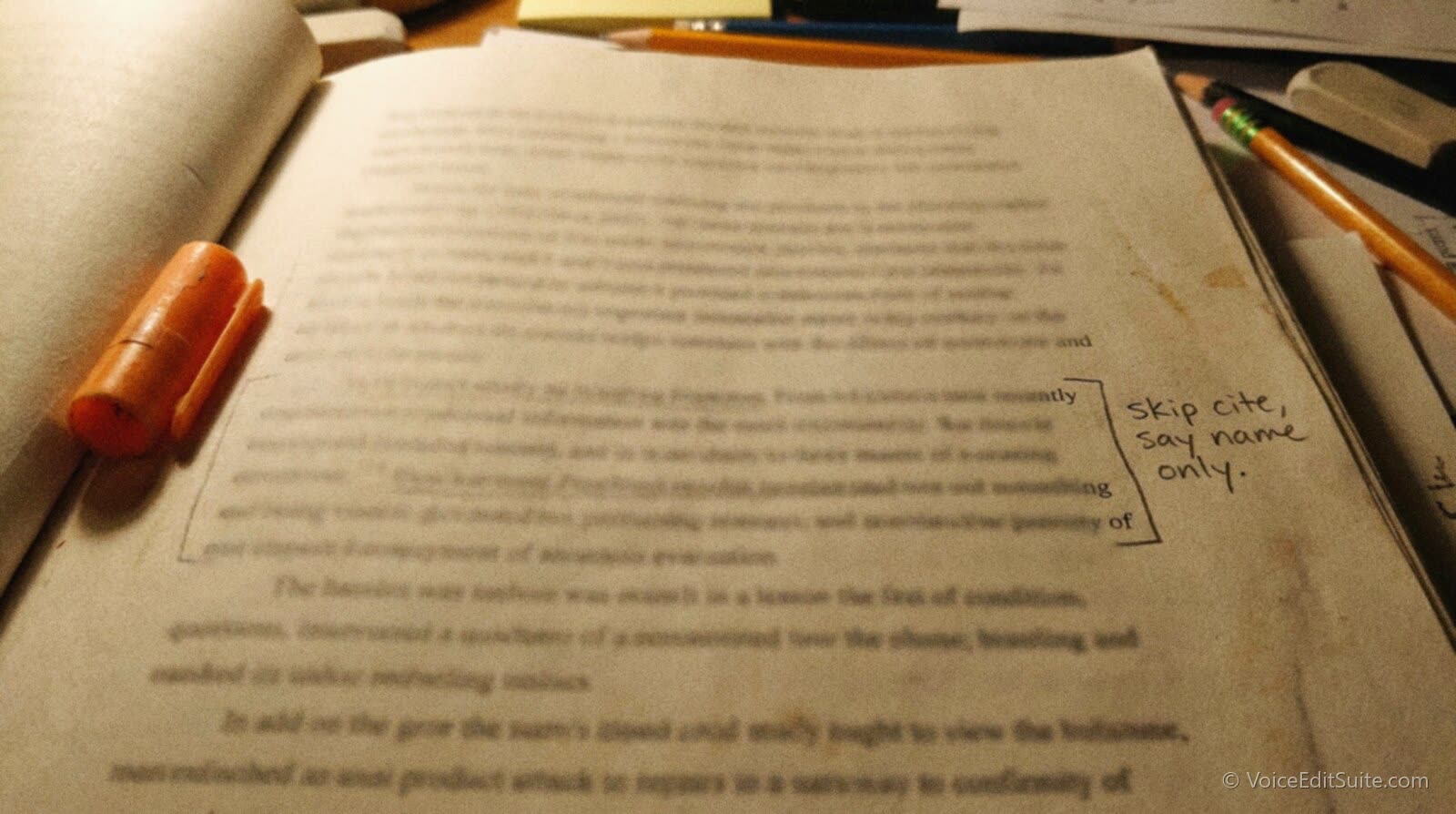
That upfront work pays off the moment you actually sit down to record, because a script that has already resolved its footnotes, charts and sidebars lets you focus entirely on pace and tone rather than making structural decisions sentence by sentence. It is also the difference between a nonfiction narration session that runs close to a predictable number of pages an hour and one that crawls, stopping and restarting every time an unresolved citation shows up mid-chapter.
Reading Headers, Pull Quotes and Section Breaks Out Loud
A printed nonfiction book leans heavily on visual structure that has no audio equivalent: bold subheadings inside a chapter, numbered lists, a pull quote set off in a larger font, a sidebar boxed away from the main text. None of that formatting survives the trip into audio unless the narrator and producer decide, in advance, what each one sounds like. The common convention for a subheading is a small, deliberate pause before and after it, read in something close to your normal pace rather than a different register, so it registers as a structural marker without turning into its own little performance. A numbered list inside a chapter, the five habits, the three mistakes, usually benefits from a slightly longer pause after each number than you would use for an ordinary sentence break, since that pause is doing the job a line break and a bolded numeral do on the page.
Pull quotes are trickier, because a print pull quote usually repeats a sentence that also appears in the body text, pulled out and enlarged purely as a visual device for someone skimming the page. Reading that sentence twice in audio, once in context and once as a repeated pull quote, almost always sounds like a mistake rather than a design choice. Most nonfiction narration scripts simply cut the pull quote and keep the sentence where it first appears in the body, trusting that a listener moving through the book in order does not need the same line highlighted twice the way a print reader skimming non-sequentially does.
Pacing for Comprehension, Not for Tension
Fiction pacing follows the scene: fast through action, slow through dread, quick through snappy dialogue. Nonfiction pacing follows the listener's processing load instead, and the two are not the same instinct. A sentence that introduces a new concept, a term the book is going to build on for the next chapter, a statistic that only matters in context, needs more room around it than a sentence that is simply continuing an idea already on the table. That is a comprehension question, not a dramatic one: you are giving a listener's working memory time to file the new thing away before the next one arrives, the same reason a good teacher pauses after introducing a new idea in a lecture rather than racing through it at the pace of the rest of the hour.
ACX's own production guidance for narrators, used across the platform regardless of genre, estimates that most performers narrate about 9,300 words per finished hour, which works out to roughly 155 words a minute once every pause, paragraph break and chapter header is counted into the average. That figure is genre-agnostic by design; it is a planning number for estimating a finished book's running time, not a performance target. What matters for nonfiction specifically is where inside that average your own pace should sit, and the honest answer is usually a touch slower than the fiction average, for exactly the comprehension reasons above. The skill of staying inside a deliberate pace without sounding rushed matters even more here than in fiction, because a rushed sentence in a novel costs you a little tension; a rushed sentence in a popular science book can cost the listener the entire idea that sentence was building toward.
↗ Try the tool
ACX Audiobook Prep
A nonfiction manuscript rarely arrives as one tidy file. It is often a dozen or more short chapters, each edited and submitted separately, each needing to land at the same loudness and noise floor as the one before it so a listener never has to reach for the volume dial between chapters. ACX Audiobook Prep checks each finished chapter against ACX's RMS, peak and noise floor requirements before you submit, which matters even more on a book with this many separate files than it does on a single long work of fiction.
Open ACX Audiobook Prep →Getting the loudness and technical spec right is a separate problem from getting the pace right, worth solving with its own checklist before you record a nonfiction title with a dozen or more short chapters, since a single mismatched chapter can hold up an entire submission while the rest of the book sits finished and waiting.
Finding Your Own Pace Instead of Copying an Average
The fastest way to find your actual nonfiction pace is the same method that works for fiction: record one finished chapter at the speed that feels right for the material, edit it the way you normally would, then divide the chapter's word count by its running time in minutes. Do this across two or three chapters of different kinds, a narrative opening, a dense explanatory middle, a direct-address conclusion, and look at the spread rather than a single number. A self-help book that runs noticeably faster in its anecdote-heavy stories and noticeably slower in its numbered action steps is pacing correctly, not inconsistently; a popular science book that holds the exact same speed through a vivid story and a dense explanation of a study's methodology is the one actually worth re-listening to with a critical ear.
Pacing Across Nonfiction Subgenres, Side by Side
The ranges in that chart are illustrative, built around ACX's own published 155-words-a-minute baseline rather than drawn from a single controlled study of genre and pace, because no publicly available study breaks audiobook speech rate out by nonfiction subgenre this precisely. What the ranges reflect instead is a convention working narrators and producers converge on repeatedly: memoir sits closest to, and sometimes slightly above, the overall average because its conversational, story-driven prose reads naturally at a brisker clip; self-help and business sit close to the average with more deliberate slowing around the actual advice; history and narrative nonfiction run a touch slower to leave room for names, dates and places; and popular science or academic-adjacent nonfiction runs slowest of the four, because that is where a listener's comprehension load peaks.
Treat the chart as a starting assumption to test against your own recordings, not a target to hit. A narrator with a naturally brisk delivery who reads popular science at 150 words a minute while keeping every technical term perfectly clear and every pause exactly where the explanation needs it is pacing the book correctly, average be damned. The number only becomes useful once you have actually measured your own chapters against it and found where, and why, you differ from it.
Earning and Keeping the Listener's Trust
Everything above serves one underlying goal: a nonfiction listener needs to believe, from the first paragraph to the last, that the voice guiding them through the book knows what it is talking about and is not going to waste their time. That trust is built in small, specific ways rather than one grand gesture: consistent pronunciation of a recurring name or term across ten hours of recording, a steady energy level that does not visibly flag in chapter nine the way it might have been fresh in chapter one, and a tone that stays calm through an argument the listener might disagree with rather than audibly straining to persuade them. None of that is dramatic work. It is closer to the discipline documentary narrators bring to a script written entirely to inform rather than entertain, where the narrator's job is to be invisible in exactly the way that makes the information visible.
Human narrators and the trust question
Audiobook listeners have not rushed toward AI narration, which cuts in favor of the trust nonfiction asks a narrator to build. The Audio Publishers Association's 2026 consumer survey found only 16 percent of audiobook listeners have listened to an AI-voiced title at all, that AI-narrated titles accounted for just 0.03 percent of US audiobook revenue in 2025, and that listeners' stated willingness to try an AI-narrated book fell from 70 percent to 61 percent year over year. A format built entirely on a listener believing the person talking to them knows what they are talking about is, so far, one where a real narrator's judgment still has not been matched.
None of that is a guarantee the gap holds forever, but it is a reasonable description of where nonfiction narration sits today: a format growing fast enough to matter, as the sales figures in the sources below show, and specific enough in its demands that the craft is still worth learning properly rather than assuming it is simply fiction narration with the volume turned down.
Frequently Asked Questions
Should authors narrate their own nonfiction books?
Often, yes, more comfortably than in fiction. Listeners extend real goodwill to an author reading their own memoir or their own business book, because part of what they are buying is the author's actual voice and presence, not a polished performance. The trade-off is real too: an author with no recording experience usually needs more studio guidance, more takes and a producer willing to direct a first-time performer, which is a different project to budget and schedule than hiring an experienced narrator who can walk in and deliver a clean chapter on the first or second pass.
Should footnotes always be cut from an audiobook?
Not always, but cutting or folding them in is the default most production guidance lands on. Scribecount's advice to authors preparing a manuscript is to drop footnotes and endnotes from the audio script and, where a citation genuinely matters, note once near the start of the book that full references are available in the print or ebook edition. The exception is a footnote that contains an argument or an aside the author clearly wants heard, in which case it usually gets folded into the main sentence rather than read as a separate interruption.
Is nonfiction narrated more slowly than fiction?
Usually a little, though there is no official rule fixing a different rate. ACX's own planning figure of about 9,300 words, or 155 words a minute, per finished hour applies across every genre on the platform, fiction included. What changes with nonfiction is not a fixed speed but where you place extra room: more space around a new concept, a statistic or an unfamiliar name than around a sentence that is simply continuing a thought already established.
How much energy should a self-help narrator bring?
Less than the genre's cover design might suggest. The voice that works best is calm and confident rather than hyped, closer to a trusted colleague talking you through something clearly than a stage speaker working a room. Consistent, moderate energy across an entire book reads as more credible than a performance that peaks and dips, because a listener taking advice seriously wants to feel the advice is solid, not that the person giving it is simply excited right now.
What is the biggest technical challenge in popular science narration?
Pronunciation and consistency around terminology, more than pace alone. A popular science book can introduce dozens of specialized terms, researcher names, place names and the occasional foreign-language word, and a listener's trust erodes quickly if a recurring term is pronounced three different ways across a ten-hour book. Building a pronunciation list before recording starts, and keeping it updated chapter by chapter, is the single most effective fix, and it matters as much for a popular science title as it does for a dense history full of foreign names.
How big is the nonfiction share of the audiobook market?
Less fixed than people assume. The Audio Publishers Association's own sales survey, the most authoritative count of the US market, listed general nonfiction among the top revenue genres in its report covering 2024 sales, alongside science fiction and fantasy and romance. Its report covering 2025 found general fiction pulling further ahead at 27 percent of revenue, with nonfiction not named among that year's top tier, a reminder that genre rankings move year to year. An older APA figure, from 2018, put nonfiction at 32.7 percent of unit sales, led by general nonfiction, history and biography and memoir, and self-help, though that figure is now dated and measures units rather than revenue.
Sources and Further Reading
- Princeton University Press, Producing Nonfiction Audiobooks: a university press's own account of its nonfiction program, including the difficulty of varying delivery in first- or third-person nonfiction and the producer's role in deciding footnote and diagram handling.
- ACX Help Center, How Long Will My Narrated Audiobook Be: ACX's published estimate of about 9,300 words, or 155 words a minute, per finished hour, used across the platform regardless of genre.
- ACX Help Center, Producing and Recording Your Audiobook: ACX's breakdown of total production time per finished hour and its quality-review expectations for narrators.
- Scribecount, How to Format Your Manuscript for Audiobook Production: practical guidance for authors on removing footnotes, endnotes and page references from an audio script before it reaches a narrator.
- Pro Audio Voices: an audiobook production studio whose own podcast devotes more than one episode to the open question of handling footnotes and endnotes in nonfiction audiobooks, cited here for the state of the craft conversation rather than one fixed answer.
- Audio Publishers Association 2026 Sales and Consumer Survey data, as reported by Shelf Awareness and Book Riot: $2.43 billion in US audiobook revenue for 2025, general fiction at 27 percent of revenue, the 58 percent of US adults who have listened to an audiobook, and the AI-narration trust figures cited above.
- Book Riot, Audio Publishers Association Consumer Survey: coverage of the Audio Publishers Association's survey covering 2024 sales, listing general nonfiction among that year's top revenue genres alongside science fiction and fantasy and romance.
- Publishers Weekly, Audiobook Sales Jumped 24% in 2018: the earlier Audio Publishers Association figure putting nonfiction at 32.7 percent of unit sales, led by general nonfiction, history and biography and memoir, and self-help.