
Dubbing, replacing a film or show's original dialogue with a performance recorded in another language, is a large, mostly invisible industry built on the fact that human actors in Italy, France, Germany, Japan, and dozens of other markets have spent decades making foreign content sound native. Over the past three years, streaming platforms and AI dubbing startups have begun testing whether generative voice technology can do a version of that work faster and cheaper. This article covers what is actually documented about that shift, real pilots, real pullbacks, real union responses, sourced and linked throughout.
The Market Numbers, and Why They Do Not Agree With Each Other
Nimdzi Insights, a widely cited tracker of the language services industry, sizes the broader global language services market, translation, localization, and dubbing together, at roughly $71.7 billion in 2024, rising to about $75.7 billion in 2025. That figure covers far more than dubbing alone, and it is the most consistently sourced anchor number available; market-research reports specifically labeled "AI dubbing market" or "dubbing and voice-over market" vary by an order of magnitude between research firms depending on how each one defines the category, which is a real limitation worth stating plainly rather than picking whichever number sounds most dramatic. Slator, a trade publication that covers this industry specifically, reported in its 2025 AI Dubbing Report that AI video dubbing is a stated priority for 25 percent of the enterprises it surveyed, a more specific and directly relevant figure than any of the broader market-size estimates.
Market-sizing estimates for AI dubbing specifically are inconsistent across firms
Multiple research aggregators publish conflicting figures for "the AI dubbing market," ranging by roughly tenfold depending on scope and methodology. This article relies on Nimdzi's broader, more consistently cited language-services figure and Slator's survey finding rather than any single AI-dubbing-specific market-size number.
What Is Actually Happening on Real Productions
Amazon's own newsroom confirmed it launched an AI dubbing pilot on Prime Video on March 5, 2025, covering 12 licensed titles dubbed into English and Latin American Spanish, including *El Cid: La Leyenda*, *Mi Mamá Lora*, and *Long Lost*, described by Amazon as a human-and-AI hybrid workflow aimed specifically at titles that would otherwise not have been dubbed at all due to cost. Separately, Kartoon Studios signed a deal with AI dubbing company Deepdub in June 2024 to dub its Kartoon Channel content into Castilian Spanish, Brazilian Portuguese, Arabic, and Italian, confirmed through both a Deadline report and the company's own SEC filing. Deepdub has said its own title volume grew 120 percent in the first quarter of 2024 compared with the same quarter the year before, a company-reported figure rather than an independently audited one.

When AI Dubbing Backfired: Two Documented Pullbacks
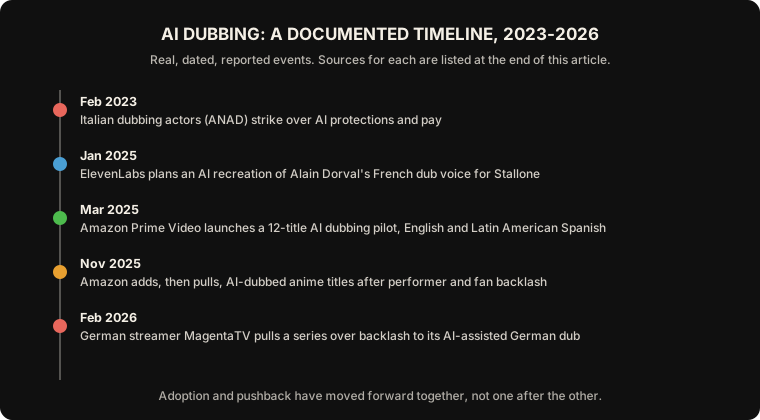
Over Thanksgiving weekend 2025, Amazon quietly added English "AI beta" dub tracks to several anime titles, including *Banana Fish*, *Pet*, and the film *No Game, No Life Zero*, and pulled them within days after a wave of criticism from performers and fans, reported by both Anime News Network and Yahoo Entertainment. Voice actor Daman Mills called the AI dubs "a massive insult to performers" and canceled his own Prime subscription in protest; the National Association of Voice Actors (NAVA) publicly branded the tracks "AI slop." The licensors involved, Kadokawa and Sentai Filmworks, stated the AI dubs had never been approved on their end, pointing to a rights dispute layered on top of the performer backlash.
A second, separate pullback happened in Germany: streamer MagentaTV removed the Polish crime series *Morderczynie* ("Murderesses") just two days after its February 1 premiere, following viewer outrage over its AI-assisted German dub, built with Israeli AI dubbing company Deepdub, reported to have been pursued because traditional human dubbing in Germany was considered prohibitively expensive for the title. Deutsche Telekom, MagentaTV's parent, subsequently offered the series in its original Polish with German subtitles instead, reported by both Hollywood Reporter and the German technology outlet Heise.
Dubbing Actors Have Organized Against This in Three Countries
Italy's national dubbing actors' association, ANAD, led a strike beginning February 21, 2023, involving roughly 2,500 dubbing-industry workers, demanding both a pay increase, wages had not moved in fifteen years, and explicit AI protections.
"AI poses a great threat to us. There is no law yet that protects us from AI, and our voices can be used and modified by it without our permission."
The strike produced a contract win worth noting specifically: a dubbing actor's recorded voice can now only be used for the specific product they were hired to work on, and any use of that voice to train or drive an AI voice clone requires a separate contract and separate consent. In France, the union SFA-CGT has run a public campaign under the hashtag #TouchePasMaVF ("don't touch my French dub"), gathering more than 150,000 petition signatures and estimating that unregulated AI dubbing could put roughly 15,000 French dubbing jobs at risk if the work is offshored to unregulated AI platforms rather than performed by union actors. A separate, broader open letter in 2026, signed by roughly 4,000 French actors including Bérénice Bejo, Léa Drucker, and Swann Arlaud and backed by the performers' rights organization Adami, described generative AI as "extraordinarily valuable for certain professions" and, in the same breath, "a devouring hydra for the artists that we are."
The most specific, named flashpoint tying these concerns to a real production came in January 2025, when AI voice company ElevenLabs announced plans to digitally recreate the French dubbing voice of the late Alain Dorval, Sylvester Stallone's longtime French dub actor, for the Amazon France release of the film *Armor*. Jimmy Shuman, a representative for FIA, the International Federation of Actors, called the plan a "provocation." In Germany, the voice actors' association VDS, representing roughly 600 members, organized a boycott of Netflix's German dubbing contracts in early 2026 over a clause the union said would allow performers' recordings to be used for AI training; VDS spokesperson Anna-Sophia Lumpe said Netflix responded to the boycott by threatening to release future content with German subtitles rather than a German dub if the boycott continued, adding that "our efforts and the efforts of the voice actors are generating a response."
The Math Behind the Concern, in One Concrete Example
India, which has no binding industry agreement or government regulation on AI dubbing as of this writing, offers the clearest documented illustration of what is actually at stake for working dubbing artists. A film with roughly ten major characters and a handful of minor ones normally requires 30 to 40 dubbing artists per language to cast properly; Hollywood Reporter's coverage of the issue notes that AI voice cloning could reduce that same job to as few as two male and two female artists providing source material for a model to generate the rest. AI voice cloning has already been used in the Indian productions *Kalki 2898 AD* and *Vettaiyan*, per the same reporting, making this a documented current practice rather than a hypothetical.
The tension is not simply human-versus-machine in the abstract. SAG-AFTRA's own National Executive Director, Duncan Crabtree-Ireland, has drawn a distinction between AI-generated speech and an actual performance in a related context, describing AI-narrated audio next to professional narration this way:
"If you use Apple's new text-to-speech tool for reading an audio book it's not the same thing as listening to an audio book that's been recorded by a professional performer. It's like listening to someone read a tax return."
That quality gap is exactly the ground the dubbing controversies above are actually being fought over: whether AI dubbing is a tool for reaching audiences a production could never otherwise have afforded to serve, Amazon's stated rationale for its pilot, or a lower-quality substitute being deployed specifically because it is cheaper than paying the human actors who could do the job better, which is closer to what happened with MagentaTV's pulled series and Amazon's pulled anime dubs.
What This Means for a Working Voice Actor Right Now
None of the documented cases above show AI dubbing succeeding on a well-known, well-funded title without controversy; the two clearest pullbacks both happened on titles with an existing, engaged fan and performer base willing to push back loudly and immediately. Dubbing and ADR work built on trained human timing and performance remains the standard for major, high-profile productions for now, while AI dubbing's clearest current use case, per Amazon's own framing, is reaching catalog titles that would never have been professionally dubbed at all otherwise. Understanding how AI voice cloning consent and rights actually work and what current law does and does not protect matters more for a working voice actor than trying to guess which direction this specific fight resolves.
↗ Try the tool
Performance Coach
Free to try: the Performance Coach sharpens exactly the kind of nuanced, character-true delivery that every documented AI dubbing controversy above turned out to be missing. Real performance is still the differentiator the data shows.
Open Performance Coach →Adoption and Pushback, Moving Together
AI dubbing is genuinely being tested on real, named productions by real, named companies, not merely discussed as a future possibility, and it is also genuinely being pushed back against, organized, and in at least two documented cases actually reversed after backlash, by dubbing actors and their unions across at least three countries. Both of those things are true at once as of this writing, and neither one has settled the argument yet.
Sources and Further Reading
- Nimdzi Insights, Language Technology and Language Services Market Size: the $71.7 to $75.7 billion global language services figures.
- Slator, The Slator 2025 AI Dubbing Report: the 25 percent enterprise-priority survey finding.
- Amazon, Prime Video Introduces AI Dubbing: the 12-title pilot, launch date, and named titles.
- Deadline, Kartoon Studios, Deepdub Dubbing Deal: the Kartoon Studios and Deepdub agreement and language list.
- Anime News Network, Answerman on Amazon's AI Anime Dubs and Yahoo Entertainment, coverage of the backlash: the Daman Mills quote, NAVA's statement, and licensor response.
- Hollywood Reporter, Europe's Film and TV Dubbers Confront AI and Heise, coverage of the MagentaTV removal: the MagentaTV pullback.
- Variety, Italian Dubbers Strike Over AI: the ANAD strike and Daniele Giuliani quote.
- Variety, Sylvester Stallone's French Voice: AI Fight Sparks European Dubbers: the ElevenLabs and Alain Dorval case, and the Jimmy Shuman quote.
- Variety, French Actors' Open Letter on AI: the 4,000-signature letter and quote.
- Hollywood Reporter, AI Is Replacing Voice Artists in India: the dubbing-cast-size figures and named productions.
- Deadline, SAG-AFTRA's Duncan Crabtree-Ireland on AI, Studios, and Streamers: the tax-return audiobook quote.
Corrections
Two figures above, Deepdub's self-reported 120 percent title-volume increase and the French SFA-CGT's estimate of 15,000 jobs at risk, are company and union estimates rather than independently audited figures, and are labeled as such. The German VDS boycott coverage relies on wire and trade-press summaries rather than a directly quoted primary transcript. If you spot an error or a newer published figure, tell us through the contact page and we will correct it.