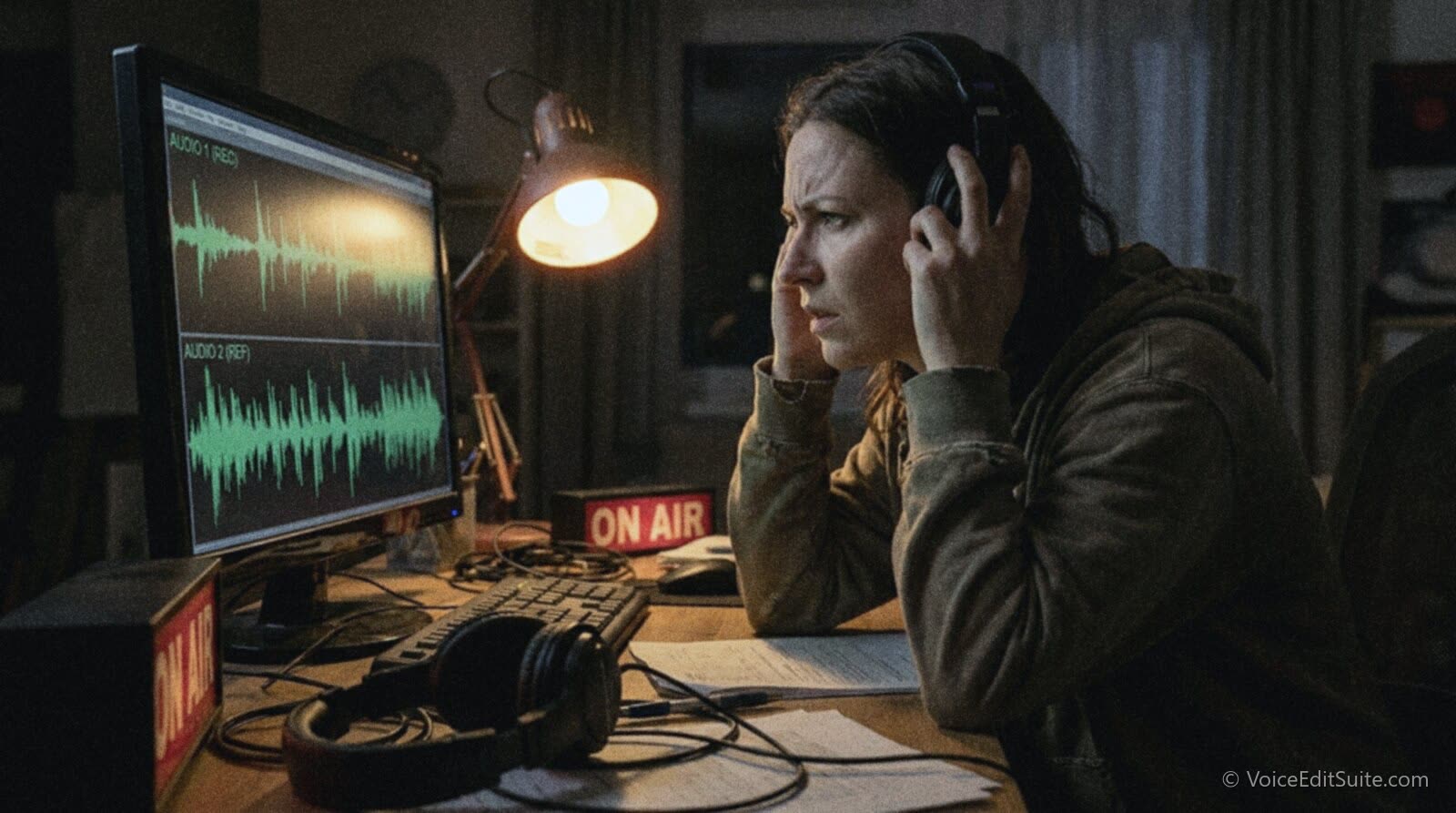
The short answer: current audio watermarking and provenance tools can tell you, with real confidence, whether a piece of audio passed through a cooperating AI system that embeds a signal, such as Google DeepMind's SynthID or a tool that signs its output with a C2PA Content Credential. They cannot tell you that a recording is genuinely, unmodified human. Absence of a watermark proves nothing, because most human-recorded audio was never watermarked at all, and absence of a Content Credential proves nothing either, because most of the internet's audio has no credential attached, AI-generated or not. For a voice actor trying to show a client, a casting director or a court that a clip is or is not actually them, that gap matters more than any of the technology's genuine strengths.
This is a narrower question than the one covered in our report on AI voice cloning's effect on working actors or the state-by-state legal landscape for unauthorized voice cloning. Those pieces are about whether cloning your voice without permission is illegal and what a union contract can do about it. This one is about the plumbing underneath both questions: what watermarking and provenance standards actually detect, how reliable the detection side of that equation really is against the newest generation of voice-cloning models, and what a voice actor can and cannot currently prove about a disputed recording using the tools that exist today, as opposed to the tools that marketing copy implies exist.
How Audio Watermarking and Provenance Actually Work
Two different mechanisms get lumped together under the word detection, and keeping them separate matters. The first is watermarking: a signal deliberately embedded into audio at the moment it is generated, inaudible to a listener but recoverable by a matching detector later, the way SynthID marks the output of Google's own models. The second is provenance, sometimes called content credentials: cryptographically signed metadata that travels with a file recording where it came from and what has happened to it, the approach the Coalition for Content Provenance and Authenticity, known as C2PA, has built a shared specification for. A watermark survives inside the audio itself through re-encoding and modest editing. A Content Credential rides alongside the file as attached metadata and can be stripped outright if whoever handles the file removes it, which is why C2PA's own specification pairs the two, using a watermark as a fallback that can help recover a lost credential even after the attached metadata is gone.
Both mechanisms share the same structural weakness, and it is the one voice actors most need to understand. They only work on content that passed through a system willing to embed a signal in the first place. A voice-cloning tool built without that cooperation, an older model, an open-source project with no incentive to watermark its own output, or simply a bad actor who strips a credential before distributing a file, produces audio that looks, to every detector in existence, exactly like audio that was never run through any of this at all. The technology is a labeling system for cooperating software, not a universal lie detector for sound.
C2PA and Content Credentials: The Industry's Shared Standard
The Coalition for Content Provenance and Authenticity formed on February 22, 2021, as a project hosted by the Joint Development Foundation, an affiliate of the Linux Foundation, merging two earlier efforts that had been working the same problem from different directions: Adobe's Content Authenticity Initiative, launched in November 2019, and Project Origin, a news-provenance effort Microsoft and the BBC had been running since 2020. The founding members, Adobe, Arm, the BBC, Intel, Microsoft and Truepic, published the first version of the C2PA technical specification, version 1.0, on January 26, 2022, and the standard has continued to move since, with a more recent version, 2.2, published in 2025. The Content Authenticity Initiative, the adoption-focused advocacy arm Adobe still leads separately from the C2PA's own technical steering committee, now counts thousands of member organizations pushing for the standard's use across cameras, editing software and AI generation tools alike.
What a Content Credential actually contains is a signed manifest: a record of what created or edited a file and what assertions that creator or tool is willing to make about it, cryptographically bound to the file so that tampering with either the content or the claim breaks the signature. For audio specifically, the practical application is newer and thinner than it is for images, where a camera or an editing tool can sign a credential at the moment of capture or export. An audio generation tool that supports C2PA can sign a manifest declaring that a clip was AI-generated, which is useful exactly once: the first time that file changes hands without carrying its metadata along, the declaration is gone, and nothing about the audio itself still says so unless a watermark was also embedded as a backup. The industry's own conformance testing is still catching up to that reality. In July 2026, the audio-monitoring company SoundPatrol announced that its validator had passed the C2PA Conformance Program and been added to the program's list of conforming products, a tool specifically built to check whether an audio file still carries an authentic, unbroken Content Credential, which is itself a sign of how recent and unfinished this particular piece of the standard still is.
Google DeepMind's SynthID: Watermarking at the Model Level
SynthID is Google DeepMind's own answer to the same problem, built at the level of the AI model rather than as an industry-wide metadata standard. It launched in 2023 for images generated through Google's Imagen model on Vertex AI, and was extended to audio that November, covering content made with DeepMind's Lyria music model, including audio produced through tools built into YouTube. The audio watermark works by converting the waveform into a time-frequency representation, essentially a detailed picture of how the sound's frequencies change over time, and embedding the signal inside that representation before reconstructing the audio, a method Google describes as inaudible to a listener and built to survive ordinary handling: compression into a smaller file, speeding a clip up or down, and background noise added after the fact.
Detecting that signal requires Google's own tooling. The company built a SynthID Detector portal that scans an uploaded file and flags the specific stretches most likely to carry the watermark, and rolled it out gradually, starting with a waitlist aimed at journalists, researchers and media professionals before widening access. Google has said more than ten billion pieces of content now carry a SynthID watermark across its products. ElevenLabs, a separate company whose voice-cloning tools are among the most widely used in podcasting and dubbing, has adopted SynthID for some of its own generated audio and built a free detector that checks for it first, falling back to an older, less reliable classifier of its own when no SynthID signal is present, a design that makes its own limits explicit: the tool only recognizes ElevenLabs' and Google's watermarks, and has nothing to say about audio generated anywhere else.
"Content transparency remains a complex challenge."
That one sentence is doing more work than its length suggests, and it is worth sitting with rather than rushing past. A watermark built by Google only ever proves one thing when it is found: that the clip, or some stretch of it, was generated by a Google model willing to embed the signal. It says nothing about a clip generated by a competitor's model, nothing about a clip where the watermark has been degraded past the point of recovery by heavy pitch-shifting or re-recording through a phone speaker, and critically, nothing at all about a clip that is simply a real human voice, recorded the ordinary way, which was never going to carry a watermark of any kind because nothing about it was ever generated. A positive match is meaningful. A negative result is almost always uninformative, and treating it as proof of authenticity is the single most common mistake anyone outside this field makes about what watermarking actually does.
Does AI Voice Detection Actually Work Against Today's Cloning Tools?
Set watermarking aside for a moment, since it only works on cooperating software, and ask the harder question: without any embedded signal to look for, can a detector simply listen to a clip and tell, from the audio itself, whether a human or a machine produced it? This is the classifier approach, the kind of tool marketed directly to the public as an AI voice detector, and the honest answer from the research is that it works reasonably well against the generators it was trained on and considerably worse against anything newer.
A 2026 benchmark run by the detection vendor Resemble AI, testing eight different detection systems, put its own system at the top with 98.1 percent accuracy, a figure worth taking with the skepticism due any benchmark a vendor runs on its own product. The more telling number in that same benchmark came from the open-source models included for comparison: four of them, all trained on the 2019 ASVspoof dataset, a widely used academic benchmark that predates nearly every voice-cloning tool currently in commercial use, scored between 48 and 63 percent against audio from current-generation systems such as ElevenLabs, F5-TTS and Chatterbox, barely better than a coin flip at the low end. A separate, non-peer-reviewed preprint posted to arXiv in June 2026 describing a detector called FlowFake reported a similar pattern from a different angle: 75 to 80 percent accuracy on audio generated by synthesizers the detector had never seen during training, down from whatever higher number it could claim on synthesizers it had. Every detector in this field is implicitly trained on yesterday's generators, and every generator worth worrying about is, by definition, newer than that.
Lay the dates out and the shape of the problem becomes obvious. Provenance and watermarking standards have matured in real, documented steps since 2021, and detection research has kept pace on paper, publishing steadily higher benchmark numbers with each new study. What the timeline does not show, because no single chart can, is that each of those detection numbers is measured against the generators available when the study was run, and the generators keep moving faster than the studies do. A detector that scores 95 percent against 2024's cloning tools is answering a question about 2024, not about whatever a voice actor is actually worried might have been cloned from them this month.
The most sobering recent data on this point comes from Fraunhofer AISEC, a German research institute that has published on audio deepfake detection for several years. Its 2026 study, titled Eroding Trust in Real Speech, collected 35,532 individual judgments from 1,768 participants listening to clips produced by 138 different text-to-speech and voice-conversion systems, and compared the results against an identical experiment the same lab had run in 2021. Human accuracy at correctly spotting a fake clip barely moved across five years, 72.9 percent in 2021 against 71.2 percent in 2026, which on its own might read as reassuring stability. The second number in the same study is the one that should worry a voice actor more: human accuracy at correctly recognizing a genuinely real clip as real fell from 72.7 percent to 64.1 percent over the same period. People did not get much better at catching fakes. They got measurably worse at trusting what is actually real, which the study's authors describe as a skepticism shift, arguing that the deeper risk of better cloning tools is not that people get fooled more often but that authentic recordings, including a working voice actor's own genuine reads, become harder for anyone to simply believe.
An earlier, separate experiment from the same institute, run in 2025 with 472 participants listening to nearly 15,000 audio samples, found humans correctly identified about 80 percent of deepfakes against a specialized detection model's roughly 95 percent, with one detail that undercuts the usual assumption about who is good at this: IT professionals in the study scored no better than participants with no technical background at all, while older listeners were fooled more often regardless of expertise. Even a model's own maker struggles to keep up with itself. Reporting on ElevenLabs' detector has noted it cannot reliably flag audio generated by the company's own newest model, ElevenV3, because the classifier was trained before that model existed. Detection researchers including Resemble AI have separately flagged replay attacks as a persistent blind spot: playing a synthetic clip back through a phone line or a speaker and re-recording it strips away many of the fine audio artifacts a classifier learned to look for, defeating detection without needing a more sophisticated generator at all.
None of this is an argument that detection research is worthless. It is an argument that detection is a moving target, structurally behind the thing it is trying to catch, and that any single accuracy figure you read, including the ones in this article, describes a snapshot against a specific set of generators that will be out of date within a year. SAG-AFTRA's AI agreement and the growing body of state right-of-publicity law exist precisely because the technical side of this problem was never going to resolve on its own in time to matter for the people whose voices are actually at stake.
What This Actually Means for a Voice Actor Trying to Prove Authenticity
It helps to be precise about which problem any given tool is actually solving, because the detection and provenance technology covered above answers a different question than the law does. State laws like Tennessee's ELVIS Act give a performer legal standing to sue over an unauthorized clone once one is identified. A union contract or international union agreements can require consent and compensation before a clone is made at all. Watermarking and provenance tools do neither of those things. At best, they help establish, after the fact and only in cooperating-software cases, that a specific clip did or did not pass through a specific AI system. They are forensic evidence you might eventually point to, not a legal remedy and not a guarantee anyone will check.
The uncomfortable fact for a working voice actor is that none of this technology currently lets you prove the thing you are most likely to actually need to prove: that a disputed clip is genuinely you, unaltered, recorded the way you say it was recorded. There is no equivalent watermark you can apply to your own human voice at the moment you speak into a microphone the way SynthID applies one to a generated file. A real recording simply is what it is, with no embedded signal distinguishing an honest take from a doctored one, which means the burden of proof in any real dispute still falls on ordinary, boring documentation rather than on any clever piece of audio forensics.
- Keep the raw session, not just the delivered file. An untouched original recording, with its own timestamps and file metadata intact, is more useful in a dispute than any detector result, because it is evidence of process rather than a probabilistic guess about content.
- Put the no-cloning, no-training language in writing before you record, every time. A contract's usage and rights clauses are still the strongest protection available, and they are enforceable regardless of what any detector eventually says about a leaked or disputed file.
- Understand who can claim ownership of a session once it exists. Disputes over a recording's authenticity often turn into disputes over who controls it in the first place, which is exactly the question ghost and work-for-hire arrangements raise even without AI in the picture at all.
- Treat a watermark or a Content Credential as a point in your favor, not a verdict. If a client's own AI tool embeds SynthID or a C2PA manifest and your dispute is over a clip claimed to be a clone, ask whether either system flags anything. A positive hit is real evidence. A negative result proves nothing either way, and should never be accepted as proof that a clip is genuinely you.
That last point matters because it cuts against how this technology tends to get sold. A platform advertising AI detection built in is usually describing a classifier or a watermark check, which, as the numbers above show, catches a real share of cooperating or recently trained generators and essentially nothing else. The paperwork trail remains the part of this that actually holds up in a dispute, which is also the part most voice actors are worst about keeping consistently, because it is unglamorous and happens after the creative work feels finished.
↗ Try the tool
Auto Clean Up
A clean, timestamped, unedited original is the closest thing to a provenance record a voice actor can actually produce today. Auto Clean Up transcribes your raw session as it tidies breaths and dead air, so the file you archive carries both the audio and a text record of exactly what you said and when you recorded it, the kind of boring, dated paper trail that matters far more than any watermark check if a clip's authenticity is ever disputed.
Open Auto Clean Up →Where This Technology Is Actually Heading
The direction of travel is toward more adoption, not toward a solved problem. C2PA's own membership has grown from six founding organizations in 2021 to a coalition the Content Authenticity Initiative describes as thousands of member organizations strong, spanning camera makers, editing software and AI model providers, and the European Union's AI Act includes a transparency provision requiring certain AI-generated or manipulated content to carry disclosure a machine can read, which is part of why interest in exactly this kind of labeling accelerated through 2026 rather than staying a niche technical concern. SoundPatrol's audio-specific conformance testing, approved this year, is a sign the standard is finally being built out for sound specifically rather than treated as an afterthought to the image and video work that came first.
None of that growth closes the structural gap this article keeps returning to. Wider adoption means more AI-generated audio will eventually carry a usable signal, which is genuinely good news for telling cooperating-tool output apart from everything else. It does nothing for the much larger category of audio that was never going to carry a signal in the first place, whether because it is an older or non-participating AI tool's output, or because it is simply a real person talking into a real microphone. A voice actor's actual recordings sit in that second category by definition, and no amount of progress on labeling AI output changes what it takes to prove a human recording is what it claims to be. That proof still runs through contracts, timestamps and the people who were in the room, not through a detector.
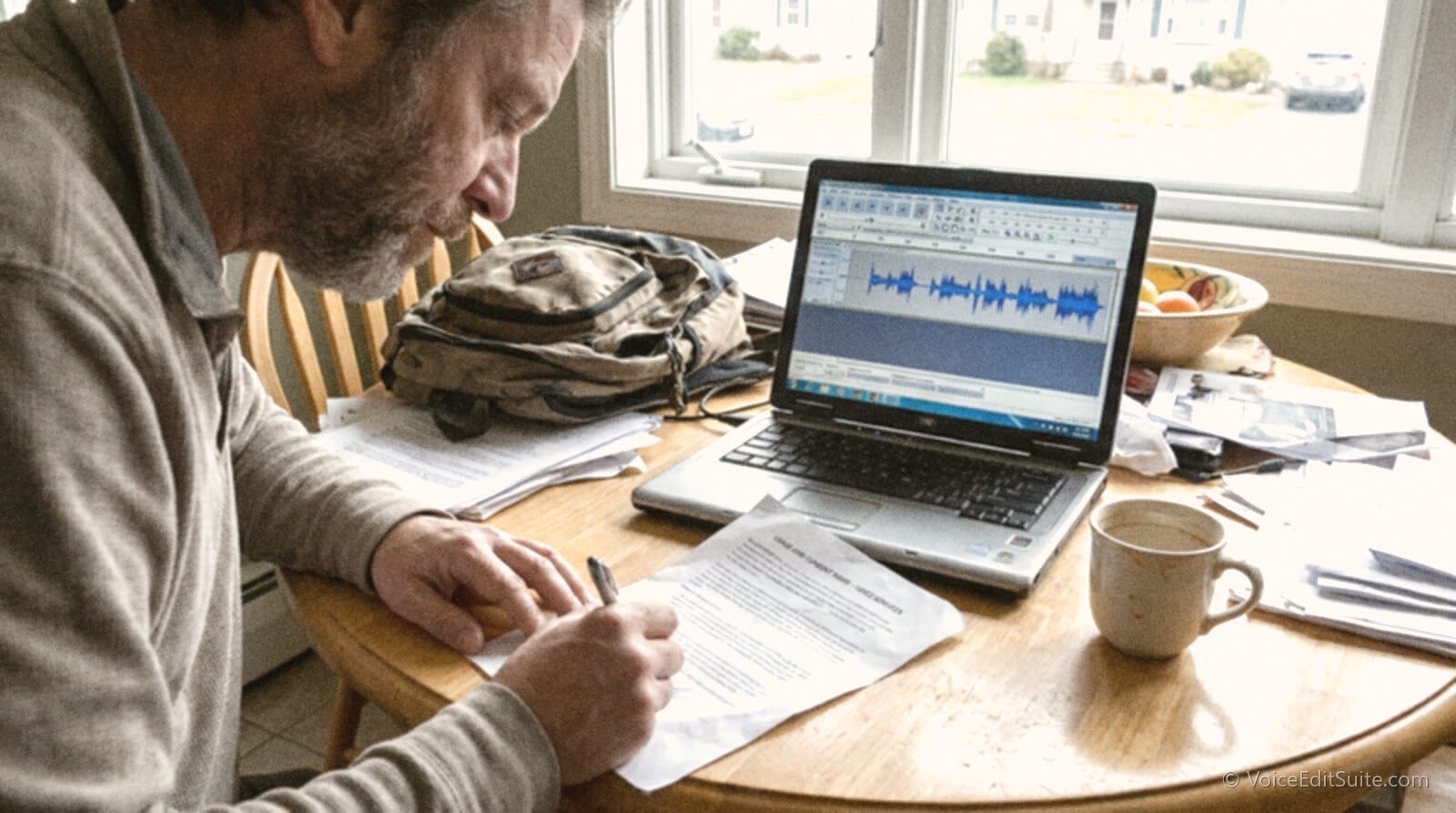
That is the unglamorous reality worth sitting with. The signed rider in the photo above, filed away in a folder nobody looks at until there is a dispute, is doing more durable work than any AI detector currently can, precisely because it does not depend on guessing anything about the audio itself. Watermarking and provenance standards are real, improving, and worth tracking, particularly for anyone who wants to know whether a suspicious clip passed through a specific major AI tool. They are just not, yet, a substitute for the ordinary paperwork a careful voice actor was already supposed to be keeping.
Frequently Asked Questions
What is C2PA and what does a Content Credential actually prove?
C2PA, the Coalition for Content Provenance and Authenticity, is an industry standard for attaching signed, tamper-evident metadata to a file, recording what tool or person made it and what has happened to it since. A Content Credential proves that a specific tool was willing to sign a specific claim about a file at a specific moment, and that the file hasn't been altered since without breaking that signature. It does not prove the underlying content is true, accurate or unaltered before the credential was attached, and it proves nothing at all once the credential is stripped, which plenty of ordinary file handling, re-encoding, screenshotting or uploading to a platform that doesn't preserve metadata, still does.
Does SynthID watermark every AI-generated voice?
No. SynthID only watermarks audio generated by Google DeepMind's own models, such as Lyria, and by partner platforms that have specifically adopted it, including ElevenLabs for some of its output. Dozens of other voice-cloning and text-to-speech tools exist that do not embed any SynthID signal at all, and nothing about their output will ever register in Google's SynthID Detector, regardless of how the audio was actually made.
Can I use any of this technology to prove a disputed clip is or isn't actually my voice?
Only indirectly, and only in narrow cases. If the clip in question was made with a tool that embeds a watermark or signs a Content Credential, a positive detection result is real evidence that it passed through that specific system. If the clip shows no watermark, that tells you nothing: it could be an untouched genuine recording of you, a clone made with a tool that doesn't watermark its output, or a watermarked clip where the signal has been degraded past recovery. For your own genuine recordings, there is currently no equivalent technology that lets you embed proof of authenticity at the moment you record. Your actual protection is the raw session file, its timestamps and your contract, not a watermark.
How accurate are AI voice detectors against current cloning tools, in practice?
It depends entirely on whether the detector was trained on the specific generator being tested, and that is the whole problem. Benchmark accuracy against familiar generators regularly lands above 90 percent in vendor-run tests. Accuracy against newer or unfamiliar generators drops sharply, with independent and preprint research reporting figures in the 48 to 80 percent range depending on the study and the generator mix. Treat any single detector's claimed accuracy as describing its performance against yesterday's cloning tools, not necessarily tomorrow's.
If a clip has no watermark and no Content Credential, does that mean it's real?
No, and this is the single most common misunderstanding about this technology. Absence of a watermark or credential is uninformative. It is consistent with the clip being a genuine, untouched human recording, and it is equally consistent with the clip being AI-generated by a tool that never embeds a signal, or being a watermarked AI clip where the signal has since been stripped or degraded through re-recording, compression or heavy editing. Nothing currently available lets a negative detection result stand in as proof of authenticity.
What should a voice actor actually do today, given these limits?
Keep raw, unedited session files with intact timestamps rather than relying only on delivered masters. Put explicit no-cloning and no-training language in every contract before you record, since that language remains enforceable regardless of what any detector eventually finds. Know which union agreements or state laws apply to your situation, since those govern consent and compensation in ways no detection tool does. And treat a watermark or Content Credential check as one useful data point to raise in a real dispute, never as a verdict on its own.
Sources and Further Reading
- C2PA, Coalition for Content Provenance and Authenticity: the coalition's own site, covering its founding, technical specification versions, and the conformance program referenced for audio validators such as SoundPatrol's.
- Content Authenticity Initiative: the Adobe-led adoption and advocacy group for Content Credentials, distinct from the C2PA's own technical steering work, and the source for its membership figures.
- Las Vegas Sun, SoundPatrol completes C2PA validator product conformance, July 16, 2026: the audio-specific C2PA Conformance Program milestone described in this article.
- Google DeepMind, SynthID: Google's own technical overview of SynthID watermarking, including its extension to audio generated with the Lyria model.
- SecurityBrief, Google unveils SynthID Detector to verify AI-generated content: the SynthID Detector portal's rollout and the Pushmeet Kohli quote used in this article.
- ElevenLabs, Audio detector documentation: ElevenLabs' own description of its SynthID-first, classifier-fallback detection tool and its stated limits.
- Resemble AI, Audio deepfake detection benchmark results: how 8 systems performed in 2026: the 2026 benchmark figures for in-domain and cross-generator detection accuracy, reported here with the caution a vendor-run benchmark deserves.
- A June 2026 preprint posted to arXiv describing a detector called FlowFake: 75 to 80 percent cross-domain accuracy against voice synthesizers not seen during training, cited here as a non-peer-reviewed preprint rather than published research.
- Fraunhofer AISEC, Eroding Trust in Real Speech: A Large-Scale Study of Human Audio Deepfake Perception, 2026, by Nicolas M. Müller and Wei Herng Choong: the 1,768-participant, 138-system study on human perception of real and fake speech over time.
- Fraunhofer AISEC, Detecting Audio Deepfakes with Artificial Intelligence, 2025: the earlier 472-participant, nearly-15,000-sample study comparing human and AI detection accuracy.
- VoiceEditSuite, AI Voice Cloning and Voice Acting in 2026 and The Emerging Legal Landscape for AI Voice Cloning: companion reports on the performance and legal sides of this subject.
Corrections
C2PA's founding date, founding members and specification version history are drawn from the coalition's own site and secondary reporting on it; the exact current membership count varies by source (the Content Authenticity Initiative, a related but distinct adoption group, is the source for the thousands-of-members figure used here, not the C2PA's own technical steering body). The Pushmeet Kohli quote and his title are as reported in SecurityBrief's coverage of the SynthID Detector launch; we were unable to verify the exact wording against Google's original blog post directly and welcome a correction if it differs. The Fraunhofer AISEC figures come from two separate studies run by the same institute in 2025 and 2026, which used different sample sizes and methods and should not be averaged together. The Resemble AI benchmark is run by a company that sells detection technology and should be read as an interested party's own figures, not independent testing; the FlowFake figures come from a non-peer-reviewed preprint. Detection accuracy in this field changes with every new generator released, so treat every percentage in this article as describing a specific study at a specific moment, not a permanent fact. Spot an error or a newer figure? Tell us through the contact page and we will correct it with a note.