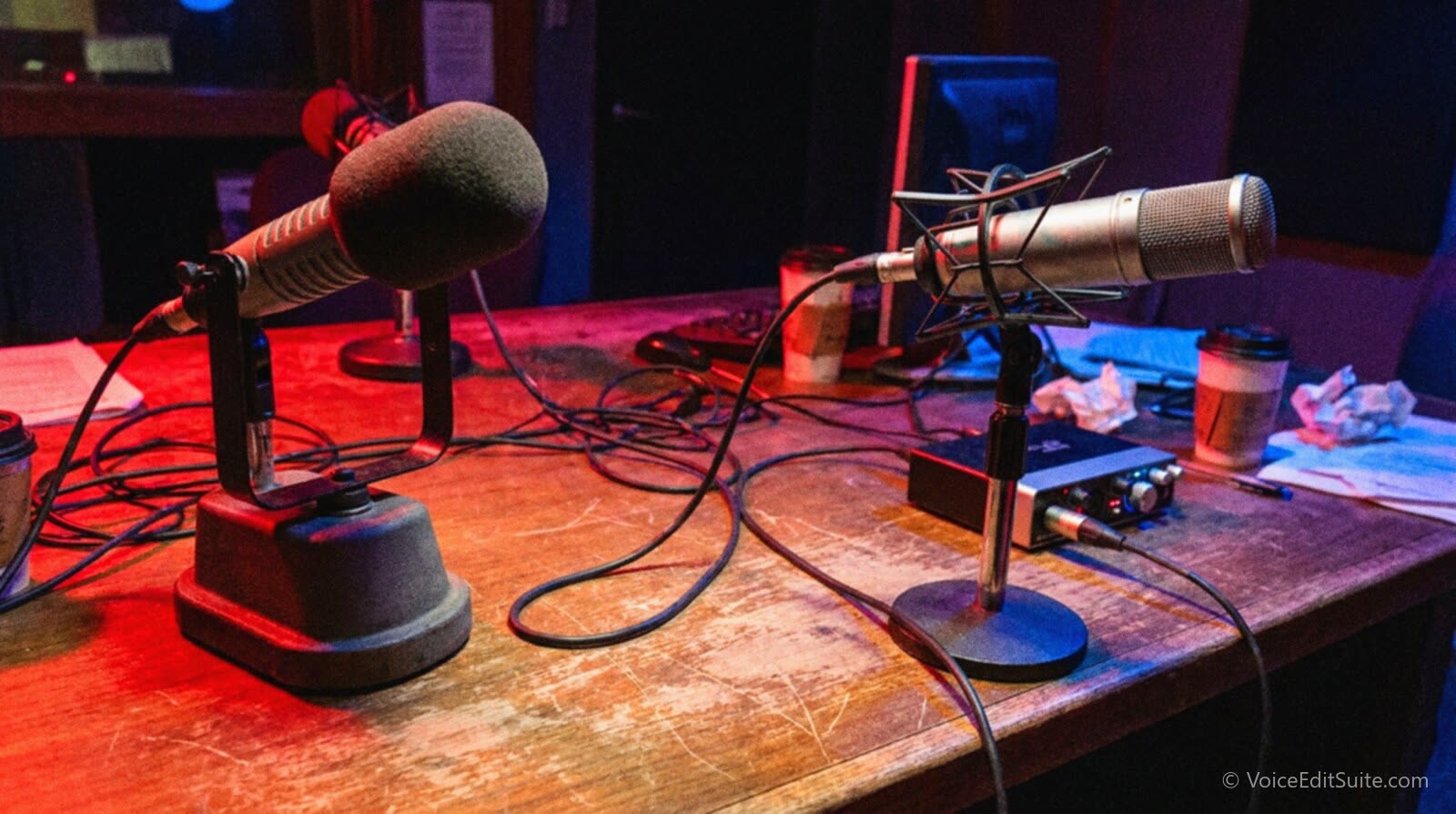
The short answer: a condenser microphone is the better default for voice-over and podcasting recorded in a genuinely treated room, because its internal preamp and high sensitivity capture fine vocal detail with self-noise as low as 4 to 7 dB-A. A dynamic microphone is the better default in an untreated bedroom, a shared apartment, or anywhere real background noise is a fact of life, because its low sensitivity and tight cardioid pattern reject everything that is not close to the capsule, at the cost of needing a lot more clean gain from your preamp. Neither type is universally better. The room you actually record in decides more of the outcome than the badge on the microphone body.
This comparison gets searched constantly because dynamic and condenser mics solve different problems rather than representing two generations of the same technology, the way a newer phone camera replaces an older one. Before spending money on either type, it is worth confirming this is actually the decision you need to make, rather than whether a USB or XLR microphone fits your setup or whether your current microphone is even the real bottleneck. Both questions sit underneath this one, and skipping them is how people end up with an expensive condenser that sounds worse than the budget dynamic mic it replaced.
How Each Microphone Actually Works
Both microphone types do the same basic job: they turn a moving column of air into an electrical signal a preamp can amplify. The difference is entirely in how the diaphragm, the thin surface that actually moves when sound hits it, generates that signal in the first place. That one design choice explains almost every practical difference covered in this guide: why a dynamic mic needs no power and a condenser needs 48 volts, why one tolerates a bad room better than the other, and why a condenser's spec sheet lists a self-noise figure that a dynamic mic's spec sheet simply does not have.
Dynamic Mics: A Moving Coil in a Magnetic Field
A dynamic microphone works through electromagnetic induction, the same basic physics as a tiny generator. A lightweight diaphragm is physically attached to a coil of fine wire, and that coil sits suspended inside a fixed magnetic field created by a small permanent magnet. When sound pressure pushes the diaphragm back and forth, the attached coil moves with it, and a moving coil inside a magnetic field induces a small electrical current on its own, with no external power required. That is the entire mechanism: no battery, no phantom power, no internal amplifier. It is also why a dynamic capsule is comparatively heavy and mechanically simple, which makes it rugged, tolerant of being bumped, dropped, or shouted into at close range, and relatively insensitive to quiet, low-level detail far from the capsule. The coil and magnet assembly simply needs more force, meaning more sound pressure, to move enough to generate a usable signal.
Condenser Mics: A Capacitor That Needs Its Own Power
A condenser microphone works on a completely different principle: capacitance. Its diaphragm is an extremely thin, electrically conductive membrane suspended a tiny fraction of a millimeter from a fixed metal backplate, the two forming a capacitor. That capacitor is given a polarizing charge, and as sound pressure moves the diaphragm closer to or further from the backplate, the capacitance changes, which produces a tiny, rapidly changing voltage. That voltage is far too weak and too high-impedance to travel down a cable on its own, so every condenser microphone built for professional use carries a small internal preamp, usually a field-effect transistor circuit, to convert that signal into something a mixer or interface can actually use. Powering the polarizing charge and that internal preamp is exactly what 48-volt phantom power supplies, sent up the same XLR cable that carries the audio signal back down, which is why a condenser mic is dead silent on an interface with phantom power switched off. A USB condenser does the same job with power drawn from the USB port instead. The practical upside of this extra complexity is a much lighter, more responsive diaphragm that picks up fine detail and quiet passages a dynamic capsule would simply miss, and it is also the reason condenser spec sheets publish a self-noise figure in dB-A at all: that number describes the hiss generated by the internal preamp circuit itself, a component a passive dynamic mic does not have, which is also why dynamic spec sheets almost never list a comparable self-noise rating in the first place.
The Five Tradeoffs That Actually Decide This
Strip away the marketing copy and the real decision between dynamic and condenser comes down to five concrete differences, not vibes about which one sounds "more professional." Here is what actually changes when you pick one over the other.
- Self-noise. A condenser mic's self-noise, the hiss its own internal circuit adds before any sound even arrives, ranges from roughly 4 dB-A on the quietest consumer condensers to around 20 dB-A on entry-level models, with studio reference mics like the Neumann TLM 103 rated at 7 dB-A under the DIN/IEC 651 standard. A dynamic mic has no comparable published figure because it has no active circuit to generate that kind of noise. Its noise problem shows up elsewhere instead, covered next.
- Sensitivity and gain. A typical condenser outputs somewhere around 14 to 32 millivolts per pascal of sound pressure, while a dynamic mic built for voice work typically outputs closer to 1 to 1.5 millivolts per pascal, roughly 15 to 20 times less signal for the same loudness. That gap means a dynamic mic needs far more clean gain from your preamp to reach a usable recording level, and if your audio interface's preamp is weak or noisy, that gain stage can introduce more audible hiss than a condenser's own self-noise would have in the first place. This is exactly why low-sensitivity dynamic mics like the SM7B are routinely paired with an inline gain booster or an interface chosen specifically for high clean gain, a topic our audio interface buying guide for voice-over covers directly.
- Room and proximity rejection. Both types are usually cardioid, so both reject sound from behind the capsule, but a dynamic capsule's lower sensitivity means it is also less responsive to quieter reflections and ambient noise arriving from the sides, on top of its directional pattern. A condenser's higher sensitivity picks up more of everything, including the room itself, which is why the same untreated bedroom sounds noticeably boxier on a condenser than on a dynamic mic placed in the exact same spot. Polar pattern and proximity behavior interact here too; our guide to microphone polar patterns goes deeper into how pattern shape and sensitivity combine to decide what a mic actually rejects.
- Durability and handling. A dynamic capsule's heavier moving parts and simpler mechanical design make it far more tolerant of being knocked, dropped, or spoken into loudly at close range, which is part of why dynamic mics dominate stage and field work. A condenser's thin, closely spaced diaphragm is more fragile and considerably more sensitive to plosives, wind, and handling noise, which raises the practical importance of a good pop filter versus a foam windscreen for anyone recording close to a condenser capsule.
- Price tiers. Usable dynamic mics for voice work start around $99 and the category tops out, for voice-over purposes, somewhere around $450. Condensers span a much wider range, from roughly $99 budget models to studio reference mics well north of $1,000, with no ceiling in practice once you move into specialized recording mics. A bigger price tag buys lower self-noise, tighter manufacturing tolerances, and better off-axis behavior on a condenser; it does not buy a dynamic mic any real advantage over a $99 one for most home voice-over work.
Real Microphones at Real Prices
Specs on a page only matter once they are attached to mics people actually buy. The figures below come from manufacturer datasheets where available and current retailer listings, and street prices do fluctuate, so treat the dollar figures as a current approximate range rather than a fixed number.
Dynamic Microphones Worth Buying
The Rode PodMic sits at the budget end, a cardioid dynamic with a published sensitivity of around -57 dBV per pascal and a frequency response of 50 Hz to 15 kHz per Rode's own datasheet, selling for around $99. It needs a reasonable amount of clean gain but is far more forgiving than the SM7B on a weak preamp. The Shure SM7B, the broadcast and streaming standard, is a cardioid dynamic rated at roughly -59 dBV per pascal, about 1.12 millivolts per pascal, which is low enough that it routinely demands 60 dB or more of clean gain, enough that many owners add an inline gain booster between the mic and their interface. It sells for roughly $400 at current street prices, down from its $499 list. The Electro-Voice RE20 is the other broadcast workhorse, a cardioid dynamic rated at 1.5 millivolts per pascal with a 45 Hz to 18 kHz frequency response and a built-in Variable-D design that specifically reduces the bass buildup close-talking would otherwise cause, selling for around $449. All three are passive designs with no published self-noise figure, for the reason covered above: there is no internal circuit to generate it.
Condenser Microphones Worth Buying
The Audio-Technica AT2020 is the long-running budget benchmark, a cardioid condenser rated at -37 dB (14.1 millivolts per pascal) sensitivity with self-noise around 20 dB-A, selling for roughly $99 to $119 depending on retailer, making it priced identically to a budget dynamic mic while behaving completely differently in a bad room. The Rode NT1 5th Generation, a hybrid XLR and USB cardioid condenser, is rated at an unusually low self-noise of around 4 dB-A, among the quietest self-noise figures of any microphone sold at this price, and sells for roughly $249 standalone. The Neumann TLM 103, a genuine studio reference mic, is rated at 7 dB-A self-noise under the DIN/IEC 651 standard with a sensitivity of 23 millivolts per pascal at 1 kHz and a maximum SPL around 138 dB, and sells for roughly $1,200 to $1,300 depending on finish and bundle. If you are weighing a first condenser purchase on a tighter budget than any of these, our budget microphone roundup for voice-over covers more entry-level options on both sides of this comparison.
Which Room Actually Suits Which Microphone
An untreated bedroom, a shared apartment, or a home office with hard walls and a window is a dynamic mic's natural habitat. The room is going to add reflections, hum, and background noise no matter what sits on the stand, and a dynamic capsule's lower sensitivity genuinely reduces how much of that gets captured in the first place, on top of whatever rejection the cardioid pattern itself provides. Working close to the capsule, a technique covered in depth in our guide to mic technique and the proximity effect, also helps a dynamic mic's signal stay well above the room noise floor without needing to push the gain uncomfortably high. None of this makes a dynamic mic sound better than a condenser in an absolute sense. It makes a dynamic mic sound more usable in a room that was never going to sound great on any microphone.
A condenser does not fix a bad room, it reveals it
Buying a more expensive condenser to solve a boxy, noisy recording usually backfires, because higher sensitivity means more of the room comes through, not less. If your current recordings sound bad, test whether the problem is the room before assuming it is the microphone.
A treated room, whether that is a purpose-built isolation booth, a closet lined with absorption, or just a small bedroom with enough soft furnishing and panels to kill flutter echo, is where a condenser earns its reputation. With reflections and background noise already under control, a condenser's extra sensitivity stops being a liability and starts being the thing that captures breath detail, vocal nuance, and a genuinely clean noise floor that a dynamic mic, built to ignore quiet detail on purpose, simply cannot match. Getting a condenser to actually sound clean also depends on feeding it through a decent interface with real phantom power and a quiet preamp, which is worth checking against our audio interface buying guide for voice-over before assuming the mic itself is underperforming. If you are planning the room and the gear together from scratch, it is also worth budgeting both pieces as one project rather than two separate purchases, a planning approach our guide to the real cost of a home voice-over studio walks through in more detail.
↗ Try the tool
Home Studio Analysis
Not sure whether your room is actually treated enough for a condenser, or whether it is quietly working against the mic you already own? Home Studio Analysis listens to a sample take from your real space and flags background noise, reflections, and tonal imbalance separately, so you know whether to match a dynamic mic to the room you have or invest in treatment before a condenser is worth the money.
Open Home Studio Analysis →The Decision Framework
Cut through the hedging with a short, honest set of rules rather than a list of pros and cons that never actually resolves into an answer.
- If your room is untreated and staying that way, buy a dynamic mic. Start with a $99 to $150 model like the Rode PodMic before spending more; the extra money in the SM7B or RE20 buys broadcast-grade construction and a slightly different tonal character, not a fundamentally cleaner recording in a bad room.
- If your room is genuinely treated, whether through a real booth or careful DIY absorption, buy a condenser and let its sensitivity work for you instead of against you. A $99 to $250 model is enough for the overwhelming majority of voice-over and podcasting work; the jump to a $1,000-plus studio reference mic buys diminishing returns unless you are delivering broadcast or audiobook work where every dB of self-noise is scrutinized.
- If you are not sure whether your room counts as treated, it almost certainly does not yet. A room needs real absorption on at least the first reflection points, not just carpet and curtains, before a condenser's extra sensitivity becomes a genuine advantage rather than a liability.
- If you record in more than one space, such as a home studio and a hotel room on the road, default to a dynamic mic as your primary, since it degrades far less gracefully than it improves: a dynamic mic in a great room still sounds fine, while a condenser in a bad room can sound unusable.
- If you are already set up with one type and your recordings sound clean, do not switch types just because a more expensive option exists. Revisit whether an upgrade is actually justified before spending money on a different mechanism rather than a better version of what already works.
What ties all five rules together is that the room, not the microphone, is doing most of the work in any recording that sounds genuinely clean. A voice actor who treats a closet properly and records on a $99 condenser will consistently out-perform someone running a $1,300 studio mic in an untreated living room with a tile floor and a window behind the stand. Buying the right type for the room you actually have, rather than the room you plan to eventually build, is the single highest-leverage decision in this entire comparison.
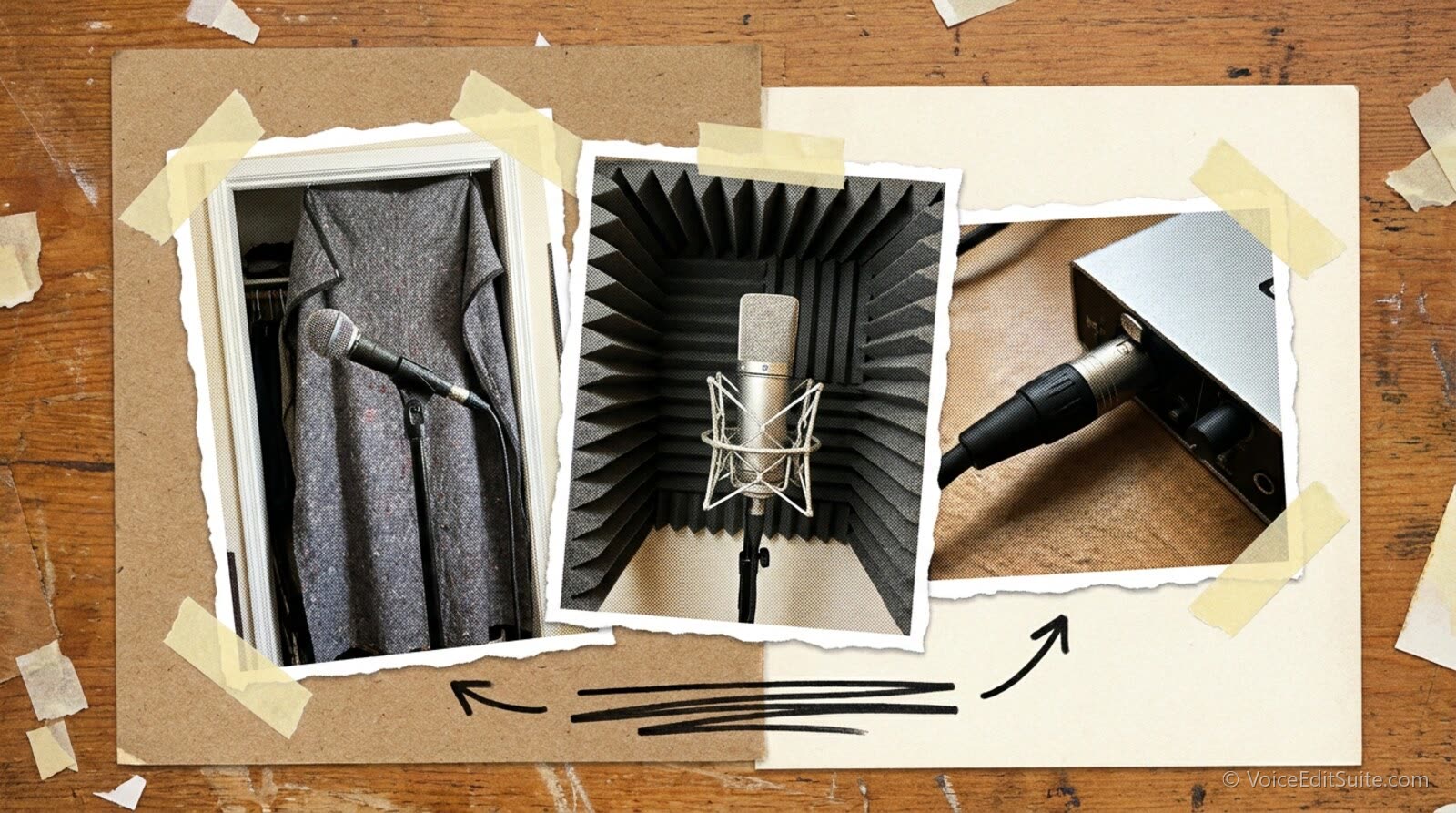
Seeing the two setups side by side makes the logic easier to hold onto than any spec sheet does. The blanket-draped closet and the dynamic mic belong together because neither the room nor the microphone is trying to capture more than it has to. The foam-paneled booth and the condenser belong together for the opposite reason: the room has already done the work of controlling reflections, so the microphone is free to be as sensitive as it wants to be. The XLR run into an audio interface matters in both photos, but it only becomes a design decision, phantom power on or off, gain staged high or low, once you know which microphone is actually at the other end of the cable.
Frequently Asked Questions
Can a dynamic microphone sound professional enough for paid voice-over work?
Yes, unambiguously. The Shure SM7B and Electro-Voice RE20 are both dynamic mics and both are industry-standard choices for broadcast, podcasting, and voice-over, used on countless paid professional sessions. What a dynamic mic will not do is make an untreated room sound like a treated one, but in the room it is actually suited for, it produces entirely broadcast-ready results.
Can I use a condenser microphone without any room treatment at all?
You can, but expect the recording to sound noticeably boxier and noisier than the same room would sound through a dynamic mic, because the condenser's higher sensitivity picks up more of the reflections and ambient noise the untreated room is producing. If you already own a condenser and cannot treat the room yet, moving closer to the capsule and recording in the quietest part of the room helps, but it will not fully substitute for real absorption.
Do I still need a real audio interface for a dynamic microphone?
Yes, and arguably more than a condenser does. A dynamic mic's low sensitivity means your interface's preamp has to supply significantly more clean gain to reach a usable level, and a weak or noisy preamp will introduce audible hiss trying to do that, especially with a low-output mic like the SM7B. A condenser needs phantom power from the interface instead, but generally needs less raw gain because its own output is already much hotter.
Does self-noise actually matter for home studio voice-over work?
It matters less than room noise in almost every home setup. The difference between a condenser rated at 7 dB-A and one rated at 20 dB-A is real but small compared with the 20 to 30 dB or more of difference a treated versus an untreated room makes to your actual noise floor. Self-noise becomes the deciding factor only once the room itself is already quiet and controlled, which is exactly why it matters most on expensive studio reference mics used in professional booths.
Should I own both a dynamic and a condenser microphone?
It is a genuinely common and sensible setup for anyone who records in more than one environment, a treated home booth and a hotel room while traveling, for example, or a quiet apartment that sometimes gets noisy when roommates are home. Many working voice actors and podcasters keep a dynamic mic as the reliable fallback and a condenser as the primary in their best-controlled space, rather than trying to find one microphone that does both jobs equally well.
Do USB condenser microphones follow the same tradeoffs as XLR ones?
Yes, the underlying capsule physics is identical; a USB condenser is still a capacitor diaphragm with an internal preamp, just powered through the USB port instead of phantom power, and digitized inside the mic body rather than by a separate interface. It still picks up more of a bad room than a dynamic mic would, and it still benefits the most from a treated space. The practical differences between USB and XLR microphones generally, including latency, upgrade flexibility, and multi-mic setups, are covered in our dedicated USB versus XLR comparison.
Sources and Further Reading
- Shure, SM7B User Guide (PDF): Shure's own published sensitivity figure of approximately -59 dBV per pascal for the SM7B and its cardioid dynamic specification.
- RecordingHacks, Electro-Voice RE20 Specifications: the RE20's published 1.5 mV/Pa sensitivity, 45 Hz to 18 kHz frequency response, and Variable-D cardioid dynamic design.
- Rode, PodMic Datasheet (PDF): Rode's official sensitivity (-57.0 dB re 1V/Pa) and 50 Hz to 15 kHz frequency response figures for the PodMic.
- Produce Like A Pro, Audio-Technica AT2020 Review: the AT2020's published sensitivity of -37 dB (14.1 mV) re 1V at 1 Pa and signal-to-noise specifications, from which its approximate 20 dB-A self-noise is derived.
- Juno Daily, Rode NT1 Studio Mic Upgraded to Fifth Generation: coverage of the NT1 5th Generation's launch specifications, including its self-noise rating of around 4 dB-A, among the lowest published for any studio condenser.
- Sound On Sound, Neumann TLM 103 Review: an independent review citing Neumann's published 7 dB-A (DIN/IEC 651) self-noise figure and 23 mV/Pa sensitivity for the TLM 103, compared against the U87 Ai's 12 dB rating.
- Shure, Multi-Pattern Microphones: What, Where and How?: Shure's own explanation of cardioid pickup behavior referenced in the room-rejection discussion in this guide.