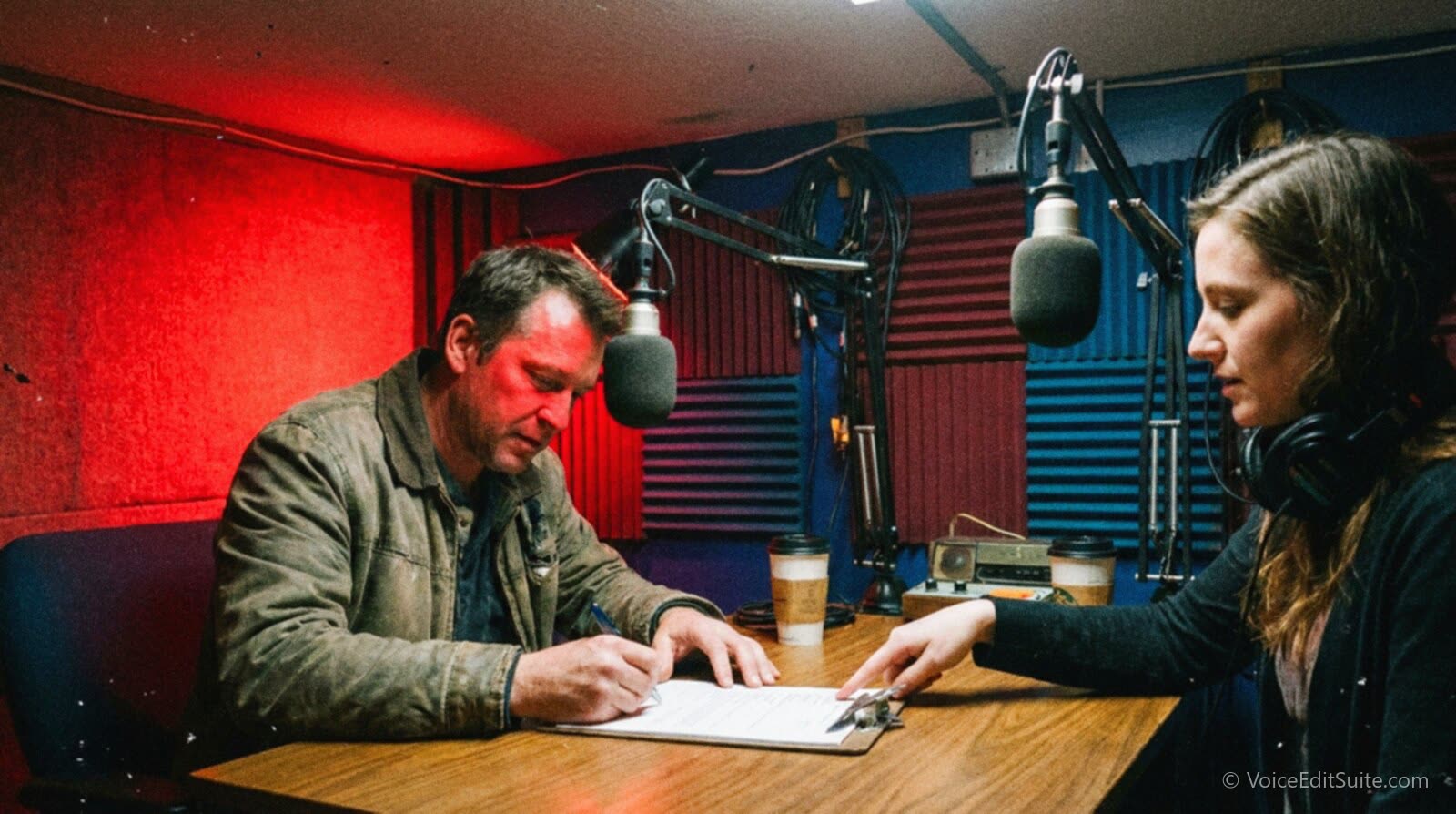
The short answer: a podcast guest release needs to cover five things in writing before you publish, not just verbally agree to them. It needs the guest's consent to record and distribute their voice, name, and likeness; it needs to say whether you can monetize the episode and run ads around their segment; it needs to say you can edit the conversation rather than publish it word for word; it needs to say whether clips can be reused for promotion separately from the full episode; and if the guest is a minor, it needs a parent or guardian's signature, not the minor's own. None of that requires a lawyer or a long document. It requires getting it in writing, before you hit record, rather than relying on the fact that someone showed up and talked to you.
What a Guest Release Actually Needs to Cover
A podcast guest release is doing a narrower job than people often assume. It is not primarily there to protect you from a guest later claiming they said something they regret, since editorial judgment about what to publish is a separate issue from consent. Its real job is to establish, in writing, that the guest agreed to the specific things that happen to a recording after it leaves the room: being distributed publicly under their real name and voice, being edited, being used to sell advertising, and sometimes being clipped into short promotional pieces that circulate well beyond the original episode. A release that only covers 'permission to record' and stops there leaves every one of those downstream uses unaddressed.
- Recording and distribution rights. Explicit permission to record the guest's voice, name, and likeness, and to publish that recording publicly across the platforms you actually use, not just 'the podcast' in the abstract.
- Monetization and ad insertion. A plain statement that the episode may carry advertising, sponsorship messages, or dynamically inserted ads around or during the guest's segment, since a guest who assumed an ad-free conversation can feel blindsided by a mid-roll spot dropped next to their story.
- The right to edit. Permission to cut, rearrange, or trim the conversation for length, clarity, or flow, rather than an obligation to publish the full, unedited recording.
- Name and likeness in promotional material. Separate, explicit permission to use short clips, quotes, or the guest's name and photo in standalone promotional content, such as social clips or a trailer, since that use can outlive and reach further than the full episode itself.
- Scope and duration. Whether the consent covers one episode or any future use of the same recording, and whether it has any expiration or renewal requirement at all.
A release that is specific about each of these five points does real work even though it rarely runs longer than a single page. Templates built around this structure are common enough that even university-run podcast programs publish their own version. Columbia University Libraries, for example, maintains a short standard release form for its own podcast guests covering exactly this ground: consent to record, consent to edit, and consent to distribute publicly, matching the same shape independent podcasters use.

Sending the form before the recording starts, not after, also changes how a guest reads it. A release handed over after an hour of good conversation reads like a formality nobody wants to slow down to question. The same release sent with the original booking confirmation, days ahead of the call, gives a guest time to actually read it, ask about the ad-insertion language or the promotional-clip clause, and raise any concerns before either of you has spent an hour recording something you'd then have to renegotiate consent for after the fact.
Recording Consent Law: One-Party vs. All-Party States
Separately from what a release covers contractually, most U.S. states regulate whether you can legally record a conversation at all, and the baseline rule varies by state. The Reporters Committee for Freedom of the Press, whose Reporter's Recording Guide is a standard reference for working journalists navigating this exact question, explains that most states only require the consent of one party to the conversation, meaning you yourself count if you're a participant and are recording your own conversation. A smaller group of roughly a dozen states instead require the consent of every party to the conversation before it can be lawfully recorded, a rule sometimes called 'two-party consent' even though the more accurate term is 'all-party consent,' since a conversation with three participants needs all three, not just two, to agree.
The practical complication for podcasting is that these rules were written with phone calls and in-person conversations in mind, not a remote interview where the host sits in a one-party state and the guest is dialing in from an all-party state. The generally accepted practice, and the safer assumption, is to apply the stricter of the two states' rules whenever a recorded conversation crosses state lines, since a one-party-consent host recording a guest physically located in an all-party state can still be subject to that guest's state law. Some all-party states also narrow the rule further depending on context. Connecticut and Nevada, for instance, require all parties' consent specifically for phone calls while applying a one-party standard to in-person conversations, according to the Reporters Committee's guidance, which is exactly the kind of state-by-state nuance that makes a blanket assumption risky.
None of this is legal advice for your specific show, your specific state, or your specific guest's location, and recording consent law genuinely does vary by state and sometimes by the type of communication involved. The Reporters Committee publishes a more detailed practical guide, often referenced by its shorthand title 'Can We Tape?,' walking through the state-by-state landscape for exactly this purpose, and it is worth reading directly rather than relying on a general summary if a specific recording situation concerns you. The one practice that sidesteps most of this uncertainty regardless of which states are involved: get the guest's recorded or written consent to being recorded, explicitly, before you start, rather than relying on the fact that they stayed on the call.
A written release signed before the call does double duty here. It satisfies the consent requirement under either a one-party or an all-party standard, since the guest themselves is the party whose consent the law cares about, and it creates a dated record you can point to later if a question about consent ever comes up. A verbal 'yes, go ahead and record' said at the top of a call is still consent, but it is consent that exists only in the recording itself, which is a weaker position than a signed or emailed confirmation sent before you ever opened the recording software.
When the Guest Is a Minor
A minor generally cannot give the kind of informed legal consent a release depends on, which means a parent or guardian has to sign in the minor's place, not alongside them as a formality. Stanford University's Fair Use Project, a frequently cited plain-English legal resource on release agreements, explains the underlying logic directly: because a minor may not fully understand the terms of a release, the signature of a parent or legal guardian is required, and that signer needs both to understand what they're agreeing to and to actually have the legal authority to grant it on the minor's behalf.
- Get the parent or guardian's name and relationship to the minor in writing, not just a signature with no context, so it's clear who consented and on what basis.
- State plainly that the signer has legal authority to consent on the minor's behalf, which matters most in a shared- or split-custody situation where it may not be automatically obvious.
- Cover the same five points as any adult release, recording and distribution, monetization, editing, and promotional use, rather than a shorter, less specific form just because the guest is young.
- Consider a witness to the signature where practical, particularly for a minor guest appearing in any kind of sponsored or branded episode.
- Keep the signed form on file for as long as the episode stays published, not just until the episode airs, since the consent is what justifies the recording's continued availability.
If a branded or sponsored episode is involved, treat a minor guest as a reason to get more documentation, not less. One independent producer described deliberately introducing a formal release specifically for a branded podcast involving minors, after rarely using one for adult guests, precisely because the stricter expectations around working with children and a stakeholder client who wanted clear, defensible paperwork left no room for an informal verbal understanding.
Written Consent Versus a Verbal Okay
A verbal 'sure, that's fine' at the top of a recording is not nothing, and in many everyday situations it's genuinely enough to get by on. But it is a weaker form of consent than a written or emailed release for a few specific, practical reasons that matter more as a show grows. A verbal agreement exists only inside the recording itself, so if a dispute ever arises about exactly what the guest agreed to, you're pointing back at a single audio moment rather than a document either party can read again later. A written release, by contrast, can spell out the specific scope, recording, monetization, editing, promotional clips, in a way a casual verbal exchange rarely does, because nobody states five separate legal permissions out loud before a conversational interview.
Email consent sits in a reasonable middle ground and is often the most practical option for a remote guest you'll never meet in person. A clear email from the guest confirming they understand the episode will be recorded, edited, distributed publicly, and potentially monetized, sent before the recording happens, gives you a dated, written record without requiring a notarized form or an in-person signature. The content of what's agreed to matters far more than the exact format it arrives in. A one-line 'sounds good, see you then' email that never mentions recording, editing, or publication is barely better than a verbal yes. An email that walks through the same five points a formal release would cover is functionally equivalent to one, just lighter-weight to send and sign.
↗ Try the tool
Auto Clean Up
Once consent to edit is actually in writing, use it. A guest release that grants permission to trim and rearrange the conversation is most useful when you take that permission seriously: cutting dead air, false starts, and long pauses tightens an episode without changing anything the guest actually said. The Auto Editor tool handles that cleanup automatically, so the editing right your release already grants doesn't sit unused while listeners sit through silence you were free to remove.
Open Auto Clean Up →Revocation and Takedown Requests After Publication
A guest asking you to remove or edit an already-published episode is one of the more common disputes that arise after the fact, and it has no single settled legal answer that applies the same way to every show. What actually happens next depends on two separate things: what your release agreement specifically says about revocation, and what general privacy or publicity law in the relevant state might independently allow a guest to claim, separate from the contract altogether. A release that is silent on revocation, which most are, leaves the question open rather than resolved, and resolving it usually comes down to a direct conversation rather than a clear legal line either side can point to with confidence.
- Hear out the specific concern before deciding anything. A guest asking for a full takedown is sometimes really asking to have one specific moment removed, a stray comment, a detail they didn't mean to share, rather than the whole conversation pulled.
- Offer a narrower fix first where the concern is narrow. Removing or re-editing one segment, rather than deleting the entire episode, resolves most requests without losing the rest of a conversation both sides spent real time recording.
- Treat a full takedown request seriously when the guest insists. Weigh the relationship and your show's reputation against the cost of losing one episode. For most independent podcasts, that trade favors accommodating the guest.
- Document what you did and why. If you remove an episode or a segment, note the date and the reason in your own records, the same habit worth keeping around any consent or ownership question covered in who owns a voice recording once it's delivered.
- Say so publicly if you pull something already live. A short, honest note that an episode was removed at a guest's request, without re-litigating why, reads as more professional than silently deleting it and hoping nobody notices the gap in the feed.
The underlying tension here is close to the one covered in voice over NDAs and confidential projects: consent that was freely given at the time of recording doesn't automatically stay comfortable for the person who gave it once the material is actually public and permanent. A release that's clear about revocation terms upfront, even just a line stating that published episodes generally won't be taken down except in specific circumstances, sets an expectation before the issue ever comes up, rather than leaving both sides improvising a policy in the middle of an uncomfortable email exchange.
Building the Release Into Your Booking Workflow
A release only works if it actually gets signed before recording starts, which means it has to live inside your normal booking process rather than as a separate step people forget. The outreach and vetting stage covered in booking podcast guests: outreach and vetting is the natural place to introduce it: send the release alongside the calendar invite and the standard pre-interview questionnaire, not as a surprise attachment five minutes before the call. For remote guests specifically, the setup covered in recording a podcast with remote guests should include a check that the signed release is actually on file before you hit record, the same way you'd confirm audio levels or a stable connection.
If your show publishes transcripts or captions, make sure the release's distribution language actually covers that format too, since a guest who consented to 'the podcast' back when a show was audio-only may not have specifically agreed to having their name and words searchable in a published transcript. The practical steps covered in podcast accessibility, transcripts, and captions are worth reading alongside your release template for exactly this reason: accessibility work expands where and how a guest's words get distributed, and a release written before transcripts existed on your show may not explicitly say so.
Frequently Asked Questions
Isn't a guest agreeing to come on the show and talk already a form of consent?
It's a weak, informal form of consent to being recorded, and many independent podcasters do rely on exactly that assumption without major issue. It is not the same as consent to the specific downstream uses that actually matter: monetization, editing, promotional clips, and indefinite public availability. Showing up to a call strongly implies someone expects to be recorded. It says nothing about whether they expect an ad to run next to their segment, or a thirty-second clip of their most personal answer to end up as a separate promotional post months later. The release's job is to cover that second, much more specific layer of consent, not to re-establish that the person knew they were being recorded at all.
Does it matter which state a remote guest is actually sitting in when we record?
It can, specifically around recording consent law. If your guest is physically located in a state that requires all parties' consent to record a conversation, the generally accepted safe practice is to treat that stricter rule as the one that applies to your call, regardless of which state you're recording from. Since this varies by state and sometimes by the type of communication, it is not something to guess at for a show that records guests regularly; the Reporters Committee for Freedom of the Press's recording guide is the standard reference for checking the current rule in both your state and your guest's.
What if I already published episodes without ever using a signed release?
Going forward, start using one; for past episodes, a clear, specific confirmation email with the guest, even sent after the fact, is better than nothing, though it's weaker than consent obtained before recording. Review your back catalog for any episode involving a minor, a particularly sensitive topic, or a guest you have an ongoing relationship with, and consider reaching out proactively to confirm their consent in writing now rather than waiting for a dispute to force the conversation.
Can a guest ask to approve the final cut before it's published?
They can ask, and some producers agree to it for certain guests, particularly on sensitive or technical topics, but it isn't something a standard release grants automatically. If you're willing to offer pre-publication review, say so explicitly and set a firm deadline for their feedback, since an open-ended review window can hold an episode in limbo indefinitely. If you don't intend to offer it, the release's language granting you the right to edit without further sign-off is what protects your ability to publish on your own schedule.
If I pay a guest an appearance fee, does that change what the release needs to cover?
Not fundamentally, though a paid arrangement is worth documenting more carefully overall. The same five areas, recording and distribution, monetization, editing rights, and promotional use, still need to be covered in writing regardless of whether money changes hands. What a fee does add is a second document worth having alongside the release: a short agreement on the payment amount, timing, and what happens if the interview is cancelled or the final episode never airs, which is a separate question from consent itself.
Corrections
This guide summarizes general recording-consent law and release-form practice based on publicly available guidance from the Reporters Committee for Freedom of the Press, Stanford University's Fair Use Project, and other cited sources, current as of its publication date. Recording consent law varies by state, sometimes by the type of communication, and can change; this is not legal advice, and a producer with a specific concern about a specific state or guest should consult a licensed attorney. Spot an error? Tell us through the contact page and we will correct it with a note.
Sources and Further Reading
- Reporters Committee for Freedom of the Press, Introduction to the Reporter's Recording Guide: the one-party versus all-party consent framework and the practice of applying the stricter state's rule when a recorded conversation crosses state lines.
- Reporters Committee for Freedom of the Press, Can We Tape? A Practical Guide to Taping Phone Calls and In-Person Conversations: the detailed, state-by-state reference behind the general summary used in this guide.
- Stanford University Libraries, Fair Use Project: Personal Release Agreements: the plain-English explanation of why a parent or guardian, rather than a minor, must sign a release, and what that signer needs to establish.
- Columbia University Libraries, Podcast Guest Release Form: an example of a university-run podcast program's standard guest release, covering recording, editing, and distribution consent.
- Federal Trade Commission, Complying with COPPA: Frequently Asked Questions: background on federal rules governing the online collection of personal information from children under 13, relevant background for any show that records minors.