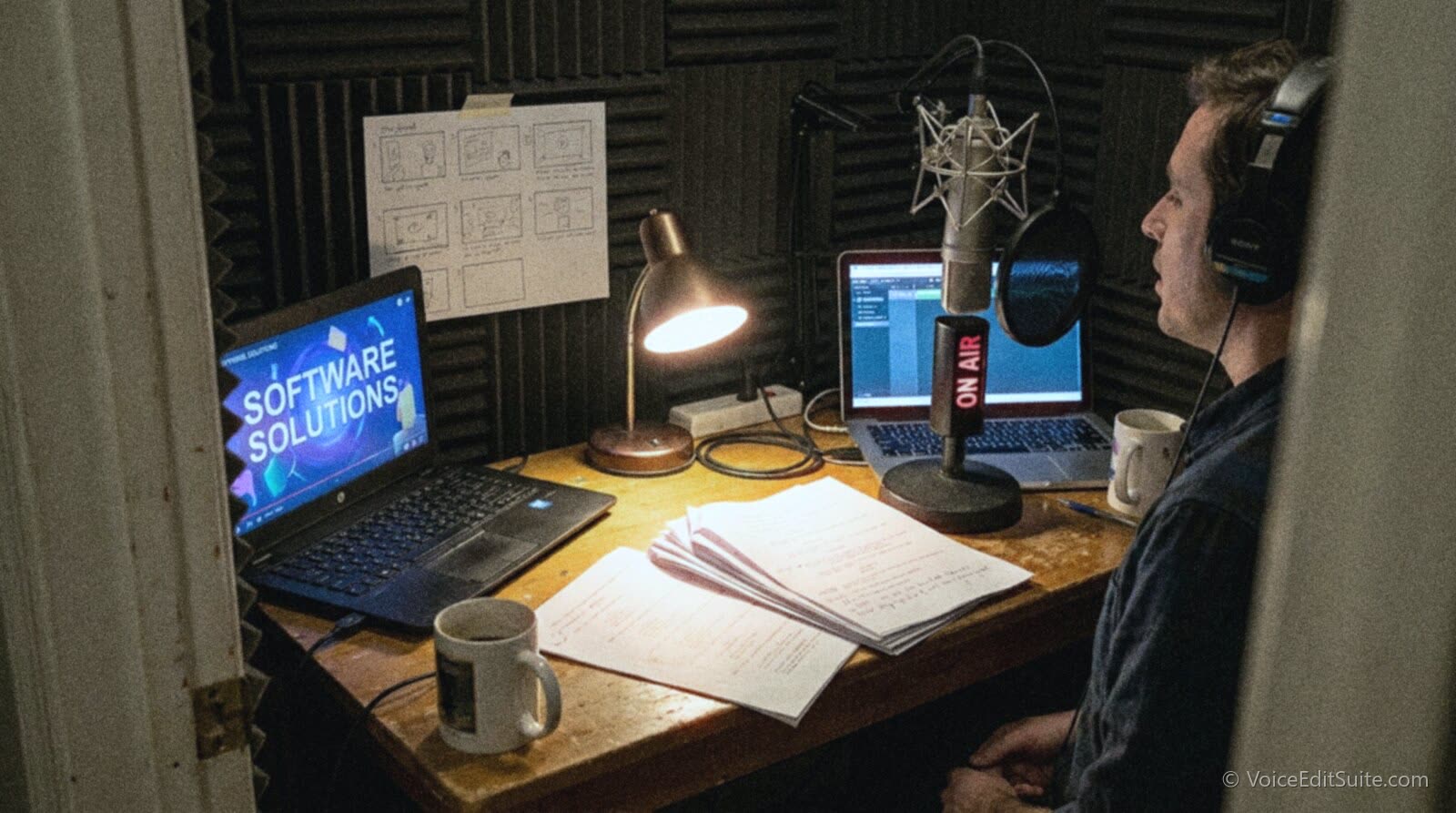
The short answer: software and SaaS companies hiring for product explainer and onboarding videos, direct-to-consumer and performance-marketing brands buying short paid-social ads, and the production studios and agencies that serve both of them. That is where the volume sits in 2026, not in the thirty-second national television spot that used to define commercial voice over. The buyers have changed, and the format has shrunk and multiplied at the same time: dozens of short video assets per campaign instead of one polished broadcast cut. The read they want has changed with it, too. Fewer booming announcers, more people who sound like they are explaining something to a friend rather than selling it to a stadium.
This niche sits next to corporate e-learning and training narration, covered in detail in this guide to corporate and e-learning narration and the e-learning market numbers for 2026, but it is not the same work. E-learning rewards hours of neutral, steady pacing across a training module nobody is trying to sell. Explainer and marketing video voice over is shorter, faster-turnaround, and judged on whether it moves someone toward a click, a signup or a purchase. Below is who is actually buying this work, how the read itself has changed, what the sourced market data shows, how the money is structured, and what AI voice tools and dubbing are already doing to the demand for a human in the booth.
Who Is Actually Hiring for This Work
Four kinds of buyer make up most of this market. The biggest, by volume if not always by budget per project, is software and SaaS companies: a product explainer for the homepage, a two-minute feature walkthrough for a release, a series of fifteen-second cutdowns for paid social, and an onboarding sequence that walks a new user through their first login. A single product launch at a mid-sized software company can generate ten or more separate video assets, each needing its own voice track, often from the same script trimmed and re-timed rather than written fresh for each one.
The second is direct-to-consumer and performance-marketing brands: skincare, supplements, apps, subscription boxes, anyone running paid ads on Meta, TikTok or YouTube where the ad has to work in the first three seconds or get skipped. This is where the UGC-style read lives, covered in more detail below, and where a brand will test five or six different voice reads against the same thirty-second script to see which one actually holds attention and converts, something a single thirty-second broadcast spot never had to do, because it only ran once, to one audience, through one channel.
The third buyer is the explainer video production studio or agency itself. Companies like Vidico, which describes itself on its own site as building 2D, 3D and live-action explainers mainly for SaaS, fintech and enterprise marketing teams, sell the work on a monthly subscription model rather than a single flat project fee. A studio like this is a direct, recurring client relationship for a voice actor rather than a one-off booking: land a good working relationship with one, and a single script can turn into forty or more individual video assets reused across a hero page, social cuts, email and landing pages, in Vidico's own description of its process, which means one recording session can become a recurring monthly credit on an invoice rather than a single payment.
The fourth is the in-house marketing or creative team at a larger company that has decided to stop outsourcing every video to an agency and instead keeps a short bench of voice talent on retainer for internal use: product marketing videos, investor explainer decks turned into narrated video, and internal change-management content dressed up as external-style video. None of these four buyers look much like an ad agency casting a national TV spot through a traditional process, and that is the point. The work moved to where the budget and the volume actually are.
The Read Has Changed: Conversational Over the Announcer
The style brief has moved with the buyer. The booming, declarative "announcer voice", hard consonants, rising pitch on the product name, the kind of read that used to close every drugstore commercial, has lost ground across most of this category. A long-running argument in commercial voice-over trade writing, made plainly in a Killerspots blog post on the subject by Storm Bennett, is that the announcer read increasingly comes across as a brand talking at an audience rather than to one, and that a flatter, more conversational delivery reads as more trustworthy precisely because it sounds like one person talking to another rather than a company reciting a script. Whether or not every agency creative director would phrase it that way, the casting briefs circulating for explainer and marketing video work in 2026 consistently ask for the opposite of "announcer": words like relatable, observant, a little dry, the person next to you rather than the voice above you.
That shift has not erased the announcer style entirely. It survives, and is still actively cast, in categories where the brand wants authority rather than intimacy: pharmaceutical disclaimer reads, legal and financial compliance language, automotive spots that still lean on a deeper, more declarative voice for the tagline even when the body copy is conversational, and the fast-talking disclaimer at the end of a radio-style ad. The honest read of the trend is not that one style replaced the other, but that the conversational read became the default for the bulk of explainer and marketing video work, with the announcer read surviving as a specific tool for specific categories rather than the house style for commercial voice over generally.
A third style sits alongside both of those and did not really exist as a paid, castable category a decade ago: the UGC-style read, built to sound like an ordinary person talking into their own phone camera rather than a professional voice actor at all. Performance-marketing brands buy this style deliberately for paid social ads, because an ad that sounds too polished gets recognized as an ad and scrolled past, while one that sounds like a friend's recommendation gets a few extra seconds of attention before the thumb moves. It is a specific, learnable skill, not simply the absence of training, and voice actors who can hit it convincingly are in real demand for exactly the kind of short-form paid social work described above.
None of these three styles get handed to a voice actor as a single word in a casting note. A brief that says "conversational" is doing almost none of the work on its own, which is exactly the problem this guide to reading a casting brief sets out to fix: the same word means something different coming from a SaaS company's brand guidelines than it does coming from a D2C skincare brand's paid-media team, and the only way to find out which one you are actually being asked for is to ask for reference reads, a brand voice document, or at minimum a sentence about who the video is for and where it will run.
How Big Is This Market, Really
Market-research estimates for this category disagree with each other more than most, mainly because "explainer video" gets defined differently by different firms: some count only animated explainers, some count live-action and software tools, some count the full production-services spend. 360iResearch, in a report listed through GII Research, puts the global explainer video services market at $3.15 billion in 2025, estimates $3.41 billion for 2026, and forecasts $5.97 billion by 2032, a 9.57 percent compound annual growth rate. Intel Market Research, covering what it labels the same category, puts 2025 at $3.12 billion, nearly identical to 360iResearch's figure, but projects a much slower climb: $3.26 billion in 2026 and only $4.20 billion by 2034, a 4.4 percent CAGR, less than half the growth rate the other firm reports from an almost identical starting point. Two firms, two very different pictures of where this is headed, from the same base number.
What is not in dispute is that the broader habit of marketing with video keeps climbing. Wyzowl's own State of Video Marketing research, based on 266 respondents surveyed in late 2025, found that 91 percent of businesses now use video as a marketing tool, back to the all-time high the category had briefly dipped below the year before, and that 93 percent of video marketers call video an important part of their overall strategy. That is a demand signal for video generally, not proof of a specific growth rate for voice over spend inside it, but it is the clearest evidence available that the pool of companies commissioning some kind of marketing or explainer video, and therefore some kind of voice track to go with it, has not shrunk.
The clearest hard number on where ad dollars are actually flowing comes from the IAB and PwC's Internet Advertising Revenue Report for full-year 2025, published in April 2026. It puts total US digital advertising revenue at $294.6 billion, up 13.9 percent year over year, and breaks out digital video specifically, spanning connected TV, social video and short-form video together, at $78 billion, up 25.4 percent, an acceleration from the 19.2 percent growth rate the category posted the year before. Video is growing faster than digital advertising overall, and faster than it grew the year before that. None of this is explainer-video-specific, and plenty of that $78 billion is streaming pre-roll and connected-TV inventory that never touches a freelance voice actor's inbox, but it is the backdrop the smaller, messier explainer-video-market estimates above sit inside: a video advertising economy that is still expanding, and expanding faster than the digital ad market around it.
What the Money Actually Looks Like
The pricing mechanics for this work follow the same session-fee-plus-usage logic that governs the rest of commercial voice over, laid out in full in this guide to voice over rates and this explanation of usage fees and buyouts, but explainer and marketing video work has its own version of the usage question, because "where will this run" has more possible answers than it used to. A read destined only for a company's own website and owned social channels is a much smaller usage grant than the same script running as a paid ad across Meta, TikTok and YouTube, which is itself smaller than a cutdown of the same spot buying airtime on connected TV or broadcast. Clients in this category increasingly try to buy the broadest version of that usage upfront, a full digital buyout covering owned and paid channels indefinitely, because tracking and renewing usage terms across a dozen video variants is more administrative overhead than most marketing teams want to carry.
Length tiers compound the same way: a client who needs 15-, 30- and 60-second cuts of one script is not asking for one recording trimmed three ways, because a trimmed 60 almost never lands as a complete thought at 15, a mechanic already true of podcast ad reads and equally true here. Each duration is effectively its own deliverable and should be quoted that way, and negotiating rates directly with a client who has never bought voice over before, which many SaaS and D2C marketing teams have not, usually means walking them through why a 15-second cutdown is not simply one quarter the price of the 60-second original.
None of this needs to be guesswork on a given booking. A usage scope that is vague in the client's brief, "for our website", "for socials", "for the launch", is worth pinning down in writing before you quote a number, because the gap between the narrowest and broadest usage tier above is routinely the difference between a fair price and a quietly underpriced one.
↗ Try the tool
Rate Calculator
Working out what a 15-second paid-social cut, a 60-second hero version and a web-only explainer script are each actually worth, before usage and duration multiply the difference, is exactly the kind of math the Voice Over Rate Calculator is built for. Enter the usage scope, the number of duration variants and where the final video will run, and get a defensible quote range to bring into the conversation instead of guessing at a single flat number.
Open Rate Calculator →AI Is Already in the Room
Explainer and marketing video is also the category where a major ad platform has already shipped a free, automated alternative to hiring a voice actor at all. Google Ads has offered a text-to-speech feature for YouTube video ads since 2022, built, according to Google's own announcement, in collaboration with copywriters and advertising professionals, and modeling seven distinct voices on a sample of 5,000 real YouTube ads so the output would sound like advertising copy rather than a generic text reader. Google's own case study on the feature, run with Sony, found that the version of the ad carrying the text-to-speech voice over drove 25 percent higher ad recall and a 50 percent lower cost per lifted user than the same ad running with only background music and no voice at all, a result that argues less for the specific AI voices used than for the much older point that any competent voice over outperforms none, even when the client's simplest option is a built-in tool rather than a freelancer.
Trade coverage reported that Google pushed this further in 2026, extending automatic AI voice-over into Performance Max video campaigns as an opt-out default rather than an opt-in extra, meaning a silent video asset uploaded into that campaign type becomes eligible for an AI-generated voice track automatically unless an advertiser actively turns the feature off. That default matters more than the underlying voice quality does: a feature a marketer has to actively choose competes with hiring a voice actor on equal footing, while a feature that is already switched on by the time anyone notices it exists has quietly become the baseline, and the human read becomes the thing someone has to go out of their way to choose instead.
The more striking example of how far AI voice has already moved inside mainstream marketing video is a single campaign out of India. For Cadbury Celebrations' 2021 Diwali push, the agency Ogilvy Mumbai, working with Wavemaker Mumbai and the voice-cloning company Respeecher, built a system that recreated the face and voice of Bollywood star Shah Rukh Khan well enough to generate a personalized ad for each participating small shop, with Khan's AI-recreated voice saying the shopkeeper's own store name as though he were personally recommending it. Ogilvy's own account of the campaign puts its reach at over 200,000 small stores, and reporting on the award cites a 35 percent sales increase for Cadbury Celebrations over that Diwali period. The campaign, built entirely around a consenting celebrity's cloned voice rather than an anonymous voice actor's, went on to win a Titanium Lion in 2022 and the Creative Effectiveness Grand Prix at the Cannes Lions International Festival of Creativity in 2023, and later topped WARC's Effective 100 ranking of the world's most effective campaigns.
"We are overjoyed and humbled to be given the Grand Prix for Creative Effectiveness for 'Shah Rukh Khan-My-Ad.'"
That statement was about winning an award, not about voice acting, but the award itself is the signal worth paying attention to. The advertising industry's own effectiveness and creativity benchmarks now celebrate a campaign built around a cloned celebrity voice as a flagship achievement, not a controversy, which is a different cultural starting point than the one voice actors were arguing from even two or three years earlier. It is worth being precise about what this case actually is and is not, the same distinction worth drawing around AI dubbing's rapid rise in the broader industry: a consenting, paid celebrity brand ambassador licensing a synthetic version of his own voice for his own campaign is a different transaction than an anonymous voice actor's read being used to train a model without their knowledge, or being quietly swapped for a synthetic voice on a job they auditioned for. The first has existed, in some form, for as long as celebrity endorsement deals have. The second is the version that the National Association of Voice Actors' most recent survey data, covered in this report on AI voice cloning and voice acting in 2026, found 21 percent of working voice actors now say has actually cost them a booking, up from 14 percent the year before.
The other place AI is visibly reshaping this niche is localization. A SaaS company that used to publish its product demo and onboarding videos in English only, and leave international markets to read subtitles, is now a realistic candidate for AI dubbing into a dozen languages at once, at a fraction of the cost and turnaround of booking a studio voice actor in each market. Vendors in this space are, unsurprisingly, the loudest promoters of that shift, and their cost comparisons should be read as marketing claims rather than independent figures, but the underlying economics are real enough that the direction of travel is not really in question: a short, frequently updated product video is exactly the kind of content a marketing team is least willing to pay full studio dubbing rates to re-localize every time a feature ships. Where that leaves room for a human voice is in the languages and markets AI dubbing still handles badly, in brand-critical hero content a company is not willing to risk on an unreviewed synthetic read, and in the direction, adaptation and quality-control work that a fluent voice actor or voice director can do on top of a machine-generated first pass, rather than in the high-volume, low-stakes localization work that AI is already absorbing.
Breaking In: What Actually Gets You Booked
A demo reel built for audiobook or e-learning narration will not land this kind of booking, and a general commercial reel with one announcer-style read at the top is increasingly the wrong first impression too. A demo reel built for how this work is actually cast needs, at minimum, one clean conversational SaaS-style explainer read, one short paid-social or UGC-style read that sounds unscripted even though it is not, and one brand-voice read with a bit more polish for a hero or launch video, each under thirty seconds, because the people listening to reels for this work are almost always skimming for a specific read, not sitting through a showcase.
Production studios and small agencies in this space, the Vidico-type shops described earlier, are a far more reliable path in than any single casting notice, because they book the same kind of voice repeatedly across many clients rather than once per project. Finding and pitching those studios directly usually means identifying the handful of production companies that specialize in explainer and SaaS marketing video, listening to the voice work already on their own showreel and client case studies, and reaching out specifically about the gap in their current roster rather than sending a generic reel to a generic inbox.
Once you are in that roster, the real value to a studio or an in-house marketing team is consistency across a campaign, not a single good read. A brand that has settled on a voice for its hero explainer wants that same voice, or a close match to it, across every cutdown, onboarding update and feature launch that follows, for the same reason companies invest deliberately in choosing a consistent sonic identity: a voice a customer half-recognizes across a dozen touchpoints is doing brand work that a different competent voice on each individual video cannot do, no matter how good any single read is on its own.

This is also where the line to e-learning and corporate narration work is worth drawing clearly, rather than assuming the two niches are interchangeable just because both involve a script and a monitor. Corporate e-learning narration rewards a steady, neutral read across far more running time per project and almost no pressure to sound persuasive, while explainer and marketing video work is shorter, faster-turnaround, and judged specifically on whether the read makes someone want to keep watching or click through. A voice actor who is strong in one does not automatically sound right in the other, and casting teams on both sides know it, which is exactly why building a reel and a reputation around one specific niche, rather than a generalist reel that gestures at everything, is the more reliable way to actually get hired for this particular kind of work.
Frequently Asked Questions
Who is actually paying for explainer and marketing video voice over right now?
Mostly software and SaaS companies commissioning product explainers, onboarding sequences and feature-launch videos, direct-to-consumer and performance-marketing brands buying short paid-social ad reads, the production studios and agencies that serve both of those clients on a recurring basis, and in-house marketing teams at larger companies that keep a small bench of voice talent on retainer rather than outsourcing every video to an agency.
Is the old "announcer voice" completely gone from this kind of work?
No. It has lost its position as the default style for most explainer and marketing video briefs, replaced by a more conversational, peer-to-peer read, but it is still actively cast for categories where a brand wants authority rather than intimacy: pharmaceutical and financial disclaimer language, parts of automotive advertising, and legal compliance reads in particular. The shift is in what the typical brief asks for, not a total disappearance of the style.
How much does explainer or marketing video voice over typically pay?
It follows the same session-fee-plus-usage structure as the rest of commercial voice over, which this rates guide covers in full, with the usage question in this niche usually turning on how broad the client's digital buyout is, owned channels only, paid social included, or a full digital buyout, and how many separate duration cuts of the same script they need, since a 15-second cutdown is its own deliverable rather than a quarter-priced trim of the 60-second original.
Is AI voice-over already replacing human voice actors for this kind of video?
Partially, and unevenly. Automated text-to-speech tools built directly into ad platforms like Google Ads are a real, free alternative that some advertisers now get by default rather than by choosing it, and AI dubbing is absorbing a growing share of high-volume, low-stakes localization work for things like SaaS product demos. What AI voice has not absorbed is brand-critical hero content a company is not willing to risk on an unreviewed synthetic read, and the direction, adaptation and judgment work a skilled human voice actor or voice director brings on top of a script, which remains a real and bookable lane inside a shrinking pool of low-value, high-volume work.
What is a UGC-style voice over read, and why do brands pay for it?
It is a deliberately unpolished-sounding read built to sound like an ordinary person talking into their own phone camera rather than a trained voice actor, used heavily in paid social advertising because an ad that sounds too produced gets recognized as an ad and scrolled past, while one that sounds like a peer's recommendation holds attention a few seconds longer. It is a specific, learnable performance skill rather than simply the absence of training, and voice actors who can deliver it convincingly are genuinely in demand for short-form paid social work.
What should a demo reel for this niche actually include?
At minimum, one clean conversational SaaS-style explainer read, one short paid-social or UGC-style read that sounds unscripted even though it is not, and one slightly more polished brand-voice read suited to a hero or product-launch video, each kept under thirty seconds, since the people listening are usually skimming for a specific style rather than sitting through a full showcase.
Sources and Further Reading
- GII Research, listing of 360iResearch's Explainer Video Services Market Global Forecast: the $3.15 billion 2025 base, $3.41 billion 2026 estimate, $5.97 billion 2032 forecast and 9.57 percent CAGR cited above.
- Intel Market Research, Explainer Video Services Market: a competing estimate for the same labeled category, with a 4.4 percent CAGR, used here to show how much published market-size figures disagree depending on the research firm.
- Wyzowl, Video Marketing Statistics: the 91 percent business-adoption and 93 percent strategic-importance figures, from a survey of 266 respondents collected in late 2025.
- IAB and PwC, Internet Advertising Revenue Report, Full-Year 2025, April 2026: the $294.6 billion total US digital ad revenue figure and the $78 billion, 25.4 percent year-over-year digital video figure.
- Google Ads Help, Give every video ad a voice-over with new text-to-speech feature in Google Ads: the seven-voice, 5,000-ad text-to-speech feature and the Sony ad-recall case study figures.
- Search Engine Land, Google Ads adds AI voice-over to Performance Max video ads: the 2026 opt-out default rollout of automatic AI voice-over described above.
- Ogilvy, Ogilvy wins Creative Effectiveness Grand Prix for Cadbury's Shah Rukh Khan-My-Ad: the quote above, the campaign's reach, and the Cannes Lions 2023 win.
- WARC, Cadbury: Shah Rukh Khan-My-Ad: the reported 35 percent Diwali sales increase and the campaign's effectiveness ranking.
- Killerspots, E-VO-lution: Why Brands Have Moved Away from "Announcer Voice", by Storm Bennett: the trade-side argument for the shift away from the announcer read, summarized in this guide's own words rather than quoted directly.
- Vidico, Explainer Video Production: a production studio's own description of its subscription-based, multi-asset-per-script model, cited here as a company's own claim rather than independently verified.
- VoiceEditSuite, Voice Over Rates 2026 and Usage Fees and Buyouts: companion guides on the pricing mechanics referenced throughout this piece.
Corrections
Market-size figures for "explainer video services" differ sharply depending on which research firm is counted and how the category is defined: 360iResearch's $3.15 billion 2025 base and 9.57 percent CAGR and Intel Market Research's near-identical $3.12 billion base but 4.4 percent CAGR are both paid, vendor-style market reports we could not independently audit, so they are presented here as two firms' published estimates, not as a single agreed number. The Wyzowl figures come from Wyzowl's own survey of 266 respondents collected in late 2025, a different kind of measurement again, a self-reported adoption survey rather than a revenue estimate, and should not be averaged against either market-size figure. The IAB and PwC figures are a census-style revenue estimate covering all US digital video advertising, not explainer or marketing video specifically, and are included only as the broader backdrop those narrower estimates sit inside. The quote from Ogilvy India's Chief Creative Officers is reproduced as published in Ogilvy's own release on the campaign's Cannes Lions win; the 35 percent sales figure and the campaign's reach are as reported by WARC and Ogilvy respectively, and we have not seen Cadbury's or Mondelez's own underlying sales data. The characterization of the "E-VO-lution" argument from Killerspots is presented in this guide's own words rather than as a direct quotation, since we could not confirm an exact sentence to quote from the original post. Spot an error or a newer figure? Tell us through the contact page and we will correct it with a note.